The MCATMedical College Admission Test is arguably the most important exam in your pre-medical journey. Your score doesn't just influence which medical schools you can attend – it often determines if you'll attend medical school at all.
Here's what makes the MCAT unique: It's not just hard – it's long and exhausting. At 7.5 hours including breaks, it tests not only your knowledge of biology, chemistry, physics, psychology, and sociology, but also your mental stamina, critical thinking under pressure, and time management skills.
The good news? MCAT success is highly predictable.
Students who invest 300–500 hours of strategic, focused study time consistently score in their target range.
This guide will show you exactly how to approach MCAT preparation using evidence-based time management strategies and systematic progress tracking. For a broader overview of exam preparation timelines, see our guide on How Long Should You Study for an Exam? You may also find our comprehensive exam preparation guide helpful for understanding the fundamentals of high-stakes test preparation.

Understanding the MCAT: format and scoring
The four sections
| Section | Questions | Time | Score Range |
|---|---|---|---|
| Chemical and Physical Foundations of Biological Systems (C/P) | 59 | 95 min | 118–132 |
| Critical Analysis and Reasoning Skills (CARS) | 53 | 90 min | 118–132 |
| Biological and Biochemical Foundations of Living Systems (B/B) | 59 | 95 min | 118–132 |
| Psychological, Social, and Biological Foundations of Behavior (P/S) | 59 | 95 min | 118–132 |
The MCAT's scoring system can feel opaque at first. Each section is scored from 118–132, with 125 representing the midpoint. Your total score ranges from 472–528, with the median falling around 500–501. A score of 510–511 puts you in the 80th percentile – competitive for most MD programs. Reaching 515+ places you in the 90th percentile and makes you competitive for top-tier schools, while 520+ (98th percentile) represents truly elite performance.
What each section actually tests
The Chem/Phys section draws roughly 30% of its content from general chemistry, 25% from physics, 25% from biochemistry, and 15% from organic chemistry. About half the questions emphasize first-order reasoning – you'll need to actually think through problems, not just recall formulas.
CARSCritical Analysis and Reasoning Skills stands apart from the other sections entirely. It tests 100% reading comprehension with no outside knowledge required – you'll encounter passages from the humanities and social sciences and answer questions based purely on reasoning and analysis.
CARS is the only MCAT section that doesn't test content knowledge. You can't "study" for it the same way – it requires months of practice to develop specific reading and reasoning skills.
The Bio/Biochem section leans heavily on biology (65%) and biochemistry (25%), with small contributions from organic chemistry and general chemistry (5% each). Introductory reasoning skills account for about 35% of the section.
Psych/Soc breaks down as roughly 65% psychology and 30% sociology, with 5% biology. Research methods and statistics appear throughout – understanding experimental design is essential for this section.
How Many Hours Should You Study for the MCAT?
This is the most common question – and the answer varies based on your starting point.
The research-backed hour ranges
Research and survey data from thousands of MCAT test-takers reveals clear patterns:
- 505–510 target (strong science background): 300–350 hours minimum
- 510–515 target: 350–400 hours
- 515–520+ target: 400–500 hours
- Weaker backgrounds or retakers: 500+ hours
Factors that affect your hour needs
Your science background significantly influences how much time you'll need. Students who earned As in all their prerequisite courses can often succeed with 300–400 hours. Those with a mixed background – some Bs or Cs in key courses – should plan for 400–450 hours. If your foundational coursework is weak or you took those classes years ago, budget 450–500+ hours to rebuild that knowledge.
Your target score also matters enormously. Aiming for 500–505 requires roughly 250–350 hours, while 505–510 demands 300–400 hours. The competitive range of 510–515 typically takes 350–450 hours, 515–520 requires 400–500 hours, and elite 520+ scores often need 450–500+ hours of preparation.
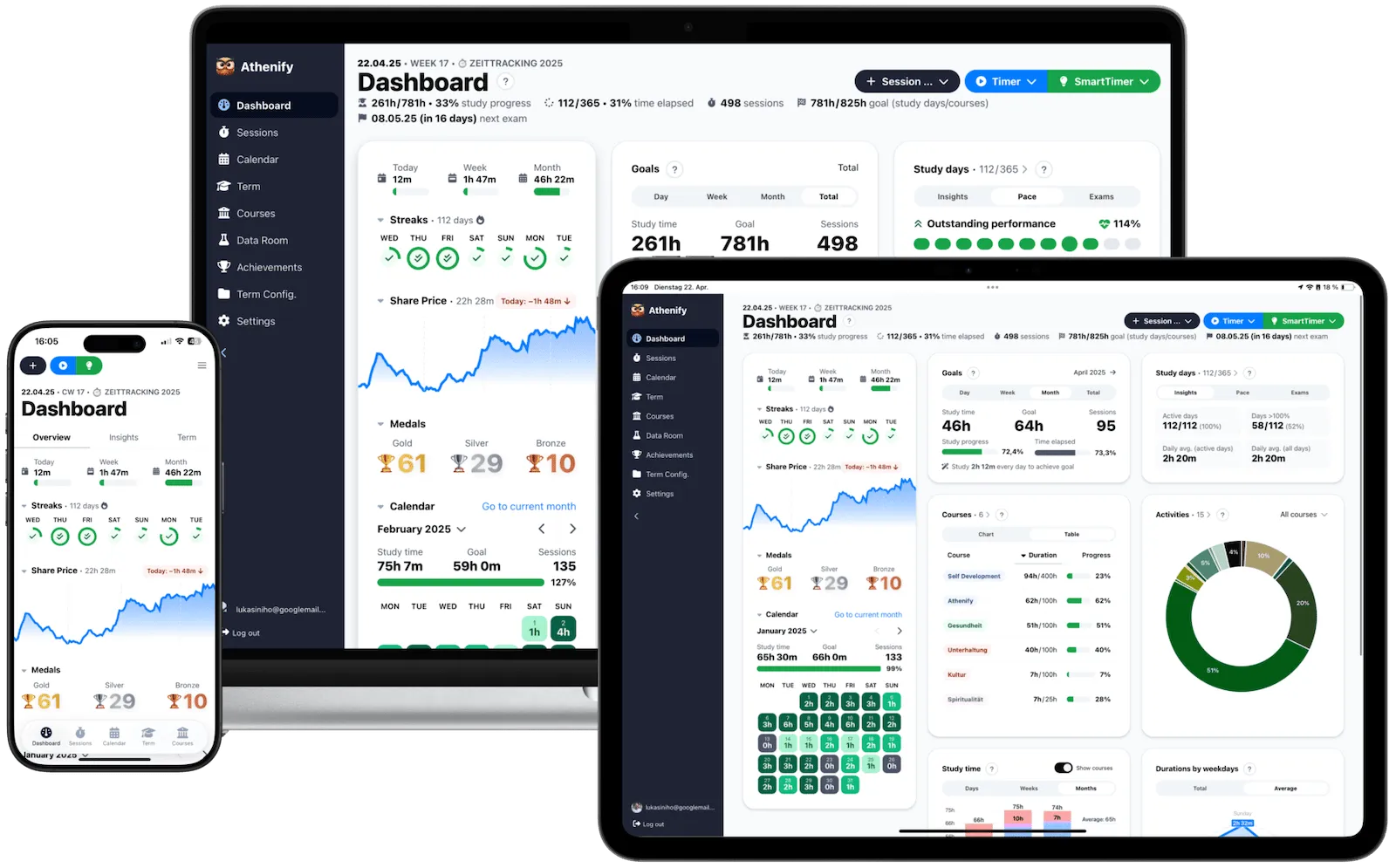
Study efficiency creates the biggest variance. A student who tracks 400 hours of focused, distraction-free study will outperform someone who claims 500 hours of half-distracted "study" time. Untracked, casual study requires 30–50% more hours to achieve the same results. This is why tracking your study time with Athenify is crucial – it forces honest accountability and reveals where your hours are actually going.
Try Athenify for free
Track your 300–500 hours of MCAT prep by section, see which content areas need more time, and maintain momentum over 4–6 months.
No credit card required.
No credit card required.
Creating your MCAT study timeline
Study timeline options
| Timeline | Total Hours | Weekly Hours | Best For |
|---|---|---|---|
| 3-Month (Intensive) | 300–350 | 25–30 | Summer study, gap year, few commitments |
| 4-Month (Balanced) | 350–400 | 20–25 | Most students – adequate review and practice |
| 6-Month (Extended) | 400–500 | 15–20 | Full-time school, research, or work |
The three-month plan carries real risks: high burnout potential and little time for course correction if something isn't working. The four-month plan hits the sweet spot for most students, which is why it's the most popular timeline. The six-month plan trades intensity for sustainability – a lower weekly burden that's easier to maintain alongside other commitments.
Most successful MCAT students study 4–6 months. The 3-month plan works but requires near-full-time commitment.
If you're taking 15+ credit hours, working, or involved in research, opt for 5–6 months rather than trying to compress your preparation.
The proven MCAT study plan: 4-month timeline
Let's detail a 4-month (16-week) study plan targeting 400 hours for a competitive 512+ score.
Phase 1: Content review (Weeks 1–8)
Goal: Build comprehensive foundation across all subjects Hours per week: 20–25 Total phase hours: 160–200
During the first two weeks, focus on general chemistry and biology basics. Weeks 3–4 shift to organic chemistry and introductory biochemistry. Weeks 5–6 tackle physics alongside a deeper dive into biochemistry. Finally, weeks 7–8 cover psych/soc while ramping up CARS practice. Throughout all eight weeks, combine review books, Anki flashcards, and practice problems.
For a typical 20-hour week, study about 2.5 hours on each weekday and 4 hours on each weekend day. This adds up to roughly 20.5 hours per week – sustainable but demanding. To maintain focus during these long study blocks, consider using the Pomodoro Technique to break sessions into manageable intervals with short breaks.
Popular resources include Kaplan or Princeton Review books (comprehensive but lengthy), Khan Academy MCAT videos (free and excellent for P/S), and Anki flashcards for memorization-heavy content. For optimal flashcard use, combine them with spaced repetition and active recall techniques. Practice problems from AAMCAssociation of American Medical Colleges are essential for understanding question styles. Track time spent on each resource type in Athenify to identify your most efficient study methods.
Phase 2: Practice and application (Weeks 9–12)
Goal: Apply knowledge through practice problems and full-length tests Hours per week: 20–25 Total phase hours: 80–100
Week 9 marks your first full-length test – AAMC FL #1 – alongside continued practice problems from UWorld or Jack Westin. Week 10 shifts to targeted review, addressing the specific content gaps your first test revealed. Week 11 brings mixed practice and your second full-length test (AAMC FL #2). Week 12 focuses on reviewing that test and reinforcing content through Anki review.
Your full-length test schedule should spread across your preparation: FL #1 in Week 9 as a diagnostic, FL #2 in Week 11, FL #3 in Week 13, and FL #4 in Week 15.
Don't rush practice tests. Each full-length requires 7.5 hours to take, 4–6 hours to review thoroughly, and additional time to drill the weaknesses it reveals. That's 12–15 hours per test. Plan accordingly and track every hour in Athenify.
Phase 3: AAMC materials and refinement (Weeks 13–15)
Goal: Master AAMC-style questions and hit target score Hours per week: 25–30 Total phase hours: 75–90
Week 13 brings the AAMC Section Banks – the hardest official questions available – alongside FL #3. Week 14 focuses on AAMC Q-Packs for section-specific practice and targeted review. Week 15 is your final full-length test (FL #4) followed by comprehensive review, polishing any remaining weak areas.
Phase 4: Final week (Week 16)
Goal: Light review, confidence building, rest Hours: 10–15 total
The final week follows a strategic taper. Six days out, do 2–3 hours of light content review in your weakest areas. Five days before, maintain CARS skills with about an hour of practice. Four days out, review your formula sheet and key pathways. Three days before – take a complete rest day with zero MCAT work. Two days out, do a quick 1-hour content scan. The day before, prepare your materials and go to bed early.
If you've tracked 380+ hours in Athenify, you're ready. The final week is about rest, confidence, and showing up fresh on test day – not cramming.
Section-specific study strategies
Mastering Chem/Phys (C/P)
Allocate 25–30% of your total study time to Chem/Phys. The section draws from general chemistry (30%), physics (25%), biochemistry (25%), organic chemistry (15%), and research/reasoning skills (5%).
Key strategies for C/P mastery:
- Memorize all equations: Unlike college exams, the MCAT provides no formulas
- Practice dimensional analysis: Most physics problems actually test unit manipulation
- Master acid-base chemistry: It appears on every C/P test without exception
- Focus on concept understanding: The MCAT tests application, not rote recall
Create a personal formula sheet with all Gen Chem and Physics equations. Review it daily for 10 minutes during content review. By test day, you should be able to write the entire sheet from memory in under 15 minutes.
High-yield topics include electrochemistry (galvanic and electrolytic cells), thermodynamics (especially Gibbs free energy), enzyme kinetics (Michaelis-Menten), fluid dynamics (Bernoulli's equation, continuity), and optics (lenses and mirrors).
Conquering CARS (Critical Analysis and Reasoning Skills)
CARS presents a unique challenge: no content to study, pure reasoning. Allocate 20–25% of your total study time to this section.
This seems counterintuitive – why spend 80–100 hours on a section with no content? Because CARS improvement requires building new cognitive patterns through repeated practice. You're rewiring how you read and reason, which takes months of consistent effort.
Your CARS improvement strategy should progress through three phases. During Weeks 1–4, focus entirely on accuracy. Do 3–4 passages daily without timing yourself. Don't worry about speed – just focus on selecting the right answer. Aim for 80%+ accuracy before adding time pressure.
Weeks 5–10 shift to speed building. Start timing passages at 10 minutes each while maintaining 75%+ accuracy. Practice the crucial skill of skipping difficult passages and returning to them later. Track your time per passage in Athenify.
Weeks 11–16 simulate test conditions. Complete full 90-minute CARS sections using only AAMC materials. Maintain 80%+ accuracy at speed.
Most students hit a CARS plateau where their score stagnates for 2–4 weeks. This is normal. Continue consistent practice – the breakthrough comes suddenly, not gradually.
For reading strategies, focus on the main idea rather than getting lost in details on your first pass. Practice active reading by mentally summarizing each paragraph as you finish it. Identify the author's tone – is it neutral, critical, or supportive? Map the passage so you know where to find specific information. And eliminate aggressively: 2–3 answers are usually clearly wrong.
CARS questions fall into three types: Foundations (main idea, purpose) at 30%, Reasoning (strengthen/weaken, analogy) at 40%, and Beyond (apply, extrapolate) at 30%. Practice each type separately and track which gives you the most trouble.
Dominating Bio/Biochem (B/B)
Allocate 25–30% of your total study time to Bio/Biochem. The content breaks down as biology (65%), biochemistry (25%), organic chemistry (5%), and general chemistry (5%).
Master metabolism first – glycolysis, TCA cycle, electron transport chain, gluconeogenesis, and beta-oxidation. Know all 20 amino acids cold, including their structures, pKa values, and properties. Understand DNA and RNA processes (replication, transcription, translation) inside and out. Cell biology details matter: signal transduction, cell cycle regulation, organelle functions. And don't neglect lab techniques – chromatography, electrophoresis, PCR, and gel electrophoresis appear constantly.
Metabolism pathways appear on every single MCAT exam. Other high-yield B/B topics include:
- Amino acids and proteins (structure, properties)
- Enzymes and kinetics (Michaelis-Menten, inhibition types)
- DNA/RNA processes (replication, transcription, translation)
- Nervous system (action potentials, neurotransmitters)
- Endocrine system (hormone pathways, feedback loops)
- Immune system (innate vs. adaptive, antibodies)
For biochemistry specifically, focus on enzyme kinetics (especially competitive vs. noncompetitive inhibition), protein structure at all four levels, metabolic regulation through feedback inhibition, and thermodynamics of reactions. For biology, master the nervous system (action potentials, neurotransmitters), cardiovascular system (blood flow, pressure regulation), respiratory system (gas exchange, ventilation), renal system (filtration, reabsorption, hormones), and digestive system (enzymes, absorption).
Excelling in Psych/Soc (P/S)
Allocate 20–25% of your total study time to Psych/Soc. The content distribution is psychology (65%), sociology (30%), and biology (5%).
Many students underestimate P/S because it seems "easier." This is a costly mistake. P/S is memorization-heavy with hundreds of terms that have subtle distinctions between them.
Anki is essential for this section – you'll need to memorize hundreds of terms. Khan Academy provides the best free resource for P/S content. Focus on making clear concept distinctions between similar terms (this is where most students lose points). Understand research methods, including experimental design and statistical concepts. And practice passage interpretation, since data analysis accounts for 30–40% of questions.
The famous "300-page KA P/S document" is a condensed version of all Khan Academy Psych/Soc videos. It's available free online and is widely considered the single best P/S resource. Read it 3–4 times during content review.
For psychology, master learning (classical conditioning, operant conditioning, observational learning), memory (types, processes, theories), emotion and motivation theories, psychological disorders (DSM categories), and development theories (Piaget, Erikson, Kohlberg).
For sociology, focus on social structures (institutions, organizations), culture and socialization, social inequality (class, race, gender), collective behavior, and demographic theories.
Certain distinctions are tested constantly and trip up students who haven't drilled them. Know the difference between positive punishment and negative reinforcement. Distinguish validity from reliability. Separate sensation from perception. Clarify explicit versus implicit memory. And understand primary versus secondary groups.
How Athenify transforms your MCAT preparation
400 hours is an enormous time commitment. Without tracking, most students drastically overestimate their study time, fail to balance sections properly, lose motivation when progress feels invisible, and can't identify what's actually working. Athenify solves these problems systematically.
1. Hour tracking across all four sections
Create categories for each MCAT component: Chem/Phys, CARS, Bio/Biochem, Psych/Soc, Practice Tests, Test Review, and Anki/Flashcards.
After 2–3 weeks of tracking, you'll see your actual time distribution. Most students discover they're neglecting CARS or P/S because those sections "feel less important."
A common imbalance: spending 40% of time on C/P and B/B (comfort zones for science students) while giving CARS and P/S only 15% each. This leads to lopsided scores like 129/125/128/126 – good science sections, weak CARS and P/S. Medical schools see this pattern as problematic.
2. Weekly and monthly hour goals
Set phase-specific goals: Content Review (Weeks 1–8) should total 160–200 hours, the Practice Phase (Weeks 9–12) should reach 80–100 hours, AAMC Materials (Weeks 13–15) should hit 75–90 hours, and the Final Week needs only 10–15 hours.
Athenify shows your progress toward each goal in real-time. Behind on Week 5? You know you need to catch up in Week 6.
3. Practice test performance tracking
Log every full-length test with the date, score (overall plus section breakdown), hours studied since your last test, key weaknesses identified, and review time spent.
After 3–4 tests, you'll see clear trends. Is your score improving linearly? Which sections are plateauing? What's your typical score range? This data guides your final weeks of study.
The ideal MCAT score progression over 4 months looks like this: FL #1 (Week 9) at 502–506, FL #2 (Week 11) at 506–510, FL #3 (Week 13) at 510–513, and FL #4 (Week 15) at 512–515. Track this progression in Athenify – each 3–4 point gain represents roughly 30–40 hours of effective study.
4. Study session analysis
After 6–8 weeks of tracking, you'll have enough data to analyze what works best for you. Are 4-hour blocks more productive than 2-hour blocks? Do you focus better in the morning, afternoon, or evening? Does the library work better than home or a coffee shop? Is active practice (problems) yielding better results than passive study (videos/reading)? For guidance on structuring your daily study hours, see our article on how many hours you should study per day.
Use this data to optimize your remaining weeks.
5. Motivation through gamification
Six months of MCAT study is grueling. Athenify's gamification keeps you going through the long haul.
Streaks reward consistency – study at least your minimum daily goal (2–3 hours) for consecutive days. Breaking a 45-day streak hurts, which keeps you showing up. Medals recognize effort levels: Bronze for meeting your minimum, Silver for exceeding your goal, Gold for doubling it. Competitive students love watching their medal count rise. The Share Price feature visualizes your cumulative study effort as a rising stock price, climbing from "startup" at 0 hours to "blue chip" at 400+ hours.
Students who maintain consistent study streaks outperform those with inconsistent study patterns – even when total hours are similar. Consistency matters more than intensity.
6. Honest accountability
The timer doesn't lie. When you start an Athenify session, you're committing to focused study. No counting "study time" spent on your phone. No logging dinner breaks as study hours. No claiming credit for watching videos at 2x speed while barely paying attention.
Only genuine, focused study time gets logged. This honesty is uncomfortable but transformative. For strategies on eliminating distractions and achieving genuine focus, explore our guide to deep work.
Common MCAT preparation mistakes
Mistake #1: Underestimating the time commitment
Every year, students attempt to prepare for the MCAT in 8–10 weeks with only 200–250 hours of study. The result: scores 5–10 points below their potential, forcing retakes and delaying medical school applications. Commit to 350–500 hours over 4–6 months. Use Athenify to track toward this goal from Day 1.
Mistake #2: Over-relying on passive learning
Watching videos and reading books feels productive. It's not. Active practice – doing problems and self-testing – produces 2–3x more learning per hour than passive review. Track "active" versus "passive" study time separately in Athenify and ensure 70%+ of your hours are active.
Active practice produces 2–3x more learning per hour than passive review. Make sure 70% of your study time involves doing problems, not watching videos.
Mistake #3: Neglecting CARS until it's too late
CARS improvement is the slowest of any section. Starting CARS practice 6 weeks before your test is far too late. Do at least 3–4 CARS passages daily starting from Week 1 and track your daily CARS time in Athenify.
Mistake #4: Not reviewing practice tests thoroughly
Taking a practice test without deep review is worthless. For every wrong answer, you should understand why you got it wrong, identify the concept tested, review that concept in depth, and then do 3–5 similar problems. This takes 4–6 hours per test.
Mistake #5: Ignoring Psych/Soc
"I'll just memorize P/S terms the last two weeks." No. P/S has 300+ terms with subtle distinctions. Last-minute memorization leads to 125–127 scores. Start your Anki P/S deck from Week 1, do 20–30 cards daily, and track flashcard time in Athenify.
The final week: taper and confidence
7-day pre-test protocol
The final week is about strategic tapering, not last-minute cramming. Seven days out, do 2–3 hours of light review on your weakest content areas. Six days out, spend 1–2 hours on CARS practice to maintain those hard-won skills. Five days out, review your formula sheet and enzyme pathways for 1–2 hours. Four days out, do one timed section in your weakest area – about an hour. Three days out, take a complete rest day with zero MCAT work. Two days out, spend an hour reviewing your formula sheet and skimming notes. The day before, prepare your materials and get to bed early.
Test day strategy
The night before
Lay out everything you need: ID, confirmation email, snacks (nuts, fruit), water, and earplugs. Get 8 hours of sleep – no studying. Have a light dinner and skip the alcohol. Review your "confidence list" of practice test scores to remind yourself that you're ready.
The morning of
Eat a high-protein breakfast like eggs or Greek yogurt. Arrive 30 minutes early. Do some light stretching and breathing exercises to calm your nerves. Visit the bathroom before check-in. Turn off your phone completely.
During the test
Each section gives you roughly 1.6 minutes per question (1.7 for CARS). Mark difficult questions and return to them rather than spiraling on a single hard problem. Use all your break time – walk, breathe, eat, and hydrate. Don't panic if a section feels hard; they all do. In the last 5 minutes of each section, answer all remaining questions even if you're guessing.
Retake strategy
About 30% of test-takers retake the MCAT. Should you?
When to retake
Consider retaking if your score is 5+ points below your practice test average, if you're below 508 and applying to MD programs, if you're below 505 and applying to DO programs, or if your section scores are severely imbalanced (more than a 5-point spread).
The average MCAT retake improvement is just 2–4 points. However, students who study an additional 100–150 hours, focus specifically on their weakest sections, and use only AAMC materials for the final month improve an average of 5–7 points.
Retake study plan (3-month timeline)
Month 1 should focus on targeted content review, concentrating on your weakest section. Month 2 shifts to mixed practice while addressing your second-weakest section. Month 3 is AAMC materials only, plus 4 new practice tests.
Track all retake study hours separately in Athenify to ensure you're putting in the 100–150 additional hours needed for significant improvement.
Conclusion: from pre-med to medical student
The MCAT is conquerable, but it demands respect. You can't cram it. You can't shortcut it. You can't luck your way to a good score.
But you can systematically prepare for it:
- Adequate time: 4–6 months, 350–500 hours
- Balanced study: Equal attention across all four sections
- Active practice: 70%+ of time doing problems, not watching videos
- Consistent tracking: Every session logged in Athenify
- Regular testing: 4–6 full-lengths with thorough review
- Honest self-assessment: Decisions based on tracked data, not feelings
Set up Athenify with your four MCAT sections. Set your total hour goal at 350–500 hours. Log your first study session today. Watch your hours accumulate and your practice scores rise.
The students who succeed on the MCAT aren't the ones with perfect memories or genius-level IQ. They're the ones who start early enough, put in enough hours, track their progress honestly, stay consistent even when it's hard, and trust the process.
You can be one of them.