
Why most students start too late
The planning fallacy is the single biggest threat to exam success. Coined by psychologists Daniel Kahneman and Amos Tversky, the planning fallacy describes our systematic tendency to underestimate the time, costs, and risks of future actions while overestimating their benefits. In the context of exam preparation, this means students consistently believe they need less study time than they actually do—and they believe this even when they have failed to prepare adequately in the past.
The planning fallacy is the single biggest threat to exam success.
Research published in the Journal of Experimental Social Psychology found that students' predictions of when they would finish assignments were accurate less than 30% of the time. The same pattern applies to exam preparation: students plan to start three weeks early but actually begin three days before the test. The gap between intention and action is not a willpower problem—it is a prediction problem. Your brain is wired to be overly optimistic about future productivity.
The solution is to replace prediction with data. Instead of guessing how many hours you need, look at how many hours you have actually studied for similar exams in the past. Our guide on how long to study for an exam breaks this down by subject type and difficulty level. If you have never tracked your study time before, start now—even rough estimates are better than pure intuition. Students who use time tracking tools develop increasingly accurate self-estimates over successive exam seasons, breaking the cycle of chronic underpreparation.
The spacing effect: your secret weapon for exams
The spacing effect is one of the most robust and replicated findings in all of cognitive psychology. First documented by Hermann Ebbinghaus in 1885, it demonstrates that information reviewed at spaced intervals is retained far better than information studied in a single concentrated session. A meta-analysis by Cepeda et al. (2006) covering 254 studies confirmed that distributed practice produces significantly stronger long-term retention across virtually every type of learning material.
The mechanism behind spacing is straightforward: each time you revisit material after a delay, your brain must work harder to retrieve it. This effortful retrieval strengthens the memory trace far more effectively than the easy, fluent re-reading that characterizes cramming. When material feels easy to review, it creates an illusion of mastery—you recognize the information but cannot actually reproduce it under exam conditions.
Practical spacing schedules depend on how far away your exam is. For an exam in four weeks, review new material after one day, then three days, then one week, then two weeks. For an exam in two weeks, compress the intervals: review after one day, two days, four days, and one week. The key principle is that each review interval should be slightly longer than the last, pushing your memory just to the edge of forgetting before reinforcing it. Building these intervals into a structured study schedule ensures that spacing happens automatically rather than relying on willpower.
Spacing also reduces total study time. Because each spaced review strengthens memory more efficiently than massed review, students who space their preparation often achieve better results in fewer total hours. This is why starting early is not about studying more—it is about studying smarter by giving your brain the time intervals it needs to consolidate information.
Active recall and practice testing
Active recall—deliberately retrieving information from memory rather than passively reviewing it—is the most effective study technique available. Research by Jeffrey Karpicke and colleagues at Purdue University demonstrated that students who practiced retrieval retained 50% more material after one week than students who used repeated study. The critical insight is that testing is not merely an assessment tool; it is a powerful learning event in its own right.
Replace every passive review session with active retrieval practice. Close your notes, write down everything you remember, then check what you missed. This single change can dramatically improve your exam scores.
The "testing effect," as researchers call it, works because retrieval physically changes the neural pathways associated with a memory. Every time you successfully recall a fact, concept, or procedure, the connections supporting that memory become stronger and more accessible. Conversely, simply re-reading or highlighting text produces a feeling of familiarity that masquerades as understanding but crumbles under exam pressure.
Practice testing takes active recall one step further by simulating actual exam conditions. Sit down with a past exam paper, set a study timer for the allotted time, close all notes, and work through the questions. This accomplishes three things simultaneously: it forces genuine retrieval, it builds familiarity with the exam format and time pressure, and it reveals specific knowledge gaps that you can address in subsequent study sessions. Students who regularly practice under test conditions report significantly less anxiety on exam day because the experience feels familiar rather than threatening.
To implement active recall daily, replace passive review sessions with self-testing. After reading a chapter, close the book and write down everything you remember. Use flashcards for factual material and work through practice problems for procedural subjects. Our detailed guide on the active recall study technique walks through specific methods for different subject types. The difficulty of retrieval is a feature, not a bug—the harder you have to work to remember something, the stronger the resulting memory becomes.
How to plan a multi-exam season
Exam season demands strategic allocation, not equal distribution. When you face four, five, or even six exams within a few weeks, the instinct to study every subject equally is both natural and wrong. Subjects differ in difficulty, credit weight, current grade standing, and exam date—and your study plan must reflect these differences. A student who allocates equal hours to an easy elective and a challenging required course is wasting the most valuable resource they have: time.
Backward planning is the foundation of multi-exam strategy. Start with your last exam date and work backward to today, mapping out every exam along the way. For each subject, estimate the total hours needed (based on past experience or course difficulty), then calculate the daily commitment required. Subjects with earlier exam dates get front-loaded; subjects with later dates can ramp up after earlier exams are complete. For a detailed walkthrough of this approach, see our guide on how to study for finals in college. This creates a staggered preparation schedule that prevents the "everything at once" overwhelm.
Prioritization should follow a simple framework: rank each exam by a combination of difficulty (how hard the material is for you personally), weight (how many credits it represents), and date (how soon the exam occurs). Exams that score high on all three dimensions get the most hours. Exams that score low on all three get the minimum required to maintain your target grade. If you are facing a packed schedule, our article on studying for multiple exams at once offers a step-by-step prioritization method. Review your allocation weekly and adjust based on actual progress—tracking your hours per subject makes this adjustment concrete rather than guesswork.
Common exam preparation mistakes
Passive review is the most widespread study mistake in higher education. Re-reading notes, highlighting textbooks, and watching lecture recordings feel productive but produce minimal learning. Research by Dunlosky et al. (2013) in their landmark review of study techniques rated highlighting and re-reading as having "low utility" for learning. The problem is that passive review produces fluency—the material feels familiar—but fluency is not the same as knowledge. Students walk into exams confident they know the material, only to discover they cannot reproduce it without their notes in front of them.
All-nighters are counterproductive, not heroic. Sleep deprivation impairs memory consolidation, reduces cognitive function, and increases anxiety — the exact opposite of what you need before an exam.
All-nighters are counterproductive, not heroic. Research on sleep and studying consistently shows that sleep deprivation impairs exactly the cognitive functions you need on exam day: working memory, logical reasoning, and long-term recall. A study at St. Lawrence University found that students who pulled all-nighters had lower GPAs than those who never did—even after controlling for total study time. Memory consolidation occurs during sleep, particularly during slow-wave and REM stages. Cutting sleep to gain study hours is a net negative trade. For more strategies on protecting your health and grades during high-pressure periods, read our guide on how to survive exam season.
Equal time allocation ignores the reality of learning curves. Spending the same number of hours on every subject means over-investing in subjects you already understand and under-investing in the ones that will actually determine your grades. The law of diminishing returns applies: the first ten hours of studying a new subject produces dramatic learning gains, while the twentieth hour on familiar material produces almost none. Allocate time proportionally to difficulty and grade impact, not equally across the board.
Ignoring weak areas feels comfortable but costs grades. Students naturally gravitate toward subjects they enjoy and already understand—it feels productive and rewarding. But the biggest grade improvements come from improving your weakest areas, not polishing your strongest ones. Moving a subject from a D to a C produces more GPA improvement than moving from an A- to an A. Use tracked data to identify where your hours are going, and deliberately redirect effort toward the subjects you have been avoiding.
Managing exam anxiety through preparation
Exam anxiety is fundamentally a response to uncertainty. When you do not know if you have studied enough, do not know what material the exam will cover, and do not know if your preparation strategy is working, your brain interprets this ambiguity as threat. The fight-or-flight response activates, flooding your system with cortisol and adrenaline—chemicals that impair the prefrontal cortex functions you need most for complex thinking and recall.
Exam anxiety is fundamentally a response to uncertainty. The more thoroughly you prepare and the more familiar you are with the exam format, the less anxious you will feel. Structured preparation is the best anti-anxiety strategy.
The most effective anxiety intervention is not relaxation techniques or positive affirmations—it is reducing the uncertainty itself. When you track every study session, you accumulate concrete evidence of your preparation. Instead of the vague worry "Have I studied enough?", you can reference specific data: "I have invested 42 hours across 18 sessions over three weeks, covering all eight chapters and completing three practice exams." This factual self-assessment replaces catastrophic thinking with grounded confidence. For a deeper dive into evidence-based coping strategies, see our article on how to overcome test anxiety.
Practice testing also reduces anxiety through a mechanism called desensitization. By repeatedly exposing yourself to exam-like conditions—timed tests, closed-book problems, unfamiliar question formats—you reduce the novelty and threat of the actual exam. Studies show that students who take at least three practice tests report significantly lower anxiety on exam day. The exam becomes just another practice session, not an unknown threat.
Building consistent study habits provides an additional buffer against anxiety. When studying is a daily routine rather than an emergency response, the entire emotional relationship with exams shifts. You are no longer someone who crams and hopes—you are someone who prepares systematically and shows up ready. This identity shift, supported by weeks of tracked data, is the most powerful antidote to exam anxiety available.
How Athenify transforms exam preparation
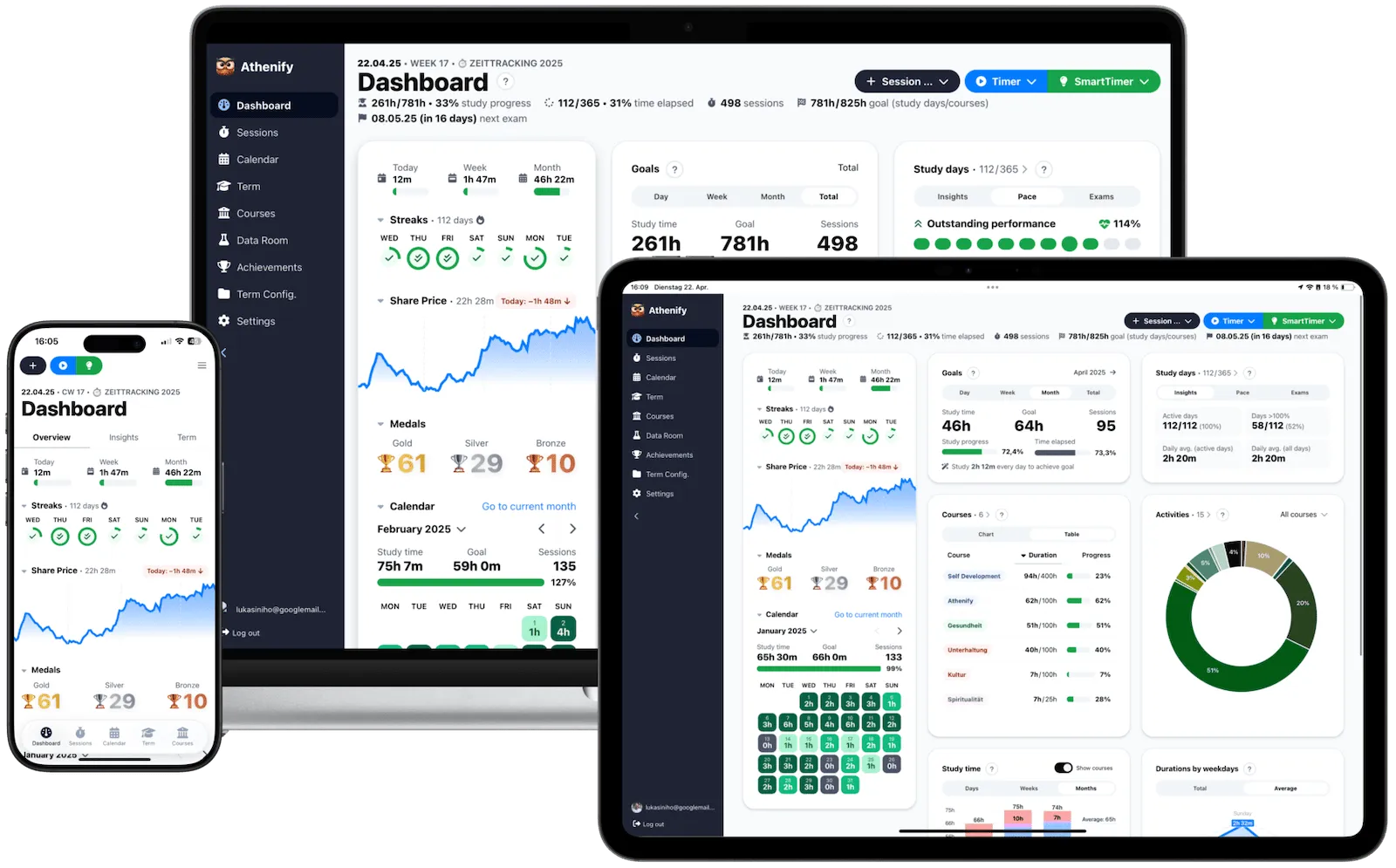
Athenify was built specifically for students who want to replace guesswork with data. The exam planner lets you enter every exam date, set total hour goals per subject, and see at a glance how many days remain and what daily commitment is required. As you log study sessions with the built-in timer, Magic Prediction continuously recalculates whether you are on track to hit your goals—or whether you need to increase your daily hours.
Per-subject tracking reveals patterns that are invisible without data. You can see exactly how many hours you have invested in each subject, compare that against your targets, and identify imbalances before they become problems. The countdown feature keeps urgency visible without creating panic—you always know how much time remains and how to use it. Students who use Athenify through an entire exam season report feeling more in control, less anxious, and better prepared than they ever have before.
The combination of planning, tracking, and prediction creates a feedback loop that improves with every exam cycle. After your first exam season with Athenify, you have real data on how many hours different types of courses require—data that makes your next semester's planning dramatically more accurate. Over time, the planning fallacy loses its grip because you are no longer guessing; you are referencing your own history.
Your exam preparation action plan
Start today, regardless of when your exams are. If your exams are more than four weeks away, you are in the ideal window for spaced preparation. Enter your exam dates into Athenify, estimate total hours per subject, and begin with your most challenging material. Build a daily habit of at least one focused study session, tracked and timed, using active recall rather than passive review.
If your exams are less than two weeks away, there is still time to be strategic. Prioritize ruthlessly: identify the three or four topics most likely to appear on each exam and focus your remaining hours there. Use practice tests to identify gaps and direct your final study sessions toward the material that will have the greatest impact on your grade. Track every session so you can see your progress accumulate—this builds confidence and prevents the spiral of anxiety that undermines last-minute preparation.
Regardless of your timeline, commit to three non-negotiable principles: space your studying across multiple sessions rather than cramming, use active recall instead of passive re-reading, and track your hours so you always know where you stand. These three study techniques, supported by decades of research and made effortless by Athenify, will transform your exam preparation from a source of stress into a system you trust.
Try Athenify for free
Ace your exams with structured preparation on Athenify
No credit card required.
No credit card required.