





What the LSAT actually tests--and why it matters
The LSAT does not test legal knowledge. It tests the reasoning skills that predict success in law school: logical analysis, argument evaluation, and dense reading comprehension. This is good news for test-takers because these skills are highly trainable. Unlike exams that require memorizing vast content, the LSAT rewards pattern recognition and strategic thinking--both of which improve dramatically with deliberate practice. Understanding this fundamental truth should shape your entire preparation approach.
The LSAT consists of three scored section types: Logical Reasoning (two sections, testing your ability to analyze arguments), Analytical Reasoning (one section, known as "Logic Games," testing formal logic through grouping and ordering puzzles), and Reading Comprehension (one section, testing your ability to understand complex passages). There is also an unscored experimental section and an unscored writing sample. Your composite score ranges from 120 to 180, with a median around 151. For a deeper look at structuring your study time, see our guide on building an LSAT study schedule.
The three pillars of LSAT success
Pillar 1: Master Logic Games first. Analytical Reasoning is the most learnable section on the LSAT. Students regularly improve by 8--12 points on this section alone through systematic practice. Learn the fundamental game types--linear sequencing, grouping, and hybrid games--and develop a consistent diagramming approach. The key insight is that every Logic Games question is fully deducible from the given rules. There is no ambiguity, no judgment call--just logic. This makes it the most predictable section and the one where practice yields the fastest returns.
Logic Games is the great equalizer. Students who initially struggle with this section often make it their strongest after 100+ hours of targeted practice. It rewards persistence more than any other section.
Pillar 2: Develop Logical Reasoning instincts. Logical Reasoning accounts for roughly half your LSAT score, making it the most important section by weight. The section tests your ability to identify argument structures, find assumptions, strengthen and weaken conclusions, and resolve paradoxes. Learn to recognize the common argument patterns--correlation vs. causation, sampling errors, false dichotomies--and you will start seeing the correct answers more quickly. Consistent daily practice with real LSAT questions is essential. Track your accuracy by question type with a study tracker to identify which patterns still give you trouble.
Pillar 3: Build Reading Comprehension stamina. RC is the hardest section to improve quickly because it draws on years of reading experience. The key strategies are: read for structure (identify the main point, author's attitude, and paragraph functions as you read), anticipate questions before looking at answer choices, and practice with real LSAT passages. Science and law passages tend to be the densest. Improvement here is gradual--expect 2--3 months of consistent practice before seeing significant gains.
Building your LSAT study timeline
A 3--6 month timeline balances thoroughness with focus. Shorter timelines risk shallow preparation; longer ones risk burnout and diminishing motivation. The optimal approach depends on your starting score and target score. If your diagnostic is 155 and you are aiming for 170, plan for 4--6 months at 15--20 hours per week. If you are starting at 160 and targeting 165, 2--3 months may suffice.
Take a full-length, timed LSAT diagnostic before beginning any preparation. Your starting score determines your timeline and study plan. Many students are surprised--positively or negatively--by their diagnostic, which prevents both over-preparation and under-preparation.
Phase 1 (weeks 1--4): Learn the fundamentals. Study the question types, learn diagramming for Logic Games, and understand argument structures for Logical Reasoning. Do not take full-length tests yet--focus on untimed, deep learning. Phase 2 (weeks 5--12): Targeted practice. Work through real LSAT questions by type, tracking accuracy and timing. Begin taking timed sections. Phase 3 (final 4--6 weeks): Full-length test simulation. Take 2--3 full-length practice tests per week under strict test conditions. Review every mistake thoroughly. Use Athenify to track your hours across all three phases--most successful 170+ scorers have logged 300+ hours by test day.
Working through plateaus
Every LSAT student hits a plateau. You improve steadily for weeks, then your score stalls despite continued effort. Plateaus are frustrating but normal--they often indicate that you have mastered the easy gains and now need to address subtler weaknesses. The solution is diagnostic precision: analyze your recent practice tests question by question. Are you missing the same Logical Reasoning question types? Are certain Logic Games variants still challenging? Is time pressure causing errors in Reading Comprehension?
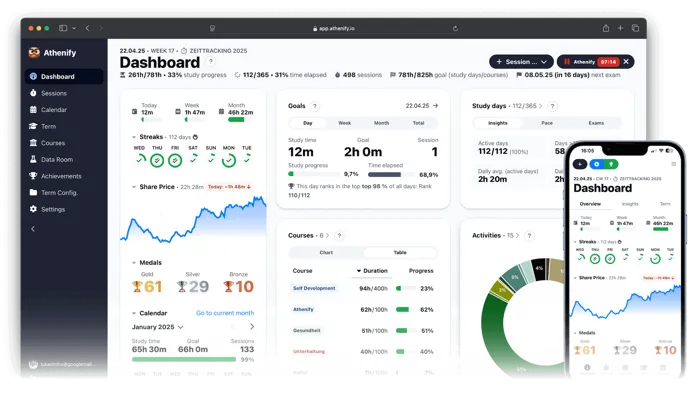
Tracking data breaks plateaus faster. When you track every study session with Athenify--categorized by section and activity type--you can see exactly where your time is going. If you have spent 80 hours on Logic Games but only 30 on Logical Reasoning, the plateau might simply be a matter of underinvestment. Data transforms vague frustration into actionable insight. Building strong study habits through this plateau period is what separates students who break through from those who give up.
The mental game: discipline and test-day readiness
The LSAT is as much a mental challenge as an intellectual one. Three and a half hours of intense concentration tests your endurance, not just your knowledge. Build stamina gradually--start with single timed sections and work up to full-length tests. Practice under realistic conditions: at a desk, with a pencil, at the same time of day you will test. Simulate the stress by working in slightly uncomfortable environments (a library, a coffee shop) rather than always in your quiet home office.
If your practice test average is significantly below your target score two weeks before test day, consider postponing. Law schools see all your LSAT scores, and while most report only the highest, a low initial score can create doubt. It is better to postpone and continue preparing than to take the test before you are ready.
Test-day confidence comes from documented preparation. When you open Athenify and see 300+ tracked hours across Logic Games, Logical Reasoning, and Reading Comprehension--with a clear upward trajectory in your practice scores--anxiety transforms into confidence. You are not hoping you are ready; you know you are. This psychological shift matters enormously for a test where calm, clear thinking is the primary skill being assessed. If test anxiety is a concern, our guide on managing test anxiety offers evidence-based strategies.
Your law school application in context
The LSAT is the single most important factor in law school admissions. Unlike undergraduate admissions, where holistic review balances many factors, law school admissions committees weight LSAT scores heavily--often more than GPA. A 170+ score opens doors to T14 schools and significant scholarship money at lower-ranked programs. A 165 makes you competitive at top-50 schools. Even a few points can mean the difference between acceptance and rejection, or between full tuition and no scholarship.
This is why structured, tracked preparation matters. Every hour you invest has a quantifiable impact on your future career options and financial outcomes. Law school debt averages over $100,000--a higher LSAT score at a better school with more scholarship money can save you tens of thousands of dollars. Use Athenify's focus timer to make every study session count.
Try Athenify for free
Start tracking your LSAT preparation with Athenify
No credit card required.

No credit card required.