




The CFA Program: a multi-year marathon through finance
The Chartered Financial Analyst designation is one of the most demanding professional credentials in the world. With three progressive levels, each requiring approximately 300+ hours of preparation, the CFA Program tests your mastery of investment management, financial analysis, and ethical practice across roughly 900+ total study hours. The pass rates tell the story: approximately 35--45% for Level I, 40--50% for Level II, and 50--55% for Level III. Only about 10--15% of candidates who begin the program ultimately earn the charter. This is not a test you can pass with casual effort--it demands structured, disciplined preparation over years.
Each level tests different competencies. Level I covers foundational concepts across 10 topic areas: Ethical and Professional Standards, Quantitative Methods, Economics, Financial Reporting and Analysis (FRA), Corporate Issuers, Equity Investments, Fixed Income, Derivatives, Alternative Investments, and Portfolio Management. Level II applies these concepts through item sets (vignettes with multiple questions), testing deeper analytical skills. Level III focuses on portfolio management and wealth planning, with constructed-response (essay) questions. Understanding this progression shapes your multi-year preparation strategy. For a detailed study plan, see our CFA preparation guide.
Studying while working: the CFA candidate's defining challenge
The vast majority of CFA candidates work full-time in finance while studying. Unlike university students who can dedicate entire days to preparation, CFA candidates must extract study hours from evenings, early mornings, weekends, and lunch breaks. This constraint makes time management not just helpful but essential for passing. The candidates who fail are often not those who lack intelligence--they are those who fail to protect and structure their study time.
The CFA exam does not test who is smartest. It tests who is most disciplined. The candidate who studies 90 minutes every morning before work for six months will pass. The one who plans to "catch up on weekends" usually will not.
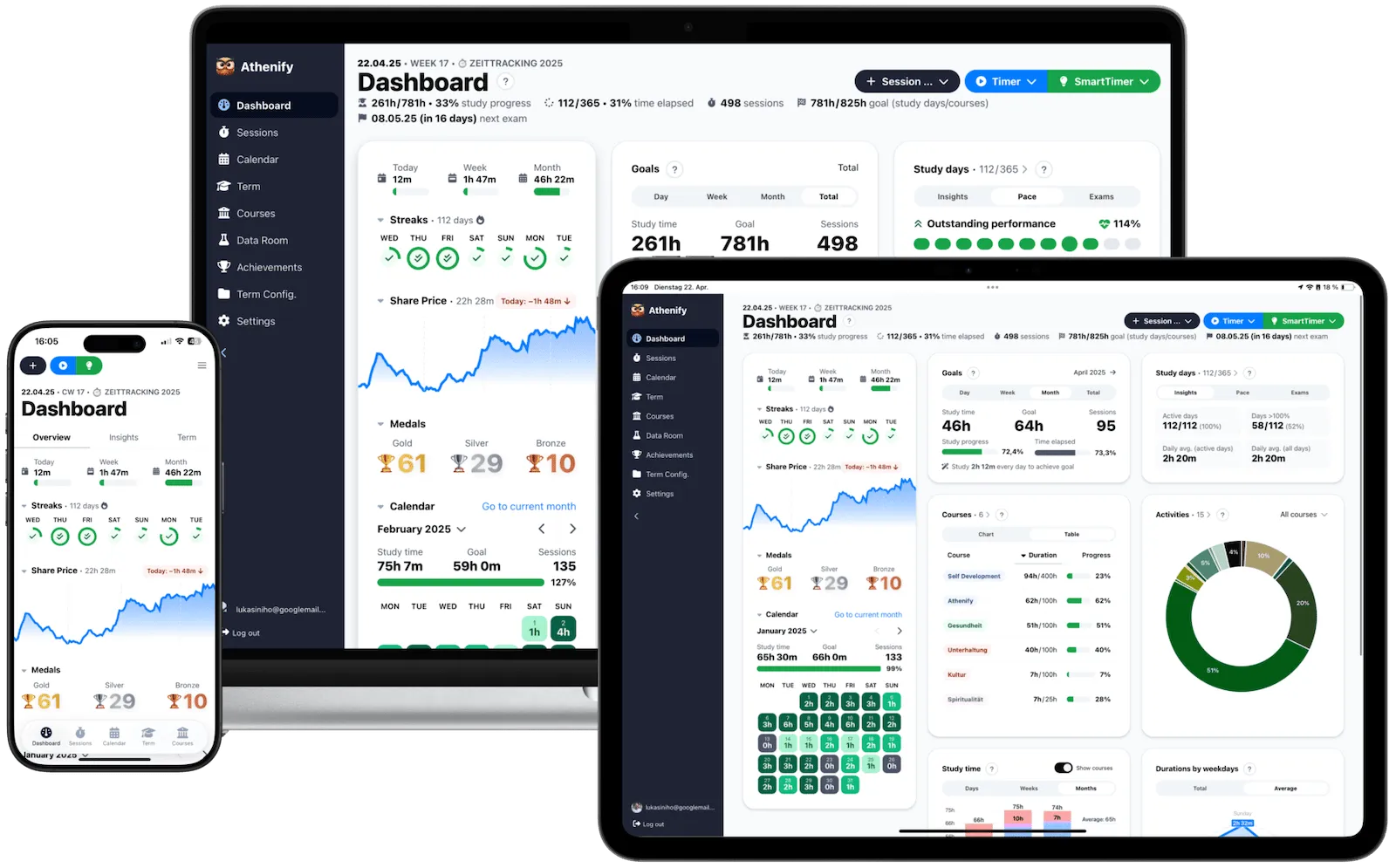
Build a daily study ritual. The most successful approach for working professionals is a fixed daily study block--typically 60--90 minutes in the early morning before work, when cognitive energy is highest. Supplement this with longer weekend sessions (3--5 hours) for practice exams and review. Total weekly target: 15--20 hours across 18--20 weeks of preparation. Use Athenify to track every session and build a streak that makes skipping feel costly. If you are new to balancing study with professional work, our guide on studying while working full-time provides practical strategies.
Topic area strategy: weight your preparation wisely
Not all CFA topics are created equal. CFA Institute publishes the topic area weights for each level, and these weights should directly guide your time allocation. For Level I, Financial Reporting and Analysis (13--17%), Ethical and Professional Standards (15--20%), and Equity Investments (10--13%) carry the most weight. A candidate who spends equal time on all 10 topics is being inefficient--invest proportionally more in high-weight areas.
CFA Institute has stated that Ethics performance can be the difference between passing and failing for candidates near the minimum passing score. Candidates who score well in Ethics can pass with slightly lower overall scores. Never neglect Ethics--study it first and review it last.
Track your hours by topic area. This is where Athenify's study time tracker becomes invaluable. Log each study session with the topic area you covered. After a few weeks, review your data: are you spending 20% of your time on a topic worth only 5% of the exam? Are you avoiding FRA because it is difficult, even though it carries significant weight? Data-driven preparation eliminates these blind spots and ensures your limited study time produces maximum results.
Level-by-level preparation approach
Level I: breadth over depth. Level I covers an enormous range of material at a conceptual level. Your goal is to understand fundamental concepts and apply them to straightforward questions. Focus on building a strong foundation in FRA, Ethics, and Quantitative Methods. Practice with the CFA Institute question bank extensively--the questions closely mirror exam style. Most candidates use either the official CFA Institute Learning Ecosystem or third-party providers like Kaplan Schweser or Mark Meldrum.
Level II: depth and application. Level II shifts from conceptual understanding to analytical application. Questions are presented in item sets--case studies with 4--6 related questions. This format rewards deep understanding of how concepts interconnect. FRA remains critical, and Equity and Fixed Income valuation models become central. Many candidates find Level II the hardest level because the jump in complexity from Level I is substantial.
Level III: synthesis and communication. Level III tests portfolio management and includes constructed-response (essay) questions. You must not only know the material but communicate your analysis clearly in writing. Practice writing concise, structured responses under time pressure. The essay section catches many candidates off guard--do not rely solely on multiple-choice practice. Use Athenify's focus timer for timed essay practice sessions.
Practice exams and mock tests
Mock exams are the single most important preparation tool for the CFA. They serve three critical functions: building exam-day stamina (Level I is 4.5 hours; Levels II and III are similar), revealing knowledge gaps under time pressure, and calibrating your readiness to pass. Take at least 3--4 full-length mock exams per level, with the CFA Institute's official mock exams being the most accurate predictors of performance.
Many candidates aim for 70% on practice exams, believing this guarantees passing. The minimum passing score (MPS) is not publicly disclosed and varies by exam sitting. Focus on consistent improvement across all topic areas rather than hitting an arbitrary percentage target.
Review mock exams with the same rigor you use for studying. After each mock exam, spend 3--5 hours reviewing every question--including those you answered correctly. Understand why incorrect answers are wrong and why correct answers are right. Categorize your mistakes by topic area and type (conceptual gap, calculation error, time pressure, misread question). This analysis feeds directly back into your study plan, making each subsequent week of preparation more targeted and efficient.
The long game: maintaining motivation across years
The CFA journey tests your psychological endurance as much as your financial knowledge. With each level separated by months of preparation and waiting for results, maintaining motivation across a 2--5 year journey is a genuine challenge. Many candidates who fail do not fail because of ability--they fail because they burn out, lose focus, or stop studying consistently.
Celebrate level completions, not just charter attainment. Each CFA level passed is a significant achievement. Take breaks between levels--most candidates wait 6--12 months before beginning the next level. Use this time to apply what you have learned professionally, which reinforces the material and provides practical context for the next level. Build sustainable study habits rather than relying on willpower alone--habits carry you through the inevitable low-motivation periods that every multi-year commitment involves.
Career impact: what the CFA charter means
The CFA charter is a career accelerator in investment management. Charterholders work in portfolio management, equity research, risk management, investment banking, and related fields. The credential signals deep technical knowledge, ethical commitment, and the discipline to complete a grueling multi-year program. Many employer positions in asset management explicitly require or prefer the CFA designation.
The financial return on your CFA investment is substantial. Charterholders typically earn 15--30% more than non-charterholders in comparable roles. Over a 20--30 year career, this premium compounds into significant lifetime earnings differences. Every hour you invest in preparation has a quantifiable long-term return--track those hours with Athenify and approach each level with the disciplined, data-driven mindset that the finance profession demands.
Try Athenify for free
Start tracking your CFA exam preparation with Athenify
No credit card required.
No credit card required.