




What the GMAT measures--and why MBA programs care
The GMAT is not a math test with some reading questions. It is a test of executive reasoning--the ability to analyze data, evaluate arguments, and solve problems efficiently under time pressure. These are exactly the skills that matter in business: processing imperfect information, making decisions quickly, and communicating clearly. This is why top MBA programs have relied on the GMAT for decades as a predictor of academic and professional success.
The GMAT Focus Edition (launched in late 2023) consists of three sections: Quantitative Reasoning (21 questions, 45 minutes), Verbal Reasoning (23 questions, 45 minutes), and Data Insights (20 questions, 45 minutes). Total testing time is 2 hours and 15 minutes. Each section is scored on a scale, with a total score ranging from 205 to 805. The test is computer-adaptive within each section--questions get harder as you answer correctly, which means every question matters. For strategies on managing your preparation time alongside work, see our guide on GMAT time management.
Preparing while working full-time: the GMAT candidate's reality
Most GMAT candidates are working professionals. Unlike the SAT or GRE, the typical GMAT test-taker is 25--30 years old and balancing preparation with a demanding job, often in finance, consulting, or technology. This reality shapes everything about your preparation strategy. You cannot study 8 hours a day--you need a plan that maximizes limited study time over weeks and months.
The working professional who studies 1 hour every morning before work will outperform the one who plans weekend marathon sessions but inconsistently follows through. Protect your daily study time like a meeting with your most important client.
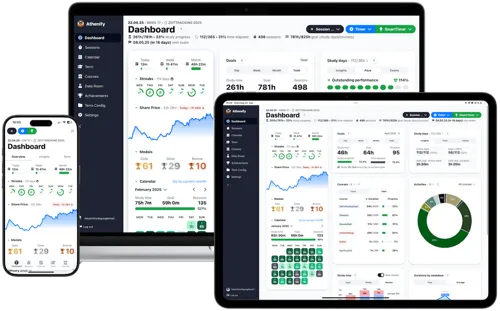
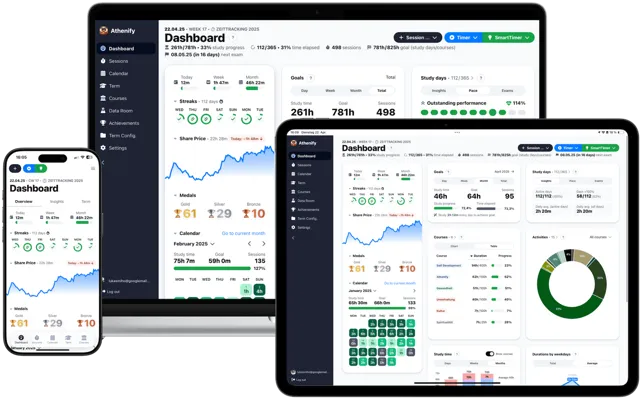
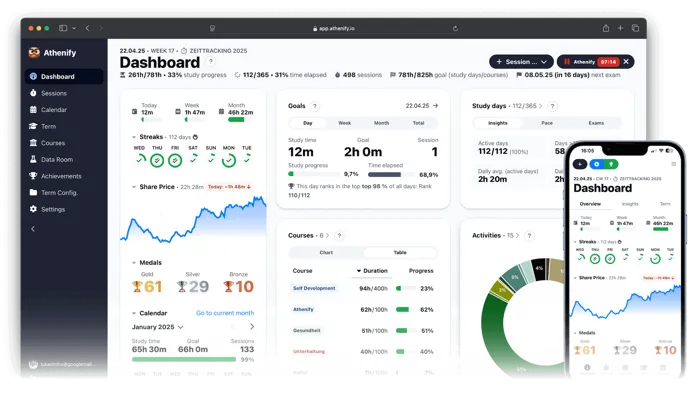
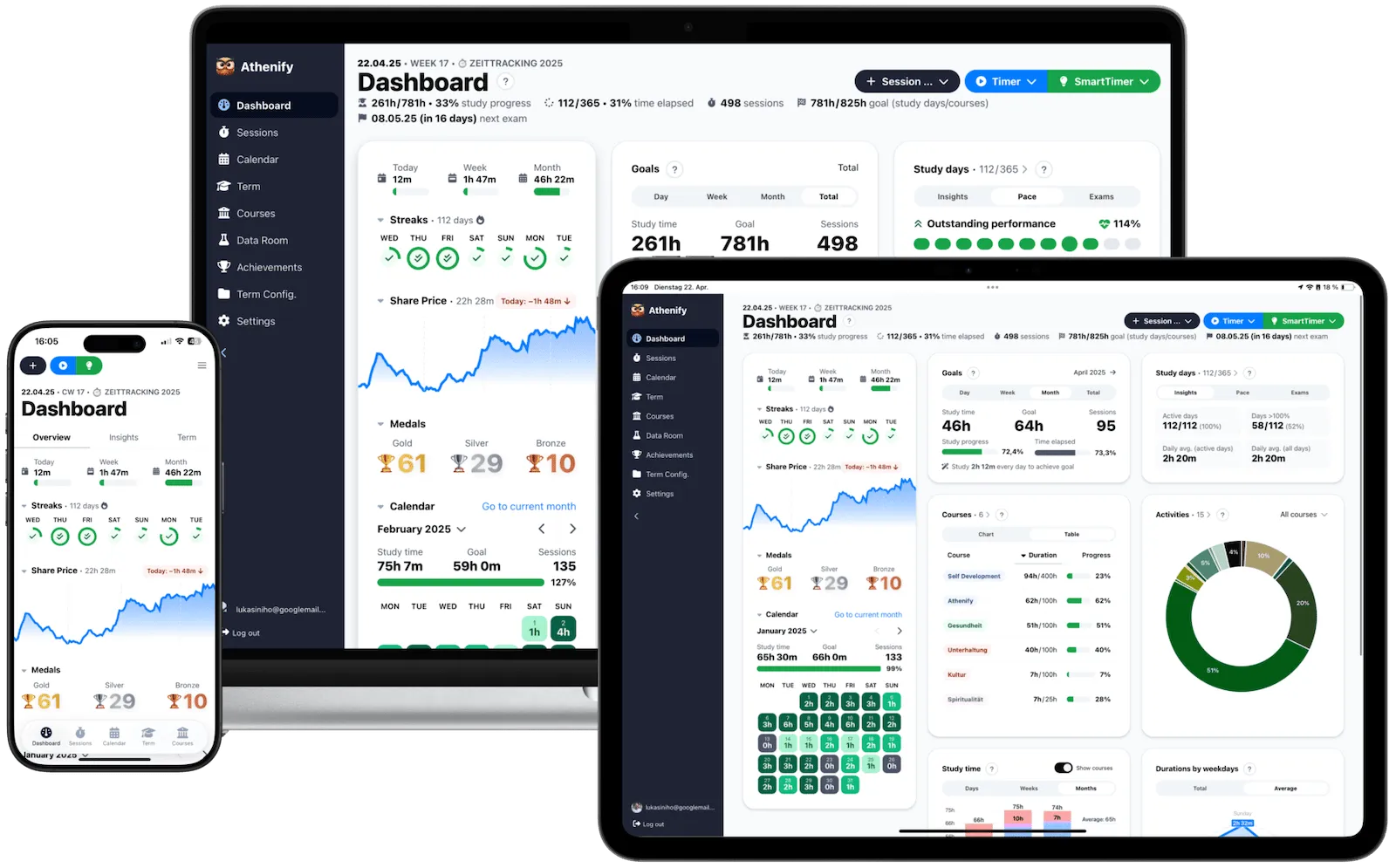
The morning study block is your secret weapon. Research on cognitive performance shows that analytical thinking peaks in the morning for most people. Set your alarm 75 minutes earlier than usual: 60 minutes of focused GMAT practice plus 15 minutes of review. This approach leverages fresh mental energy before work depletes it. Track these sessions with Athenify to build and maintain your streak--the gamification provides accountability when willpower alone is not enough. If you are new to studying alongside professional work, our guide on studying while working full-time offers practical strategies.
Quantitative reasoning: beyond math ability
The GMAT Quant section tests efficiency as much as knowledge. The math itself rarely exceeds high school level--algebra, arithmetic, geometry, and basic statistics. What makes it challenging is the time pressure (about 2 minutes per question) and the problem design, which often rewards creative shortcuts over methodical solving. Students who try to solve every problem step-by-step often run out of time; students who recognize patterns and use estimation finish comfortably.
When GMAT Quant answer choices are numeric, plug them back into the problem to check which works. Start with the middle value. This technique is often faster than algebraic solving and eliminates the risk of calculation errors.
Focus on high-yield Quant topics. Number properties (divisibility, primes, odds/evens), ratios and percentages, algebra word problems, and combinatorics appear frequently. Geometry is less prevalent but still tested. Spend your limited study time mastering these areas rather than reviewing topics that appear rarely. Use Athenify's time tracking to monitor your Quant vs. Verbal balance--most candidates naturally gravitate toward whichever section feels more comfortable, leaving the other underdeveloped.
Verbal reasoning: the section that surprises quantitative thinkers
Many GMAT candidates with strong quantitative backgrounds underestimate Verbal. The Verbal section tests Critical Reasoning (analyzing arguments) and Reading Comprehension (understanding dense business and academic passages). Critical Reasoning is especially important--it directly mirrors the kind of thinking MBA programs value: identifying assumptions, evaluating evidence, and strengthening or weakening conclusions.
Reading Comprehension rewards strategic reading, not speed reading. GMAT passages are dense but short (200--350 words). Read for structure: what is the main point, how is the passage organized, and what is the author's tone? Do not try to memorize details on the first read--instead, know where to find them when questions ask. Practice with official GMAC materials, which match the actual test's difficulty and style more closely than third-party resources.
Data Insights: the newest section
Data Insights combines quantitative reasoning with data interpretation. This section, introduced with the GMAT Focus Edition, tests your ability to analyze data from multiple sources--tables, graphs, written passages--and draw conclusions. It includes Multi-Source Reasoning, Table Analysis, Graphics Interpretation, Two-Part Analysis, and Data Sufficiency questions. Data Sufficiency is unique to the GMAT: you determine whether given statements provide enough information to answer a question, without actually solving it.
Data Sufficiency questions test whether you can answer, not what the answer is. Train yourself to stop the moment you have determined sufficiency--continuing to solve wastes precious time.
Practice Data Insights questions daily. Because this section format is relatively new, many candidates neglect it. This is a strategic opportunity--becoming comfortable with Data Insights while others struggle can significantly boost your total score. Use the official GMAC practice questions and track your progress to identify which question subtypes need the most work.
Your MBA application timeline
The GMAT is one piece of a larger MBA application puzzle. Understanding the full timeline helps you plan your preparation strategically. Most top MBA programs have application deadlines in September (Round 1), January (Round 2), and April (Round 3). Round 1 is generally considered strongest for admissions. Working backward: if you are targeting Round 1, you should have your GMAT score finalized by July or August, which means beginning preparation in April or May.
A strong GMAT score has enormous career ROI. The difference between a 680 and a 720 can mean the difference between a partial scholarship and a full scholarship, or between a top-20 and a top-10 program. MBA graduates from top programs earn significantly higher starting salaries and have access to better recruiting pipelines. Every hour you invest in GMAT preparation has a quantifiable financial return--track those hours with Athenify and approach your MBA application with the data-driven mindset that business schools value. Build the study habits now that will carry you through your MBA coursework.
Try Athenify for free
Start tracking your GMAT preparation with Athenify
No credit card required.
No credit card required.