





Understanding the SAT: what you are actually being tested on
The SAT is not an intelligence test. It is a skills-based exam that measures how well you can apply reading, writing, and math concepts under timed conditions. This distinction matters because skills can be trained--systematically and predictably. The College Board redesigned the SAT in 2016 to focus on evidence-based reasoning rather than obscure vocabulary and trick questions. The current format tests what you should already be learning in school, which means targeted preparation produces real, measurable score improvements.
The SAT has two main sections: Evidence-Based Reading and Writing (EBRW) and Math. The EBRW section includes a Reading test (65 minutes, 52 questions) and a Writing and Language test (35 minutes, 44 questions). The Math section includes a no-calculator portion (25 minutes, 20 questions) and a calculator portion (55 minutes, 38 questions). Total testing time is 3 hours. Understanding this structure is the first step toward efficient preparation--you need to know what you are preparing for before you can build a plan. For a framework on structuring your overall approach, see our guide on how to create a study schedule.
Building your SAT study timeline
Start 3--6 months before your test date. This is not arbitrary advice--it is rooted in cognitive science. The spacing effect shows that distributing practice over time produces dramatically better retention than cramming. A student who studies 1 hour daily for 90 days will outperform someone who crams 90 hours in the final two weeks. Your brain needs time to consolidate skills, and SAT preparation involves building pattern recognition that only develops through repeated exposure.
The student who studies 45 minutes every day for three months will outscore the student who crams for two weeks. The SAT rewards consistency, not last-minute panic.
The ideal timeline looks like this. Months 1--2: content review and skill-building. Focus on understanding the question types, learning the grammar rules tested on the Writing section, and reviewing math concepts. Use this phase to identify your weak areas through diagnostic tests. Months 2--4: intensive practice. Work through official College Board practice tests and question sets, drilling your weak areas specifically. Final 2--4 weeks: test simulation. Take full-length practice tests under real conditions--timed, no distractions, no breaks beyond what the actual test allows. Track all of this with a study time tracker so you know exactly how many hours you have invested in each phase.
Section-by-section strategy
Reading: learn to read like the test wants you to. SAT Reading passages come from four domains: literature, history/social studies, and science. The key skill is not fast reading--it is strategic reading. Underline the main claim of each paragraph as you go. Pay attention to transition words that signal shifts in argument. When answering questions, always find the specific line or lines in the passage that support your answer. The SAT is an evidence-based test; the correct answer is always supported by the text. Practice with official materials, because third-party passages often differ in tone and complexity.
For every SAT Reading question, the correct answer is directly supported by specific text in the passage. If you cannot point to the line that proves your answer, you are guessing. Train yourself to find the evidence before selecting a response.
Writing: master the 15 grammar rules. The Writing and Language section tests a limited set of grammar and rhetoric rules. Learn these rules explicitly: subject-verb agreement, pronoun clarity, modifier placement, comma usage, parallel structure, and a handful of others. Once you know what the test is looking for, the Writing section becomes the most predictable part of the SAT. Many students see their fastest score gains here.
Math: concepts over calculation. The SAT Math section tests algebra, problem-solving with data analysis, advanced math (quadratics, functions, polynomials), and some geometry and trigonometry. The no-calculator section specifically rewards mental math fluency and conceptual understanding. Practice solving problems without a calculator even when one is allowed--speed and confidence come from understanding, not button-pressing. If you struggle with math foundations, our guide on how to study math effectively breaks down approaches that work.
The role of practice tests
Full-length practice tests are your most valuable preparation tool. They serve three purposes that no other study method can replicate. First, they build stamina. The SAT is a 3-hour test--mental fatigue is real, and you need to train for it. Second, they reveal your true performance under pressure. Untimed practice inflates your perceived ability. Third, they show your score trajectory, which is essential for deciding whether to test or postpone.
But taking practice tests without reviewing them is wasted time. After every test, go through every question you got wrong or guessed on. Understand why the correct answer is correct and why your answer was wrong. Categorize your mistakes: was it a content gap (you did not know the concept), a careless error (you knew it but made a mistake), or a timing issue (you ran out of time)? This analysis tells you exactly what to focus on in your next study sessions. Use Athenify's study timer to track your review sessions separately from your practice tests--both are critical, but they serve different purposes.
Managing test anxiety and building confidence
Test anxiety is not a character flaw--it is a predictable response to high-stakes situations. Research from the American Psychological Association shows that moderate anxiety can actually improve performance by increasing focus and alertness. The problem arises when anxiety becomes overwhelming, leading to working memory disruption and poor decision-making. The solution is not to eliminate anxiety but to manage it through preparation and strategy. For a deeper dive, read our article on how to overcome test anxiety.
Preparation is the best anxiety management tool. When you have tracked 100+ hours of SAT preparation with Athenify, you walk into the test center with data-backed confidence. You know exactly how many hours you have invested, which sections you have strengthened, and what your practice test trajectory looks like. This transforms the experience from "I hope I'm ready" to "I know I'm ready--here's the evidence." Building strong study habits early in your preparation also reduces the last-minute panic that triggers anxiety spirals.
Score targets and college admissions context
Your target SAT score should be tied to specific schools, not abstract benchmarks. A 1400 is excellent for some universities and below average for others. Research the middle 50% SAT range for your target schools--this is the score range where the middle half of admitted students fall. If the range is 1350--1500, you should aim for at least 1400 to be competitive and 1500+ to be above the median. This gives you a concrete, motivating goal rather than a vague aspiration.
Remember that SAT scores are one component of college admissions. GPA, course rigor, essays, recommendations, and extracurriculars all matter. A strong SAT score opens doors, but it does not guarantee admission on its own. The time management skills you build during SAT preparation--tracking progress, maintaining consistency, meeting deadlines--are exactly the skills that will make you successful in college.
Scholarship money is another powerful motivator. Many state universities offer automatic merit scholarships at certain SAT thresholds. A 100-point score improvement could be worth thousands of dollars per year in scholarship funding. Calculate the financial impact of hitting specific thresholds at your target schools--this makes the hours of preparation feel like an investment with measurable returns. If you are juggling SAT prep with other commitments, see how to stay accountable to your study goals.
Making the most of your preparation time
Quality beats quantity, but quantity still matters. The most common mistake students make is passive studying--reading test prep books without actively solving problems. Active recall and deliberate practice are the fastest paths to improvement. Every study session should involve solving problems, reviewing mistakes, or taking timed sections. If you are just reading about strategies without applying them, you are wasting time. Use anti-procrastination techniques to make sure your study sessions are focused and productive rather than performative.
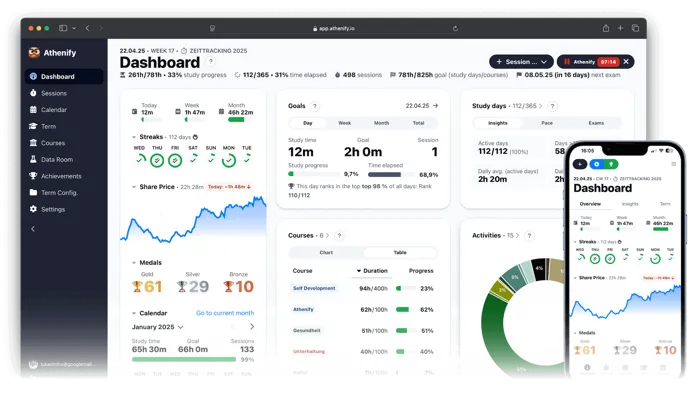
Track every session with Athenify. When you can see that you have invested 15 hours in Math but only 5 in Reading, you know where to redirect your effort. When your streak reaches 30 days, the psychological momentum makes skipping feel costly. The data eliminates the guesswork and turns SAT preparation from an overwhelming project into a manageable daily habit.
Try Athenify for free
Start tracking your SAT preparation with Athenify
No credit card required.

No credit card required.