



Why a structured study schedule is the key to passing the NCLEX-RN
The NCLEX-RN is not a test you can wing. It is a Computerized Adaptive Testing (CAT) exam that dynamically adjusts question difficulty based on your responses. The National Council of State Boards of Nursing (NCSBN) designed it to evaluate whether you meet the minimum competency standard for safe and effective entry-level nursing practice. Unlike your nursing school exams, where you could cram the night before a pharmacology test, the NCLEX requires broad, consistent preparation across all content domains. A structured study schedule is not optional---it is the difference between passing on your first attempt and facing months of delay.
The NCLEX-RN covers four major client needs categories: Safe and Effective Care Environment (management of care, safety and infection control), Health Promotion and Maintenance, Psychosocial Integrity, and Physiological Integrity (basic care, pharmacology, reduction of risk potential, physiological adaptation). Each category carries a different weight on the exam, with Physiological Integrity comprising roughly half of all questions. Your study schedule must reflect these weights while shoring up your weakest areas.
Building your 8--12 week NCLEX study schedule
Most nursing graduates need 200--300 hours of preparation, spread across 8--12 weeks. This is not an arbitrary number---it represents the time needed to review content, complete thousands of practice questions, and build the clinical reasoning skills the NCLEX demands. If you are studying full-time after graduation, 8 weeks at 4--5 hours per day is realistic. If you are working while studying, plan for 10--12 weeks at 2--3 hours per day.
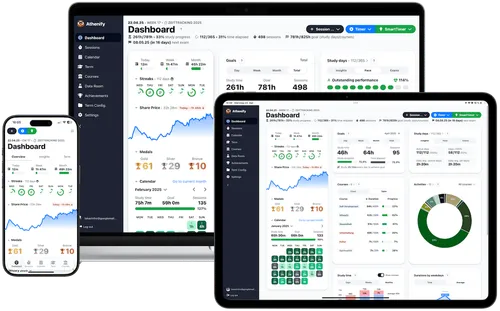
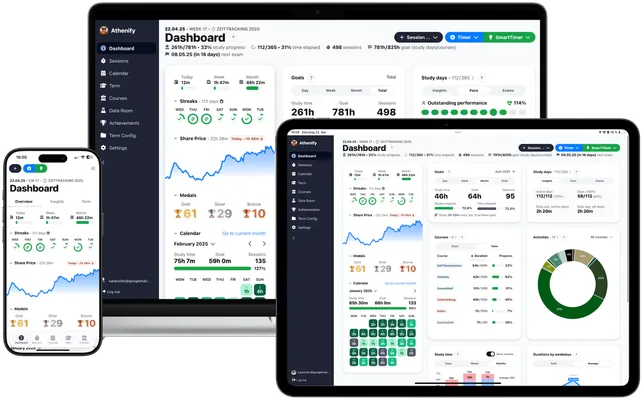
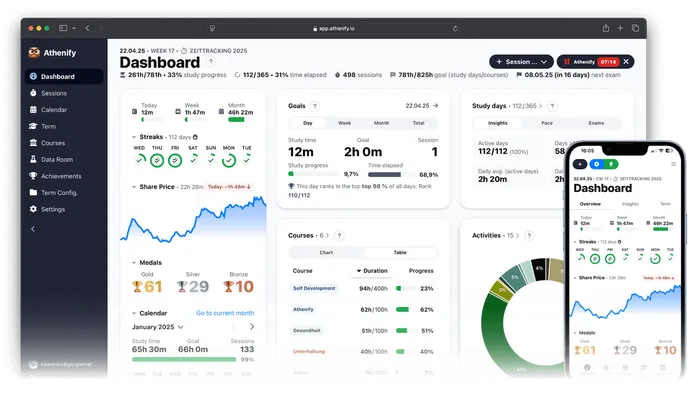
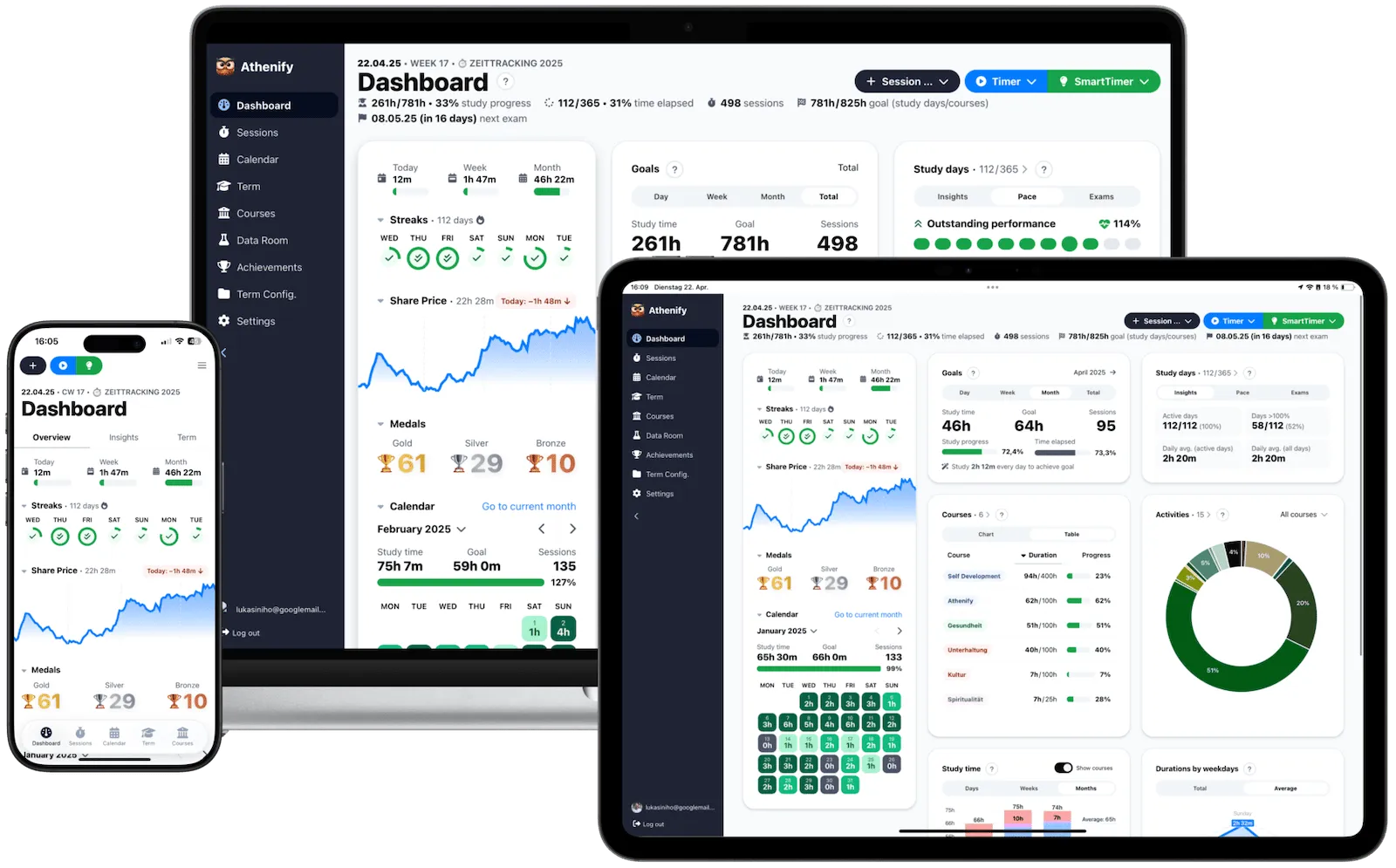
Phase 1 (weeks 1--3): Content review of high-yield topics---pharmacology, fluid and electrolytes, priority-setting frameworks. Phase 2 (weeks 4--8): Heavy practice questions, 75--150 per day with thorough rationale review. Phase 3 (weeks 9--12): Full-length CAT simulations and targeted weak-area review. Use Athenify to track hours per phase and ensure you are hitting your targets.
Your daily study schedule should mirror real testing conditions. The NCLEX gives you up to 5 hours to complete a maximum of 145 questions. Practice in 2--3 hour focused blocks using a study timer to build endurance. Take short breaks every 45--60 minutes to maintain concentration. Many graduates underestimate how mentally exhausting sustained clinical reasoning is---you need to build this stamina before test day, not discover your limits during the actual exam.
Content domains: where to focus your study time
Pharmacology is the single highest-yield content area for NCLEX preparation. Drug classifications, mechanisms of action, side effects, and nursing implications appear across all four client needs categories. Prioritize pharmacology early in your study schedule---it takes time to memorize drug classes, and spaced repetition over weeks produces far better retention than cramming. For effective memorization strategies, explore proven study techniques that leverage active recall.
Prioritization and delegation questions are the most commonly missed. The NCLEX loves to test your ability to determine which patient to see first, what to delegate to a UAP versus an LPN, and when to notify the provider. These questions require clinical judgment that goes beyond textbook knowledge. Practice with NCLEX-style priority questions daily. Use frameworks like ABC (Airway, Breathing, Circulation) and Maslow's hierarchy to guide your reasoning. Track your accuracy rates in Athenify to see whether your clinical reasoning is improving over time.
Practice questions: the core of your NCLEX study plan
Practice questions should comprise 60--70% of your total study time. After the initial content review phase, shift your study schedule heavily toward question practice. Aim for 2,000--4,000 total questions during your preparation. UWorld, Archer, and Kaplan are the most popular question banks---UWorld is widely considered the gold standard for NCLEX preparation, with detailed rationales that teach you the reasoning behind each answer.
Answering 150 questions per day means nothing if you skip the rationales. Spend equal time reviewing rationales as you do answering questions. For every incorrect answer, understand why each wrong option is wrong and why the correct option is right. This review process is where the actual learning happens.
Track your question bank completion and accuracy by content domain. Use Athenify to log your daily practice question sessions and categorize them by content area. This data reveals patterns you cannot see otherwise---maybe your pharmacology accuracy is strong but your prioritization questions hover at 50%. Without tracking, you might spend another week on pharmacology out of comfort while your real weakness goes unaddressed. Building a structured study schedule with clear targets per domain prevents this trap.
Managing test anxiety and staying consistent
The weeks between nursing school graduation and the NCLEX are uniquely stressful. You have finished four years of demanding coursework, only to face one more high-stakes exam before you can practice. Many graduates experience significant anxiety that undermines their preparation. The antidote is a consistent, trackable study schedule that provides daily evidence of progress. When anxiety whispers "you are not ready," your tracked hours in Athenify provide an objective counterpoint.
The graduates who pass the NCLEX on their first attempt are not the ones who studied the most---they are the ones who studied the most consistently. Daily practice beats weekend cramming every time.
Consistency matters more than marathon sessions. Three hours of focused study every day for 10 weeks is far more effective than 8-hour weekend sessions with nothing in between. The NCLEX tests clinical reasoning that develops through repeated, spaced practice---not through exhaustion. Athenify's streak system rewards this daily consistency, helping you build the habits that lead to first-attempt success. If you are struggling with motivation, read about studying when you have no motivation for practical strategies.
Track your entire NCLEX preparation journey with Athenify. When you have 250+ documented hours of balanced, strategic preparation across all content domains, you sit down at the testing center knowing---not hoping---that you are ready to pass.
Try Athenify for free
Track your NCLEX preparation with Athenify
No credit card required.
No credit card required.