
Your Grade Point Average (GPA) is one of the most important metrics of your academic performance. It serves as a standardized measure that universities, graduate programs, employers, and scholarship committees use to evaluate and compare students. Whether you're a freshman mapping out your college career or a senior preparing graduate school applications, understanding exactly how GPA works — and how to optimize it — gives you a significant strategic advantage.
Your GPA is not just a number — it's a strategic tool. The students who treat it that way are the ones who open doors to graduate programs, scholarships, and careers that others miss.
What Is GPA and Why Does It Matter?
GPA stands for Grade Point Average, a numerical representation of your academic achievement on a standardized scale. In the United States, the standard scale runs from 0.0 to 4.0, where 4.0 represents perfect grades. Your GPA distills all your coursework into a single number that admissions committees, employers, and scholarship boards can quickly evaluate. It matters because it directly affects your eligibility for graduate programs, professional schools, honors societies, Dean's List recognition, and competitive internships. Many employers in fields like finance, consulting, and engineering use GPA cutoffs during recruitment, making it a gatekeeper for early-career opportunities.
The GPA Formula: How It Works
GPA is calculated using a credit-weighted average. Each letter grade converts to a grade point value, which is then multiplied by the number of credit hours for that course. These products are summed across all courses, and the total is divided by the total number of credit hours attempted.
GPA Formula
GPA = Σ(Grade Points × Credit Hours) ÷ Σ(Credit Hours)
For example, if you earn an A (4.0) in a 3-credit course and a B+ (3.3) in a 4-credit course, your GPA would be: (4.0 × 3 + 3.3 × 4) ÷ 7 = 3.60. This weighting ensures that courses with more credits have a proportionally larger impact on your overall GPA — a fair reflection of the time and effort they require.
US Letter Grade to Grade Point Conversion
The standard US conversion scale assigns grade points as follows. Plus and minus grades create meaningful differences — the gap between a B+ (3.3) and a B- (2.7) is 0.6 points, which can significantly affect your cumulative GPA over multiple courses. Always verify your specific institution's scale, as some colleges use variations like a 4.3 or 4.5 maximum for honors-level coursework.
| Letter Grade | Grade Points |
|---|---|
| A+ / A | 4.0 |
| A- | 3.7 |
| B+ | 3.3 |
| B | 3.0 |
| B- | 2.7 |
| C+ | 2.3 |
| C | 2.0 |
| C- | 1.7 |
| D+ | 1.3 |
| D | 1.0 |
| D- | 0.7 |
| F | 0.0 |
Weighted vs. Unweighted GPA
There are two common meanings of "weighted GPA." At the high school level, weighted GPA adds extra points for AP, IB, and honors courses — an A in AP Chemistry might count as 5.0 instead of 4.0, rewarding students who take more rigorous courses. At the college level, "weighted" typically refers to credit-hour weighting, where a 4-credit course influences your GPA twice as much as a 2-credit course. Unweighted GPA treats every course equally regardless of credit hours or difficulty level. Nearly all universities use credit-weighted GPA for official transcripts and graduation calculations. Our calculator uses credit-hour weighting, which is the standard for college and university GPA calculations.
Our calculator uses credit-hour weighting, meaning each course's impact on your GPA is proportional to its credit hours. A 4-credit course counts twice as much as a 2-credit course — exactly how your university calculates your official GPA.
What Is a Good GPA?
What counts as a "good" GPA depends entirely on your goals. In the job market, consulting and finance firms often have cutoffs around 3.5, while many other industries prioritize experience and skills over GPA. Exact thresholds vary by institution.
| Goal | Typical GPA Required |
|---|---|
| Graduate school (minimum) | 3.0 |
| Competitive grad programs | 3.5+ |
| Law school (T14) | 3.7–3.9 |
| Medical school | 3.7+ |
| Top MBA programs | 3.5+ |
| Dean's List | 3.5–3.7 |
| Cum laude | 3.5+ |
| Magna cum laude | 3.7+ |
| Summa cum laude | 3.9+ |
| Consulting / finance firms | 3.5+ |
Latin Honors and Dean's List
Many US colleges award Latin honors at graduation based on cumulative GPA. The exact cutoffs vary by institution, but the general hierarchy is: Cum Laude ("with praise") for roughly the top 25–30% of graduates, Magna Cum Laude ("with great praise") for the top 10–15%, and Summa Cum Laude ("with highest praise") for the top 1–5%. These designations appear on your diploma and transcript permanently — a concrete reward for sustained academic excellence.
Most universities publish a Dean's List each semester for students meeting a minimum GPA (usually 3.5–3.7) while carrying a full course load. Being named to the Dean's List multiple semesters signals consistency to employers and admissions committees. Check whether your school requires a minimum number of credits per semester to qualify.
Academic standing works in the opposite direction: falling below a 2.0 cumulative GPA typically triggers academic probation, and remaining below it may lead to academic dismissal. If you're on probation, your priority should be raising your GPA above 2.0 before focusing on other goals — use this calculator's Target GPA mode to map out a recovery plan.
Cumulative vs. Semester GPA
Your semester GPA reflects performance in a single term, while your cumulative GPA (cGPA) is the weighted average across all semesters since you started college. Graduate schools and employers typically look at cumulative GPA, though some programs also consider your major GPA — the average across courses in your declared major. A strong upward trend can partially compensate for a weaker start: if your first-year GPA was 2.8 but your junior and senior year GPAs are 3.7+, many admissions committees view this favorably as evidence of growth and maturation.
Admissions committees at graduate and professional schools often look beyond the cumulative number. A clear upward trajectory — especially from sophomore to senior year — signals resilience and intellectual growth, and can offset a rocky first year.
Major GPA vs. Cumulative GPA
Your major GPA (or departmental GPA) includes only courses within your declared major or concentration, while your cumulative GPA includes everything — gen eds, electives, and major courses alike. Some graduate programs and employers care more about your major GPA, since it reflects your depth in the field you're actually pursuing. For example, a computer science student applying to CS grad programs may have a 3.2 cumulative GPA but a 3.7 major GPA — the latter is what admissions committees focus on. If your major GPA is stronger than your cumulative, highlight it on your resume and applications.
How to Improve Your GPA Strategically
Improving your GPA requires both academic effort and strategic planning. First, prioritize high-credit courses — earning an A in a 4-credit class moves your GPA more than in a 1-credit seminar. Second, use your school's grade replacement policy if available — many universities allow you to retake a course and replace the original grade. Third, choose electives strategically by selecting courses that align with your strengths. Fourth, use a GPA calculator like this one to model scenarios: enter your current GPA and remaining credits, then see exactly what average you need to reach your target. Finally, consider your course load carefully — taking fewer courses per semester and earning higher grades can be more effective than overloading and earning mediocre grades. The earlier you start optimizing, the more impact each semester has on your cumulative GPA.
The further along you are in your degree, the harder it is to move your cumulative GPA. After 90+ credits, even a perfect 4.0 semester of 15 credits might only raise your GPA by 0.1–0.2 points. Start planning early — every semester counts, and the first two years have outsized influence on where you finish.
Try Athenify for free
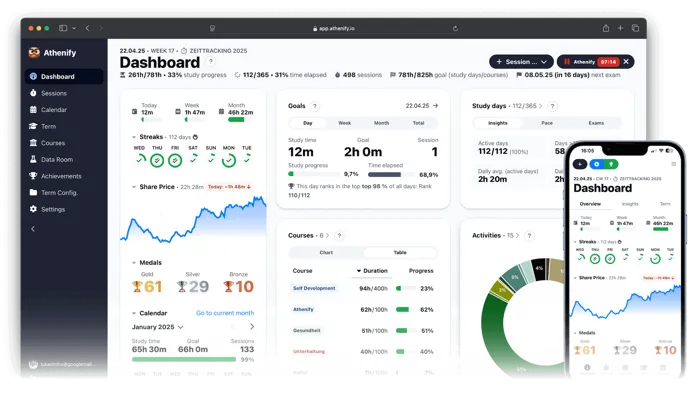
Track your GPA progress with Athenify
No credit card required.

No credit card required.