

Francesco Cirillo invented the Pomodoro Technique in the late 1980s while struggling to focus as a university student in Italy. He used a tomato-shaped kitchen timer (pomodoro means "tomato" in Italian) to break his work into focused intervals. What started as a personal productivity hack became one of the most widely used time management methods in the world.
The 25-minute work interval isn't arbitrary—it's based on cognitive science. Research on "vigilance decrement" shows that sustained attention naturally degrades after 20–30 minutes. By working in 25-minute bursts with planned breaks, you're working with your brain's natural attention cycles, not against them.
The classic Pomodoro cycle follows a 25–5–25–5–25–5–25–15 pattern. Four 25-minute work sessions, each followed by a 5-minute short break, then a longer 15–30 minute break after completing four "Pomodoros". This rhythm prevents burnout while maintaining high productivity throughout the day.
Pomodoro works especially well for tasks you've been avoiding. The technique reduces the psychological barrier to starting—you're not committing to hours of work, just 25 minutes. Once the timer starts, most people find it easier to continue. It's a powerful antidote to procrastination.
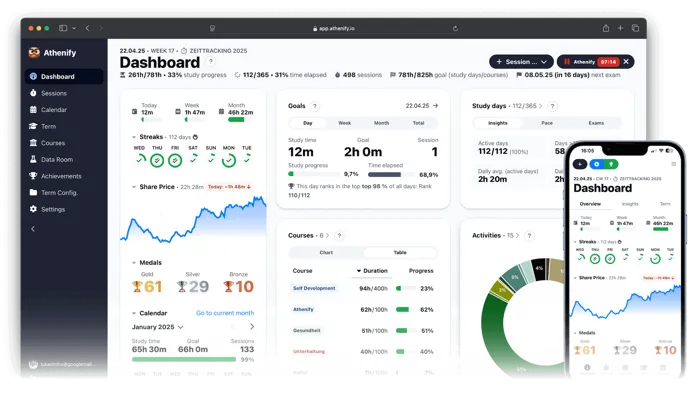
Athenify enhances the Pomodoro Technique with tracking and gamification. While a simple timer counts down, Athenify remembers every session, builds your streak, and shows you statistics on your productivity patterns. You get the proven benefits of Pomodoro plus the motivation of seeing your progress over time. For longer deep work sessions, try the focus timer, or use the fullscreen timer to block all distractions. Start with the best study tracker app for students.
Choosing the right timer technique
Pomodoro vs. 52/17 vs. 90-minute blocks: which timer technique is right for you? The classic 25-minute Pomodoro works best for repetitive tasks, studying, and building focus habits. The 52/17 method (52 minutes on, 17 minutes off) suits knowledge workers doing varied tasks. 90-minute blocks match your ultradian rhythm and are ideal for deep creative work. Experiment with all three using our free study timer to find your optimal rhythm.
The science behind 25-minute focus sessions. Research on attention spans shows that most people can sustain focused attention for 20–30 minutes before performance degrades. The Pomodoro Technique leverages this natural limit. By working in bursts that match your cognitive capacity, you maintain peak performance throughout the day rather than burning out after a few hours of forced concentration.
When to use the Pomodoro Technique. Pomodoro excels for tasks that feel overwhelming or tedious: studying for exams, reviewing flashcards, writing first drafts, answering emails, doing repetitive data entry, or any work you've been procrastinating on. The 25-minute commitment is psychologically easier than facing an undefined block of work. Once the timer starts, most people find it easier to continue.
When NOT to use Pomodoro. The technique has limitations. Deep creative work, complex problem-solving, and flow-state activities often benefit from longer uninterrupted sessions. If you're "in the zone" and the timer interrupts, you may lose valuable momentum. For these tasks, consider the 52/17 method or 90-minute blocks instead. The best approach? Know when to follow the timer and when to override it.
Pomodoro for different situations
Pomodoro for students: exam prep, homework, and revision. Students are the biggest beneficiaries of the Pomodoro Technique. When facing a mountain of material, breaking it into 25-minute chunks makes studying manageable. Use Pomodoros for active recall, spaced repetition, and working through problem sets. After four Pomodoros (2 hours of focused work), take a longer break before continuing. This rhythm prevents burnout during exam season.
Pomodoro for professionals: work-from-home and remote work. Remote workers face unique focus challenges: no commute to transition into work mode, endless digital distractions, and blurred boundaries between work and home. The Pomodoro timer creates structure. Starting a 25-minute session signals "work mode" to your brain. Tracking completed Pomodoros gives you objective evidence of productivity, reducing the guilt that many remote workers feel.
What to do during 5-minute Pomodoro breaks. Short breaks are essential—but how you spend them matters. Stand up, stretch, hydrate, or look out a window. Avoid checking email, social media, or starting new tasks. The break should give your brain genuine rest, not more stimulation. Physical movement is ideal: a quick walk, some stretches, or even just standing at a window. Return to the next Pomodoro refreshed, not drained.
The long break strategy: 15–30 minutes after four Pomodoros. After completing four 25-minute sessions, the classic Pomodoro method prescribes a longer break. Use this time for a real mental reset: eat a proper snack, take a walk outside, do light exercise, or have a non-work conversation. This longer break prevents the accumulated fatigue that comes from extended focus, even with short breaks in between.
Why counting your Pomodoros boosts motivation. "I completed 8 Pomodoros today" is more motivating than "I studied for a while." Tracking sessions provides concrete evidence of effort, which is especially valuable when results are delayed (like studying for an exam weeks away). Athenify automatically counts and visualizes your Pomodoros, turning abstract effort into visible progress. Over time, you can see patterns: which days are most productive, which subjects get the most attention, and how your focus capacity improves.