The ACTAmerican College Testing is one of the two major standardized tests used for college admissions in the United States – and for many students, it's the better choice. With approximately 1.4 million students taking the ACT annually, it remains a crucial gateway to higher education. Unlike the SAT, which emphasizes reasoning within familiar contexts, the ACT tests a broader range of content at a faster pace, rewarding students who can work quickly and accurately under pressure.
The challenge with ACT preparation is twofold: you need to master content across four distinct sections, and you need to do it fast. The ACT gives you less time per question than the SAT, making timing strategy just as important as content knowledge. This article will show you exactly how to prepare for the ACT using proven time management strategies and systematic study planning. For a broader overview of exam preparation timelines, see our guide on how long you should study for an exam.
The ACT rewards students who can work quickly and accurately under pressure – timing strategy is just as important as content knowledge.

ACT vs SAT: which test should you take?
Before diving into ACT preparation, make sure it's the right test for you. Both the ACT and SAT are accepted by virtually all U.S. colleges, so your choice should depend on which test format plays to your strengths.
| Factor | ACT | SAT |
|---|---|---|
| Total time | 2 hours 55 min (without Writing) | 2 hours 14 min |
| Sections | English, Math, Reading, Science | Reading & Writing, Math |
| Science section | Yes (40 questions, 35 min) | No |
| Math content | Includes trigonometry | Less advanced math |
| Pace | Faster (less time per question) | More time per question |
| Calculator | Allowed on all math | Calculator and no-calculator sections |
| Scoring | Composite 1–36 | Total 400–1600 |
The ACT suits students who work quickly and confidently under time pressure – if you thrive when the clock is ticking rather than freezing up, the ACT's pace will feel natural. It favours those with strong science and data interpretation skills, since the Science section (despite its name) primarily tests graph-reading and experimental reasoning. Students who excel at straightforward questions without excessive "trickiness" often prefer the ACT's more direct style. If you've completed trigonometry or feel comfortable with it, you'll be prepared for the ACT's broader math content. And if you prefer four distinct sections rather than integrated content, the ACT's clear boundaries may suit your preparation style.
The SAT, by contrast, suits students who prefer more time to think through each question carefully. If you dislike science or struggle with data interpretation, avoiding the ACT's Science section may be wise. Students who excel at puzzling through complex word problems often find the SAT's style more rewarding. And if you want to skip trigonometry-heavy math, the SAT's narrower content range may better match your preparation level.
The best way to decide? Take a full practice test of each under realistic conditions. Compare your scores using concordance tables. For more details on SAT preparation, see our SAT preparation guide.
Take a full practice test of each under realistic conditions – your scores will tell you which test is your natural fit.
Understanding ACT scoring
The ACT uses a composite scoring system that averages your four section scores. Each section is scored from 1 to 36, and your composite is the rounded average of all four.
ACT scoring breakdown:
| Section | Score Range | Questions | Time | Time per Question |
|---|---|---|---|---|
| English | 1–36 | 75 | 45 min | 36 seconds |
| Math | 1–36 | 60 | 60 min | 60 seconds |
| Reading | 1–36 | 40 | 35 min | 52 seconds |
| Science | 1–36 | 40 | 35 min | 52 seconds |
| Composite | 1–36 | 215 total | 2:55 | – |
What do ACT scores mean for college admissions?
- 20–23: Average range, suitable for many state universities
- 24–26: Above average, competitive for good schools
- 27–30: Strong scores, competitive for selective universities
- 31–33: Excellent, competitive for highly selective schools
- 34–36: Elite range, competitive for Ivy League and top institutions
How long should you study for the ACT?
Your study timeline depends on your starting point and target score. Unlike some exams where cramming can work, the ACT tests skills that develop over time.
ACT study hours by target improvement:
- 3-point increase → 40–60 hours of focused study
- 6-point increase → 80–120 hours
- 9-point increase → 120–180 hours
Factors affecting your study time
Your starting score matters significantly. Students starting at 18 often need more hours to reach 24 than students going from 28 to 32, because building foundational skills takes time while fine-tuning already-strong skills is faster. The early points come from plugging knowledge gaps; the later points come from eliminating careless errors and optimising timing.
Section balance affects your strategy profoundly. If you score 30 in Math but 22 in Reading, your study time should be heavily weighted toward Reading – not split evenly across all sections. The composite is an average, which means raising a weak section has more impact on your final score than polishing a strong one. Going from 22 to 28 in Reading adds more to your composite than going from 30 to 33 in Math.
Study efficiency changes everything. Tracked, focused study hours are worth 2–3 times as much as distracted "study time" where you're half-present. Using proper time management strategies can dramatically reduce the hours needed to hit your target, because an hour of genuine concentration accomplishes what three hours of fragmented attention cannot.
Most successful ACT students prepare for 3–4 months before their test date. This allows for gradual skill building, multiple practice tests, and time to address weaknesses without burning out.
The four ACT sections: what you need to know
English (75 questions, 45 minutes)
The English section tests grammar, punctuation, sentence structure, and rhetorical skills through five passages with 15 questions each. With only 36 seconds per question, you must work fast.
Content breakdown:
- Production of Writing (29–32%): Organization, unity, and cohesion
- Knowledge of Language (13–19%): Word choice, style, and tone
- Conventions of Standard English (51–56%): Grammar, punctuation, and sentence structure
The key skills to develop span a predictable range of grammar concepts. Comma rules dominate – serial commas, introductory phrases, and nonessential clauses appear in nearly every passage. Subject-verb agreement trips up students when subjects and verbs are separated by intervening phrases. Pronoun clarity and agreement questions test whether pronouns clearly refer to specific nouns. Modifier placement asks whether descriptive phrases sit next to what they describe. Parallelism ensures items in lists match grammatically. And concision rewards shorter answers – when in doubt, the more concise option is usually correct.
The English section is often the easiest to improve quickly because it tests learnable rules rather than accumulated knowledge. Master the top 10 grammar concepts, and you'll answer 70%+ of questions correctly on instinct rather than deliberation.
Math (60 questions, 60 minutes)
The Math section covers a broader range of content than the SAT, including trigonometry, matrices, and logarithms. You have exactly one minute per question on average.
Content breakdown:
- Preparing for Higher Math (57–60%): Algebra, functions, geometry, statistics
- Integrating Essential Skills (40–43%): Real-world problems using multiple skills
Within "Preparing for Higher Math," expect questions on:
- Number and Quantity
- Algebra
- Functions
- Geometry
- Statistics and Probability
Calculator strategy: You can use a calculator on the entire Math section, but don't over-rely on it. Many problems are faster to solve mentally or algebraically. Practice so you know when to reach for the calculator and when to skip it.
Reading (40 questions, 35 minutes)
The Reading section presents four passages – one each from Literary Narrative, Social Science, Humanities, and Natural Science – with 10 questions per passage. You have roughly 8 minutes and 45 seconds per passage.
The Reading section tests:
- Key ideas and details
- Craft and structure
- Integration of knowledge and ideas
Critical strategy: The ACT Reading section is notoriously time-pressured. Most students don't finish if they read carefully. You must develop a strategic reading approach – skimming for structure, reading questions first, or using a passage-mapping technique.
The ACT Reading section punishes slow readers. Develop a strategic approach – reading every word carefully will leave you rushing at the end.
Science (40 questions, 35 minutes)
Here's the truth about ACT Science: it's not really a science test. It's a data interpretation and scientific reasoning test. You don't need to memorize biology facts or chemistry equations. You need to read graphs, tables, and experimental descriptions quickly and accurately.
Passage types:
- Data Representation (30–40%): Read graphs, tables, and charts
- Research Summaries (45–55%): Understand experimental design and results
- Conflicting Viewpoints (15–20%): Compare multiple scientific hypotheses
What you actually need to know:
- How to read graphs (axes, units, trends)
- How to interpret tables (finding values, comparing data)
- How to understand experimental variables (independent, dependent, control)
- Basic scientific reasoning (correlation vs. causation, hypothesis testing)
The Science section is often students' most improved section once they understand what it actually tests. Don't skip it in your preparation – it's learnable.
Creating your ACT study schedule
A structured study plan prevents wasted time and ensures you cover all four sections adequately. Here's how to build one based on a 3-month timeline targeting a 6-point improvement (approximately 100 hours total).
The 3-month ACT study plan
| Phase | Duration | Weekly Hours | Focus Areas |
|---|---|---|---|
| Foundation | Weeks 1–4 | 8–10 hours | Learn content, identify weaknesses, take diagnostic test |
| Skill Building | Weeks 5–8 | 10–12 hours | Targeted practice, timed section drills |
| Test Practice | Weeks 9–11 | 12–15 hours | Full practice tests, thorough review, timing refinement |
| Final Week | Week 12 | 5–8 hours | Light review, confidence building, rest |
Phase 1: Foundation (Weeks 1–4)
Start with a full diagnostic practice test under realistic conditions. Score it and analyze your section breakdown. This reveals your natural strengths and weaknesses, informing how you'll allocate study time.
During this phase, focus on:
- Learning ACT-specific strategies for each section
- Reviewing content gaps (especially Math concepts you haven't seen)
- Building familiarity with question types
- Establishing your study routine and tracking system
Phase 2: Skill Building (Weeks 5–8)
Now you know your weaknesses. Attack them systematically. If Reading is your lowest section, spend 40% of your time there. If Math content gaps are holding you back, fill them with targeted practice.
Use active recall techniques rather than passive review. Instead of re-reading grammar rules, quiz yourself on them. Instead of watching math videos, solve problems and check your work.
Incorporate spaced repetition to retain what you learn. Review grammar rules and math formulas at increasing intervals to cement them in long-term memory.
Phase 3: Test Practice (Weeks 9–11)
Take a full practice test every 7–10 days. Between tests, do timed section practice to build speed and endurance.
Phase 4: Final Week (Week 12)
Taper your studying like an athlete before a race. Light review only. Focus on confidence and rest. Trust your preparation.
Sample weekly study schedule
For a student targeting 10 hours per week during the skill-building phase:
| Day | Time | Activity | Duration |
|---|---|---|---|
| Monday | After school | English grammar drills | 1.5 hours |
| Tuesday | After school | Math practice (algebra/functions) | 1.5 hours |
| Wednesday | After school | Reading passage practice (timed) | 1.5 hours |
| Thursday | After school | Science section practice | 1 hour |
| Friday | Evening | Review week's mistakes | 1 hour |
| Saturday | Morning | Timed full section (rotate weekly) | 1.5 hours |
| Sunday | Morning | Math practice (geometry/trig) | 2 hours |
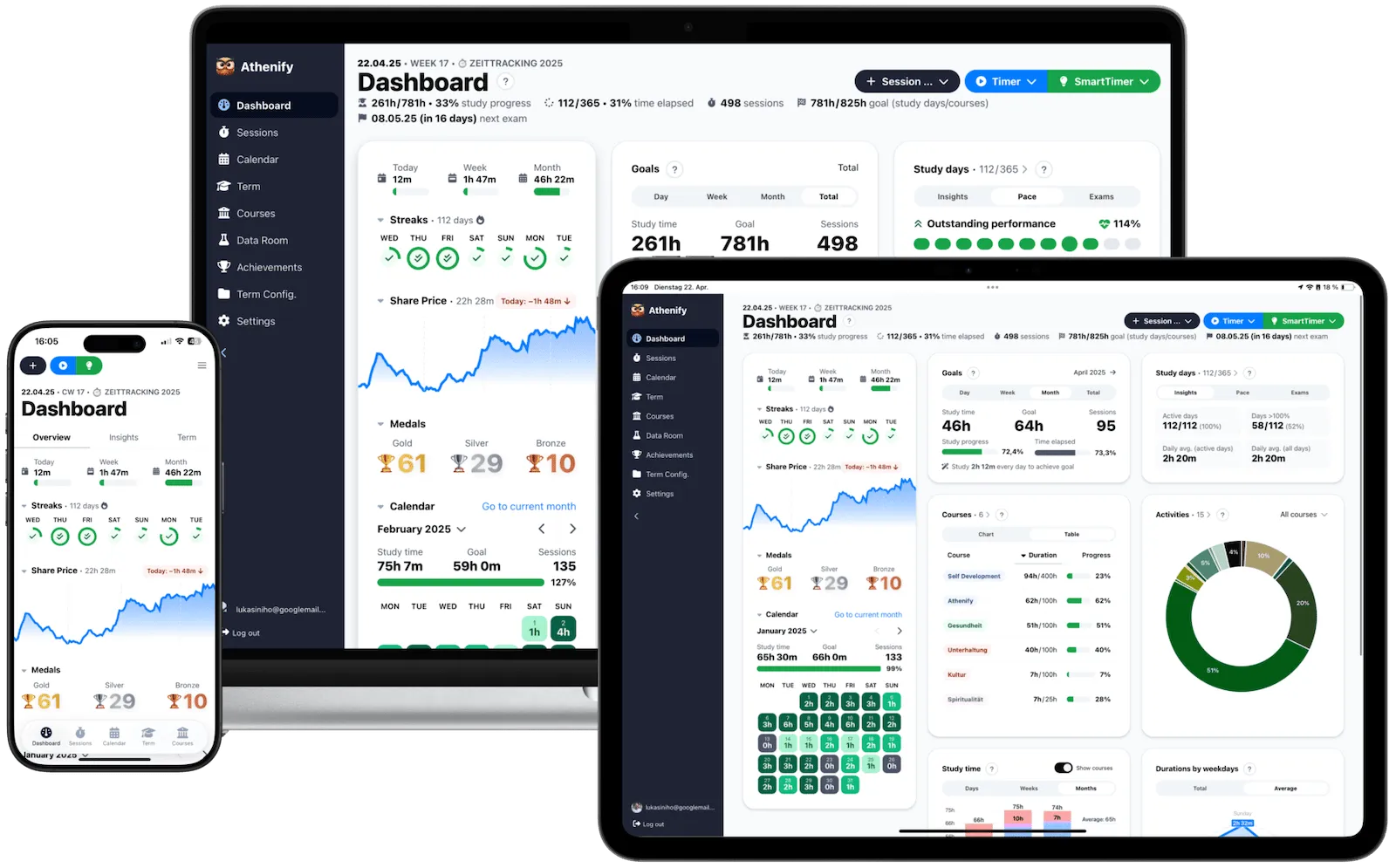
Track each session with Athenify to see exactly where your time goes. After 2–3 weeks, you'll have data showing which sections you're neglecting and whether you're hitting your hour targets.
Section-specific strategies
Mastering ACT English
The English section is your best opportunity for quick score gains. It tests learnable rules, and with practice, you'll spot errors instantly.
Top strategies:
- Read the sentence aloud in your head. Errors often "sound wrong" even if you can't name the grammar rule.
- When in doubt, choose the shortest answer. The ACT rewards concision. If two answers are grammatically correct, the shorter one is usually right.
- Watch for "NO CHANGE." It's correct about 25% of the time. Don't assume there's always an error.
- Context matters for rhetoric questions. Read the surrounding sentences when asked about transitions, relevance, or placement.
The 10 most-tested English concepts:
- Comma usage (especially with introductory phrases and nonessential clauses)
- Subject-verb agreement
- Pronoun-antecedent agreement
- Modifier placement (misplaced and dangling modifiers)
- Parallelism in lists
- Verb tense consistency
- Sentence fragments and run-ons
- Apostrophes (possessives vs. contractions)
- Word choice (affect/effect, their/they're, etc.)
- Redundancy and wordiness
Conquering ACT Math
The Math section covers more content than the SAT, so content review is essential. But strategy matters too – not every question deserves equal time.
Time management strategy:
- First pass (35 minutes): Answer every question you can solve in under 60 seconds. Skip anything that requires extensive work.
- Second pass (20 minutes): Return to skipped questions. Work through them systematically.
- Final pass (5 minutes): Fill in any remaining blanks. Guess strategically (there's no penalty for wrong answers).
Not every ACT Math question deserves equal time. Easy questions are worth the same as hard ones – bank your time on the problems you know you can solve.
Certain content you must know cold, without hesitation. The quadratic formula and factoring techniques appear repeatedly. Slope-intercept and point-slope forms are essential for coordinate geometry questions. Distance and midpoint formulas solve problems that would otherwise require tedious calculation. Circle equations and properties, including the relationship between center, radius, and equation form, appear in multiple questions per test. Trigonometric ratios (SOH-CAH-TOA) and basic trig identities are non-negotiable – unlike the SAT, the ACT tests trigonometry directly. Logarithm rules appear in at least a few questions per exam. Basic matrix operations show up occasionally. And probability rules, including combinations and permutations, round out the high-frequency content.
Your calculator strategy matters as much as your content knowledge. Use your calculator for complex arithmetic, but not for simple algebra where mental math is faster. Graph functions to visualise solutions when the algebraic approach isn't obvious. Know your calculator's capabilities before test day – discovering a useful feature during the exam wastes precious time. And practice with the same calculator you'll bring to the test; switching calculators introduces unnecessary friction when you need maximum efficiency.
Dominating ACT Reading
The Reading section is where most students run out of time. You have about 8 minutes and 45 seconds per passage and its 10 questions. That's barely enough time to read carefully and answer thoughtfully.
Choose your approach:
Approach 1: Skim first, then answer
- Spend 3 minutes skimming the passage for structure and main ideas
- Spend 5 minutes answering questions, referring back as needed
- Best for strong readers who can extract meaning quickly
Approach 2: Read questions first
- Spend 1 minute reading all questions (note line references)
- Spend 4 minutes reading the passage with questions in mind
- Spend 4 minutes answering questions
- Best for detail-oriented readers who struggle with retention
Approach 3: Passage mapping
- Read paragraph by paragraph, writing 3–5 word summaries
- Use your map to locate answers quickly
- Best for readers who get lost in dense passages
Passage order strategy: You don't have to answer passages in order. Start with your strongest passage type (whichever of Literary Narrative, Social Science, Humanities, or Natural Science you find easiest), then work through to your weakest. This ensures you bank easy points before tackling harder material.
Decoding ACT Science
The Science section intimidates students unnecessarily. Once you understand what it actually tests, it becomes one of the most improvable sections.
The Science section is really testing a specific set of skills that have little to do with science content. Can you read graphs and tables accurately, extracting precise values and identifying patterns? Can you identify trends in data, recognising whether variables increase, decrease, or remain stable as conditions change? Can you understand experimental design, identifying independent variables, dependent variables, and controls? Can you compare conflicting viewpoints logically, understanding where two scientists agree and where they diverge?
What it's NOT testing: memorised science facts, chemistry formulas, biology vocabulary, or physics equations. Students who spend hours reviewing their AP Biology notes are preparing for the wrong exam. The science content provided in each passage is sufficient to answer every question – you just need to extract and apply it quickly.
Your strategy should vary by passage type, because each type rewards a different approach.
For Data Representation passages, go straight to the questions without reading introductory text. Use the graphs and tables to find answers directly, treating the visual data as your primary source. Don't read the passage text unless a question specifically requires contextual information – most questions can be answered from the figures alone.
For Research Summaries passages, skim the experimental setup to understand what variables are being manipulated and what's being measured. Identify the independent variable, the dependent variable, and any controls. Focus on results and conclusions rather than procedural details; questions rarely test your understanding of laboratory techniques.
For Conflicting Viewpoints passages, read Scientist 1's view completely before moving to Scientist 2 – trying to read both simultaneously creates confusion. Note the key difference between viewpoints, which is usually a single fundamental disagreement from which other differences flow. Most questions ask you to distinguish or compare views, so understanding where they diverge is more important than memorising their complete arguments.
The critical role of practice tests
Practice tests are where everything comes together. They build stamina, reveal weaknesses, and reduce test-day anxiety.
How many practice tests?
Take 4–6 full official practice tests during your preparation. Space them throughout your study period:
| Week | Practice Test |
|---|---|
| Week 1 | Diagnostic test (establishes baseline) |
| Week 4 | Progress check |
| Week 7 | Mid-preparation assessment |
| Week 9 | Full test under realistic conditions |
| Week 11 | Final full test |
The review process (more important than the test itself)
Spending 2–3 hours reviewing each practice test is non-negotiable. For every wrong answer:
- Identify why you got it wrong. Was it a content gap, a careless error, or a timing issue?
- Understand the correct answer. Don't just note that B was right – understand why B was right and why you chose C.
- Categorize the question type. Was it a grammar rule you don't know? A graph-reading error? A vocab issue?
- Do 3–5 similar practice problems. Reinforce the concept immediately.
Taking a practice test without thorough review is like going to the gym without lifting weights. The review is where the actual learning happens.
How Athenify optimizes your ACT prep
Manual study tracking fails for predictable reasons: students overestimate time spent, don't track by section, and lose motivation without visible progress. Athenify solves these problems systematically.
Section-based time tracking
Create categories for each ACT section: English, Math, Reading, Science, Practice Tests, and Review Sessions. After each study session, you'll see exactly how you're allocating time across these categories. The data often reveals uncomfortable truths – are you spending 50% of your time on Math when Reading is actually your weakest section? Are you telling yourself you're preparing for Science while your logs show you've barely touched it? The imbalance becomes visible before it becomes irreversible.
Goal setting and monitoring
Set weekly hour goals that match your preparation phase: 8–10 hours during Foundation, 10–12 during Skill Building, and 12–15 during Test Practice. Athenify tracks your progress in real-time against these targets. Fall behind on Tuesday? You know immediately that you need to catch up by the weekend, rather than discovering at month's end that you're 20 hours short of your goal.
Try Athenify for free
Track your ACT prep hours by section, maintain your study streak, and see exactly where your time goes over 3–4 months of preparation.
No credit card required.
No credit card required.
Streak system for consistency
Consistency matters more than intensity. Studying 1.5 hours daily for 12 weeks beats 10-hour weekend sessions followed by nothing. Athenify's streak system rewards daily consistency, providing visible proof of your commitment.
Identifying your peak study times
After tracking for 2–3 weeks, patterns emerge. Are you sharper in the morning or evening? Do you focus better on weekdays or weekends? Use this data to schedule your most challenging work – like full practice tests – during your peak performance windows.
Common ACT mistakes and how to avoid them
Mistake #1: Ignoring the Science section
Many students assume Science requires innate ability or extensive content knowledge. It doesn't. The Science section is highly learnable – it just requires practice with data interpretation and scientific reasoning. Students who skip Science prep leave easy points on the table.
Mistake #2: Poor time management during the test
The ACT is faster-paced than most exams you've taken. Students who don't practice timing run out of time and leave questions blank. Practice with a timer from day one. Know exactly how long you have per passage and per question.
Mistake #3: Not adapting to the test's pace
What works on the SAT doesn't work on the ACT. The ACT rewards speed and decisiveness. If you're used to puzzling through problems for 2–3 minutes, you'll struggle. Train yourself to recognize when you're stuck and move on.
Mistake #4: Cramming instead of sustained practice
The ACT tests skills, not memorizable content. Skills develop over time through repeated practice. Starting two weeks before the test won't give you enough time to build reading speed, math fluency, or data interpretation skills. Start 3–4 months early.
Mistake #5: Taking too many practice tests without review
Some students take a practice test every few days, chasing higher scores without understanding their mistakes. This leads to plateau. Fewer tests with thorough review beats many tests with no review.
Timing strategies for test day
The ACT's pace is relentless. Here's how to manage time in each section:
English (45 minutes, 75 questions)
- Target: 9 minutes per passage (5 passages)
- Strategy: Read quickly but carefully. Most questions can be answered in 20–30 seconds. Flag difficult questions and return if time permits.
Math (60 minutes, 60 questions)
- Target: 60 seconds per question average
- Strategy: Easy questions first. Skip anything requiring more than 90 seconds on first pass. Return to skipped questions with remaining time.
Reading (35 minutes, 40 questions)
- Target: 8 minutes 45 seconds per passage
- Strategy: Start with your strongest passage type. Use your chosen reading approach consistently. Guess on any remaining questions in the last 30 seconds.
Science (35 minutes, 40 questions)
- Target: 5 minutes per passage (7 passages)
- Strategy: Go straight to questions for Data Representation passages. Skim setup for Research Summaries. Read carefully for Conflicting Viewpoints.
The final week: taper and prepare
The week before your ACT is for confidence building and rest, not intensive studying. Your skills are set – now focus on being mentally and physically ready.
Final week schedule
| Day | Activity | Time |
|---|---|---|
| 7 days before | Light section review (weak areas only) | 1.5 hours |
| 6 days before | Untimed practice (quality focus) | 1 hour |
| 5 days before | Review formulas and strategies | 45 min |
| 4 days before | One timed section (your weakest) | 1 hour |
| 3 days before | Rest day – no ACT work | 0 hours |
| 2 days before | Quick formula review only | 30 min |
| 1 day before | Prepare materials, early to bed | 0 hours |
| Test day | Execute | – |
Test day strategy
Night before
Prepare everything: admission ticket, photo ID, approved calculator (with fresh batteries), #2 pencils, eraser, watch (without alarms), snack, and water. Set two alarms. Get 8–9 hours of sleep. Do not study – last-minute cramming creates anxiety without adding knowledge.
Morning of
Eat a protein-rich breakfast that won't spike your blood sugar. Arrive 20 minutes early. Use bathroom before the test starts. Do light stretching or breathing exercises if you're nervous. Quick formula review in the parking lot is fine – then put everything away.
During the test
- Read each section's instructions even though you know them – it settles your mind
- Pace yourself using your watch
- Skip and return to difficult questions
- Fill in every bubble (no guessing penalty)
- Take the full break between sections
- Stay focused – don't worry about how others are doing
The students who score highest on the ACT aren't necessarily the smartest – they're the ones who prepared systematically and execute calmly on test day.
Retake considerations
Most students take the ACT 2–3 times. Each attempt provides data to improve.
When to retake
Consider retaking if:
- Your score is 3+ points below your target
- You know you underperformed due to illness, nerves, or timing issues
- Your section scores are unbalanced (e.g., 32 Math, 24 Reading)
- You have time before application deadlines
Retake study strategy
If retaking in 2–3 months, your preparation should be highly targeted rather than comprehensive. Order your score report to see exactly which questions you missed – this data is invaluable for diagnosis. Analyse patterns in your errors to distinguish content gaps (you didn't know the material), timing issues (you ran out of time and rushed), and careless mistakes (you knew it but executed poorly). Each error type requires a different intervention.
Focus 70% of your study time on your weakest section, resisting the temptation to distribute effort evenly. Take 2–3 more practice tests with thorough review of every error, not just a quick check of what you got wrong. If you ran out of time on your first attempt, address timing issues explicitly through timed section practice and strategic question-skipping drills.
Students who retake without additional targeted study see minimal improvement – often just 1 point, well within random variation. The average 2–3 point gain comes from those who invest 30–40 additional hours focused specifically on their weakest areas rather than repeating the same general preparation that produced their first score.
Conclusion: from preparation to performance
The ACT is conquerable. It's a standardized test that rewards preparation, speed, and strategy. The content is learnable, the timing is manageable with practice, and score improvement is predictable with sustained effort.
Your ACT preparation formula:
- Start early (3–4 months before test day)
- Take a diagnostic test to establish your baseline
- Set a realistic hour goal based on your target improvement (40–60 hours per 3 points)
- Track every study session by section using Athenify
- Focus on your weakest sections (they have the most room for improvement)
- Take and thoroughly review 4–6 official practice tests
- Practice timing constantly (the ACT's pace is relentless)
- Stay consistent with daily study, building your streak
The difference between a 24 and a 30, or a 28 and a 33, is often just 60–100 hours of focused, tracked preparation. That's 10 hours a week for 3 months – entirely doable alongside school and activities.
Start today. Set up your ACT categories in Athenify. Log your first study session. Watch your hours accumulate and your practice scores rise. The students who achieve their target scores aren't necessarily the most talented – they're the ones who put in the work, tracked their progress, and stayed consistent when it got hard.
You can be one of them.
For more study strategies that apply across all your exams, explore our guides on creating an effective study schedule, the Pomodoro technique, and our comprehensive exam preparation guide.