

The awareness gap: you study less than you think
You probably study less than you think. Most students overestimate their study time by 50% or more. They think they studied for 4 hours, but when distractions, phone checks, and breaks are accounted for, the real focused study time was closer to 2 hours. Tracking reveals this gap and shows the difference between time at your desk and actual productive study time. Learn more about how time tracking transforms student productivity.
The cost of distractions
Interruptions cost more than you realize. After an interruption, it takes around 23 minutes to refocus (University of California, Irvine). Seeing that cost in your own data makes you far more protective of deep-work blocks and helps you plan fewer context switches.
Why tracking drives results
Writing it down works. A study by Dr. Gail Matthews (Dominican University) found that people who write down their goals and track progress are 42% more likely to achieve them. Logging your study time turns vague intentions into measurable progress. Dive deeper into the science behind study time tracking.
You cannot improve what you do not measure. Tracking turns vague intentions into concrete data.
Quality over quantity: the optimal study hours
Quality beats quantity. Cognitive science points to quality over quantity. Most people can sustain 3–5 hours of focused, deliberate practice per day before diminishing returns set in. Not sure what the right amount is for you? Read our guide on how many hours you should study per day. Tracking your sessions helps you spot when you hit your cognitive limits and adjust your schedule accordingly.
How a timer creates accountability
The timer creates accountability. Time tracking combats procrastination. When every minute is being logged, you become intentional about how you spend your time. The data creates accountability — even if it's just to yourself. Many students report that simply starting the timer helps them get into "study mode" faster — especially when using timed techniques like the ones in our complete guide to the Pomodoro technique.
The Pomodoro technique — 25 minutes of focused work followed by a 5-minute break — is the easiest entry point to study time tracking. It structures your sessions, prevents burnout, and gives you concrete data on how many focused intervals you completed.
What to track and how to analyze it
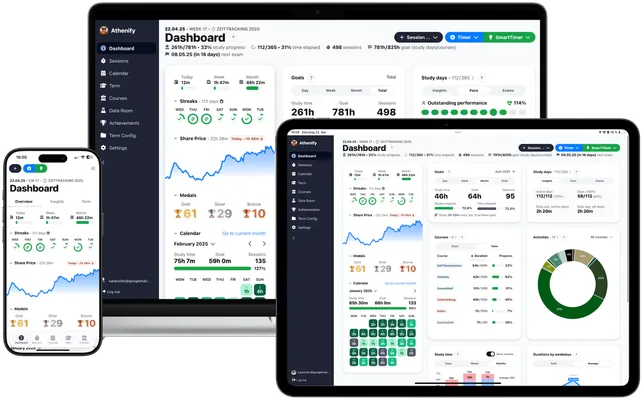
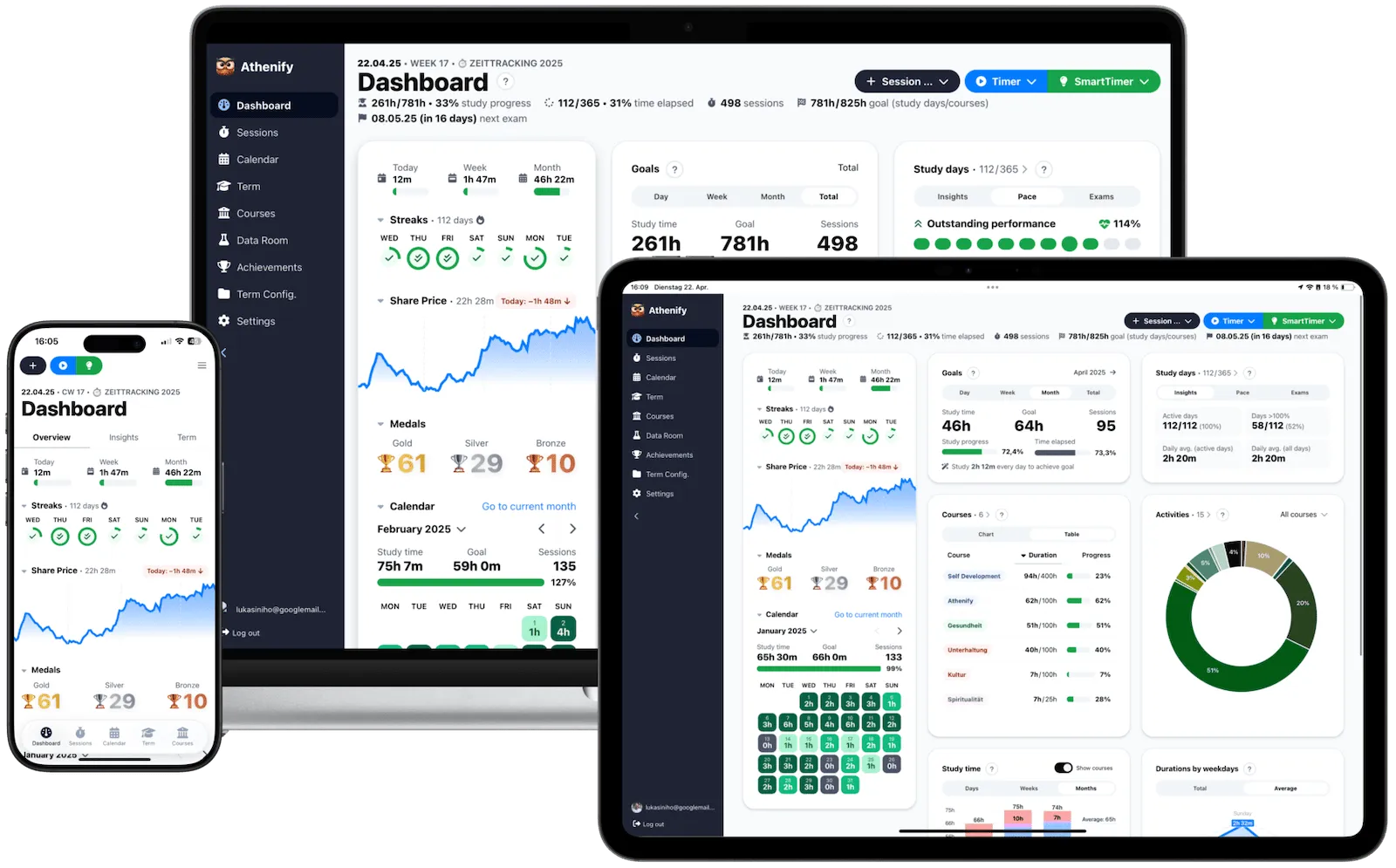
See the full picture. With Athenify, you can log every study session by subject, see your weekly and monthly patterns, identify your most productive times of day, and build lasting study habits through streaks and accountability features. The dashboard gives you a bird's-eye view of your progress, while detailed analytics help you spot trends and areas for improvement.
Benchmark: exam preparation hours
Know exactly where you stand. Whether you're preparing for the MCAT (300–500 hours), LSAT (250–400 hours), GRE (100–200 hours), or any exam that requires hundreds of hours of preparation, knowing exactly how much time you've invested gives you confidence and clarity. You'll never have to wonder "Am I studying enough?" again — the data tells the story.
Major exam preparation benchmarks: MCAT requires 300 to 500 hours, LSAT requires 250 to 400 hours, GRE requires 100 to 200 hours, and CPA requires 300 to 400 hours. Tracking your hours against these benchmarks tells you whether you are on pace.
Try Athenify for free
Start tracking your study time with Athenify
No credit card required.
No credit card required.