
Your high school GPA is one of the most consequential numbers in your academic life. It shapes which colleges you can apply to, which scholarships you qualify for, and how admissions officers perceive your readiness for higher education. Whether you are a freshman building your foundation or a junior fine-tuning your transcript for applications, understanding exactly how your GPA works gives you a strategic edge that most students never develop.
Your high school GPA is not just a reflection of past performance — it is the single most powerful lever you have for shaping your college options. Students who understand the math behind it make smarter decisions every semester.
How High School GPA Is Calculated
High school GPA uses the same fundamental formula as college GPA: a credit-weighted average of your grade points across all courses. Each letter grade converts to a numerical value, which is multiplied by the course's credit hours, then all products are summed and divided by total credits.
GPA Formula
GPA = Σ(Grade Points × Credit Hours) ÷ Σ(Credit Hours)
For example, if you earn an A (4.0) in a 1-credit English class and a B+ (3.3) in a 1-credit Biology class, your GPA would be: (4.0 × 1 + 3.3 × 1) ÷ 2 = 3.65. Most high school courses carry equal credit (typically 1.0 per year-long class or 0.5 per semester), which simplifies the calculation — but the principle of weighted averaging still applies.
Weighted vs. Unweighted GPA: The Critical Distinction
The difference between weighted and unweighted GPA is one of the most important concepts for high school students to understand, because colleges look at both.
Unweighted GPA uses the standard 4.0 scale for all courses equally. An A in AP Physics and an A in regular Art both count as 4.0. The maximum unweighted GPA is 4.0, regardless of how many advanced courses you take.
Weighted GPA adds extra grade points for advanced courses to reward academic rigor. The most common weighting system works like this:
| Course Type | A | B | C | D | F |
|---|---|---|---|---|---|
| Regular | 4.0 | 3.0 | 2.0 | 1.0 | 0.0 |
| Honors | 4.5 | 3.5 | 2.5 | 1.5 | 0.5 |
| AP / IB | 5.0 | 4.0 | 3.0 | 2.0 | 1.0 |
Our calculator computes your GPA on the standard unweighted 4.0 scale with credit-hour weighting. To calculate a weighted GPA that includes AP/honors boosts, add the extra points to your letter grade values before entering them (e.g., enter an AP A as 5.0 if your school uses a 5.0 scale).
This means a student with a mix of AP courses can achieve a weighted GPA above 4.0 — commonly 4.3 to 4.8 at competitive high schools. Colleges use weighted GPA to compare students who took different levels of course rigor.
How Colleges Evaluate Your High School GPA
Admissions officers do not simply look at a single GPA number. They evaluate your transcript holistically:
Course rigor matters as much as the grades themselves. A 3.7 unweighted GPA with five AP courses signals stronger preparation than a 4.0 with only standard classes. Selective colleges explicitly state they prefer students who challenge themselves.
Grade trends tell a story. An upward trajectory — improving from a 3.2 freshman year to a 3.8 junior year — demonstrates growth and maturity. A downward trend raises concerns, even if the cumulative GPA remains high.
Context shapes interpretation. Admissions officers consider your school's profile: average GPA, number of AP courses offered, and overall academic environment. A 3.5 at a highly competitive school may carry more weight than a 4.0 at a less rigorous one.
What GPA Do You Need? Benchmarks by College Tier
GPA requirements vary dramatically across institutions. Here is a general guide based on unweighted GPA:
| College Tier | Typical GPA Range |
|---|---|
| Ivy League / Top 10 | 3.9–4.0 |
| Top 20 universities | 3.8–4.0 |
| Top 50 universities | 3.5–3.9 |
| Competitive state schools | 3.3–3.7 |
| Most four-year colleges | 3.0+ |
| Community colleges | Open admissions |
Remember that these are guidelines, not hard cutoffs. Colleges consider your full application, including test scores, essays, extracurricular activities, and recommendation letters. A compelling application can sometimes overcome a GPA that falls slightly below the typical range.
The Impact of AP, IB, and Honors Courses
Taking advanced courses is one of the most effective ways to strengthen your college application. Beyond the weighted GPA boost, these courses demonstrate intellectual curiosity and college readiness:
AP courses follow a standardized College Board curriculum and culminate in a national exam scored 1–5. A score of 3+ often earns college credit, potentially saving you thousands of dollars and letting you graduate early or double-major. Colleges weigh AP course performance heavily in admissions decisions.
IB (International Baccalaureate) courses, particularly in the full Diploma Programme, signal a rigorous, internationally-minded education. IB students develop research, writing, and critical thinking skills that translate directly to college success.
Honors courses offer a middle ground — more challenging than standard classes, with a smaller GPA boost (typically +0.5). They are excellent stepping stones toward AP/IB in later years.
Do not overload your schedule with AP courses just to inflate your weighted GPA. Admissions officers value sustained performance in a manageable number of challenging courses over mediocre grades in too many. A B in three AP courses hurts more than an A in two AP courses plus one honors course.
Strategic GPA Planning by Year
Your high school GPA is built over four years. Here is how to approach each one:
Freshman year sets the foundation. Focus on strong study habits and time management. While some colleges weight freshman grades less heavily, these grades still count toward your cumulative GPA. Starting with a 3.8+ gives you a valuable cushion.
Sophomore year is when you should begin adding honors or AP courses in your strongest subjects. Build on your freshman foundation and aim to maintain or improve your GPA.
Junior year is the most critical year for college admissions. Most applications are submitted with grades through junior year, making this your last chance to significantly impact your GPA. Take your most challenging courses and perform at your best.
Senior year matters more than many students think. Colleges see your first-semester grades, and many require a final transcript after graduation. A significant drop in senior year — known as "senioritis" — can lead to rescinded admissions offers.
Colleges can and do rescind acceptances for significant grade drops in senior year. Maintain your effort through graduation — a strong finish reinforces the work ethic your entire transcript demonstrates.
GPA Recovery Strategies
If your GPA is not where you want it to be, there are concrete steps you can take:
- Calculate your target. Use this calculator to determine exactly what grades you need in remaining semesters to reach your goal GPA.
- Prioritize high-impact courses. Focus your energy on courses that carry the most credits or where you have the largest room for improvement.
- Consider grade replacement. Some schools allow you to retake a course and replace the original grade. Check your school's policy.
- Seek help early. Tutoring, study groups, and teacher office hours are most effective when used proactively, not as last-resort measures.
The earlier you start improving, the more impact each semester has. After three years of grades, even a perfect senior year can only move your cumulative GPA by a limited amount.
Beyond GPA: Building a Complete Application
While GPA is foundational, it is not everything. The strongest college applications combine a competitive GPA with meaningful extracurricular involvement, compelling essays, and strong recommendation letters. Use your GPA as a baseline, then build depth in areas you are genuinely passionate about. Admissions officers at selective colleges read thousands of applications — they can distinguish between students who chase numbers and students who pursue genuine intellectual growth.
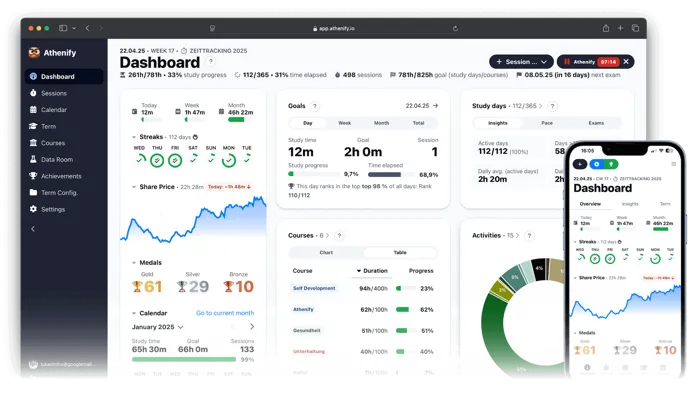
Your study habits and time management skills are just as important as raw intelligence. Students who run a study timer through every session consistently tend to earn higher grades, because they understand where their hours actually go.
Try Athenify for free
Track your study hours and grades with Athenify
No credit card required.

No credit card required.