The bar exam is the final obstacle between three years of law school and your legal career. Unlike law school exams – where you compete against classmates for grades – the bar exam is a minimum competency test. You don't need to be brilliant. You need to be prepared.
Every year, approximately 40,000 law graduates take the bar exam for the first time. About 75–80% pass on their first attempt. The other 20–25% face delayed careers, additional expenses, and the psychological weight of retaking.
The difference between passing and failing rarely comes down to intelligence. It comes down to preparation – specifically, how many quality hours you invest and how strategically you allocate them.
The bar exam doesn't test whether you'll be a good lawyer. It tests whether you can systematically prepare for and execute a high-stakes standardized exam.
This guide will show you exactly how to prepare for the bar exam using evidence-based study strategies, optimal time allocation across the MBEMultistate Bar Examination, MEEMultistate Essay Examination, and MPTMultistate Performance Test, and systematic progress tracking. If you're earlier in your legal education journey, our LSAT preparation guide covers the exam that got you into law school.

Understanding the bar exam: format and structure
The Uniform Bar Examination (UBE)
The UBEUniform Bar Examination has been adopted by over 40 jurisdictions, making it the dominant bar exam format in the United States. Your UBE score is portable – pass once, and you can transfer your score to any other UBE jurisdiction (subject to each state's minimum passing score).
UBE Structure:
| Component | Format | Time | Weight |
|---|---|---|---|
| MBE | 200 multiple-choice questions | 6 hours (two 3-hour sessions) | 50% |
| MEE | 6 essay questions | 3 hours | 30% |
| MPT | 2 performance tests | 3 hours (90 min each) | 20% |
Total exam time: 12 hours across 2 days
State-specific bar exams
Several major jurisdictions – including California, Florida, and Louisiana – administer their own exams rather than the UBE. These typically include:
- State-specific essay questions covering local law
- Performance tests similar to the MPT
- The MBE (most states still use this component)
If you're taking a state-specific exam, the strategies in this guide still apply. Adjust your subject allocation based on your state's tested topics and weighting.
Passing scores by state
UBE passing scores range from 260 (Alabama, Missouri) to 280 (Alaska, Arizona). The median passing score is 270, equivalent to roughly 135/200 on the MBE combined with solid essay and MPT performance.
| Score Range | States |
|---|---|
| 260–265 | Alabama, Missouri, North Dakota, New Mexico |
| 266–270 | Colorado, Iowa, Montana, Oregon, most UBE states |
| 272–276 | New York, Texas, New Jersey |
| 280 | Alaska, Arizona |
Research your jurisdiction's specific requirements, including any additional state-specific components or character and fitness requirements.
How many hours should you study?
The bar exam requires 400–600 hours of focused study. This is not a suggestion – it's a baseline established by decades of pass rate data and commercial bar prep experience.
Full-time vs. part-time preparation
Full-time preparation (10–12 weeks):
- 8–10 hours daily, 5–6 days per week
- 50–60 hours weekly
- Total: 500–600 hours
- Recommended for: Recent graduates, those not working
Part-time preparation (4–6 months):
- 4–5 hours daily or 25–30 hours weekly
- Requires exceptional consistency
- Total: 400–500 hours
- Recommended for: Working professionals, those with family obligations
Part-time bar prep requires more total calendar time but the same total hours. There are no shortcuts – only different schedules.
Why tracking matters
Students consistently overestimate their study time. What feels like "8 hours" often includes lunch breaks, social media checks, and unfocused reading that doesn't build exam skills.
Research on standardized test preparation shows that students who don't track typically overestimate by 30–50%. This means your "8-hour day" might actually be 4–5 hours of focused work. Over 10 weeks, this gap compounds into hundreds of missing hours.
For a deeper understanding of why tracking transforms preparation, see our guide on the science of study time tracking. The principles apply directly to bar prep.
The three components: MBE, MEE, and MPT
Multistate Bar Examination (MBE)
The MBEMultistate Bar Examination is 200 multiple-choice questions covering seven subjects. It accounts for 50% of your UBE score – making it the single most important component.
MBE Subjects and Approximate Question Distribution:
| Subject | Questions | Percentage |
|---|---|---|
| Civil Procedure | 27 | 13.5% |
| Constitutional Law | 27 | 13.5% |
| Contracts | 28 | 14% |
| Criminal Law & Procedure | 27 | 13.5% |
| Evidence | 27 | 13.5% |
| Real Property | 27 | 13.5% |
| Torts | 27 | 13.5% |
Time per question: 1.8 minutes (108 seconds)
MBE strategy fundamentals:
- Master the highly tested rules: About 20% of rules generate 80% of questions. Focus on the rules that appear repeatedly – your bar prep course will highlight these.
- Learn to read questions actively: The call of the question tells you what legal issue to analyze. Read it first, then read the fact pattern with that issue in mind.
- Understand why wrong answers are wrong: Every incorrect answer choice has a specific flaw – it misstates a rule, applies the wrong standard, or addresses an issue not in the question. Understanding these patterns improves accuracy faster than memorizing more rules.
- Track accuracy by subject: If you're scoring 75% in Torts but 55% in Evidence, your study time allocation needs adjustment.
Multistate Essay Examination (MEE)
The MEEMultistate Essay Examination consists of six 30-minute essays covering both MBE subjects and additional topics.
Additional MEE subjects (beyond the MBE seven):
- Business Associations (Corporations, Partnerships, LLCs)
- Conflict of Laws
- Family Law
- Secured Transactions
- Trusts and Estates (Wills, Trusts, Decedents' Estates)
MEE strategy fundamentals:
- Use IRAC religiously: Issue, Rule, Application, Conclusion. Graders look for this structure. Even if your analysis is imperfect, a well-organized answer scores better than a brilliant but disorganized one.
- Write to the call of the question: If the question asks "Will the motion to suppress be granted?", your conclusion must directly answer that question. Don't leave graders guessing.
- Spot issues systematically: Before writing, spend 3–5 minutes outlining all potential issues. Missing a major issue hurts your score more than shallow analysis of spotted issues.
- Practice under timed conditions: A beautiful essay written in 45 minutes is worthless. Train yourself to produce adequate essays in 30 minutes or less.
For foundational essay-writing techniques that transfer to bar prep, our guide on active recall explains how to build the rapid knowledge retrieval that essay exams demand.
Multistate Performance Test (MPT)
The MPTMultistate Performance Test asks you to complete a realistic legal task – drafting a memo, writing a brief, or preparing client correspondence – using provided materials.
MPT structure:
- 2 tasks, 90 minutes each
- Closed-universe: Everything you need is in the File and Library
- Tests practical lawyering skills, not memorized law
MPT task types:
- Persuasive briefs or memoranda
- Objective legal memoranda
- Client letters
- Contract provisions or settlement proposals
- Discovery plans or case evaluations
MPT strategy fundamentals:
- Read the task memo first: Know exactly what you're being asked to produce before diving into the materials.
- Skim the Library efficiently: Identify the relevant legal standards quickly. Don't read cases word-for-word – extract holdings and key rules.
- Organize the File facts: The fact pattern is intentionally disorganized. Sort information by legal issue as you read.
- Follow the format instructions precisely: If the task says "use headings," use headings. If it says "do not include a statement of facts," don't include one. Graders penalize format violations.
- Manage time ruthlessly: At 45 minutes, start writing regardless of whether you feel "ready." A complete adequate answer beats an incomplete excellent one.
The 10-week full-time study plan
This plan targets 500–550 hours over 10 weeks, assuming 50–55 hours of study per week. Adjust based on your starting knowledge and target jurisdiction's passing score.
Phase 1: Foundation (Weeks 1–3)
Goal: Learn core rules for all MBE subjects Hours per week: 45–50 Total phase hours: 135–150
| Week | Focus | Daily Activities |
|---|---|---|
| 1 | Contracts, Torts | Lectures + outline review + 50 MBE Qs daily |
| 2 | Real Property, Evidence | Lectures + outline review + 50 MBE Qs daily |
| 3 | Civ Pro, Con Law, Crim | Lectures + outline review + 50 MBE Qs daily |
Daily structure (9-hour day):
- Morning (3 hrs): Lecture videos for new subject
- Midday (2 hrs): Active outline review with self-testing
- Afternoon (3 hrs): 50 MBE practice questions + thorough review
- Evening (1 hr): Flashcard review of rules learned that day
Weeks 1–3 establish your knowledge foundation. Rushing this phase to "get to practice questions faster" is the most common bar prep mistake.
Phase 2: Skill building (Weeks 4–6)
Goal: Build MBE speed and accuracy; begin essay practice Hours per week: 55–60 Total phase hours: 165–180
| Week | Focus | Daily Activities |
|---|---|---|
| 4 | MBE drilling + MEE subjects | 75–100 MBE Qs + 2 essays + MEE subject review |
| 5 | Heavy MBE practice | 100 MBE Qs daily + weakness targeting |
| 6 | Balanced MBE/MEE | 75 MBE Qs + 3 essays + first MPT practice |
Week 4–6 emphasis:
- MBE: 60% of study time
- MEE: 30% of study time
- MPT: 10% of study time
By the end of Week 6, you should have completed 1,200–1,500 MBE questions and written 15–20 practice essays. Track your accuracy trends – you should see steady improvement from Week 4 to Week 6.
Phase 3: Intensive practice (Weeks 7–8)
Goal: Reach target accuracy levels; identify and eliminate weaknesses Hours per week: 55–60 Total phase hours: 110–120
| Week | Focus | Daily Activities |
|---|---|---|
| 7 | Simulated half-exams | AM: 100 timed MBE Qs; PM: 3 timed essays |
| 8 | Full practice exams | Day 1 format: MEE + MPT; Day 2 format: MBE |
Target accuracy by end of Week 8:
- MBE: 65–70% on practice sets
- Essays: Passing-range scores on commercial grading
- MPT: Completing tasks within 90 minutes with organized analysis
Phase 4: Final preparation (Weeks 9–10)
Goal: Consolidate knowledge; peak confidence; strategic rest Hours per week: Week 9: 50–55; Week 10: 30–35 Total phase hours: 80–90
| Week | Focus | Daily Activities |
|---|---|---|
| 9 | Targeted weakness drilling | Heavy review of lowest-scoring subjects; 50–75 MBE Qs daily |
| 10 | Taper and consolidate | Light review; rule refreshers; mental preparation |
Week 10 schedule:
| Day | Activity | Hours |
|---|---|---|
| Monday | 50 mixed MBE questions + review | 4–5 |
| Tuesday | 2 timed essays (weakest subjects) | 3–4 |
| Wednesday | 1 MPT practice + rule flashcards | 4–5 |
| Thursday | Light MBE (25 Qs) + outline review | 3–4 |
| Friday | Rule review only – no new questions | 2–3 |
| Saturday | Complete rest – no studying | 0 |
| Sunday | Exam Day 1: MEE + MPT | – |
| Monday | Exam Day 2: MBE | – |
Try Athenify for free
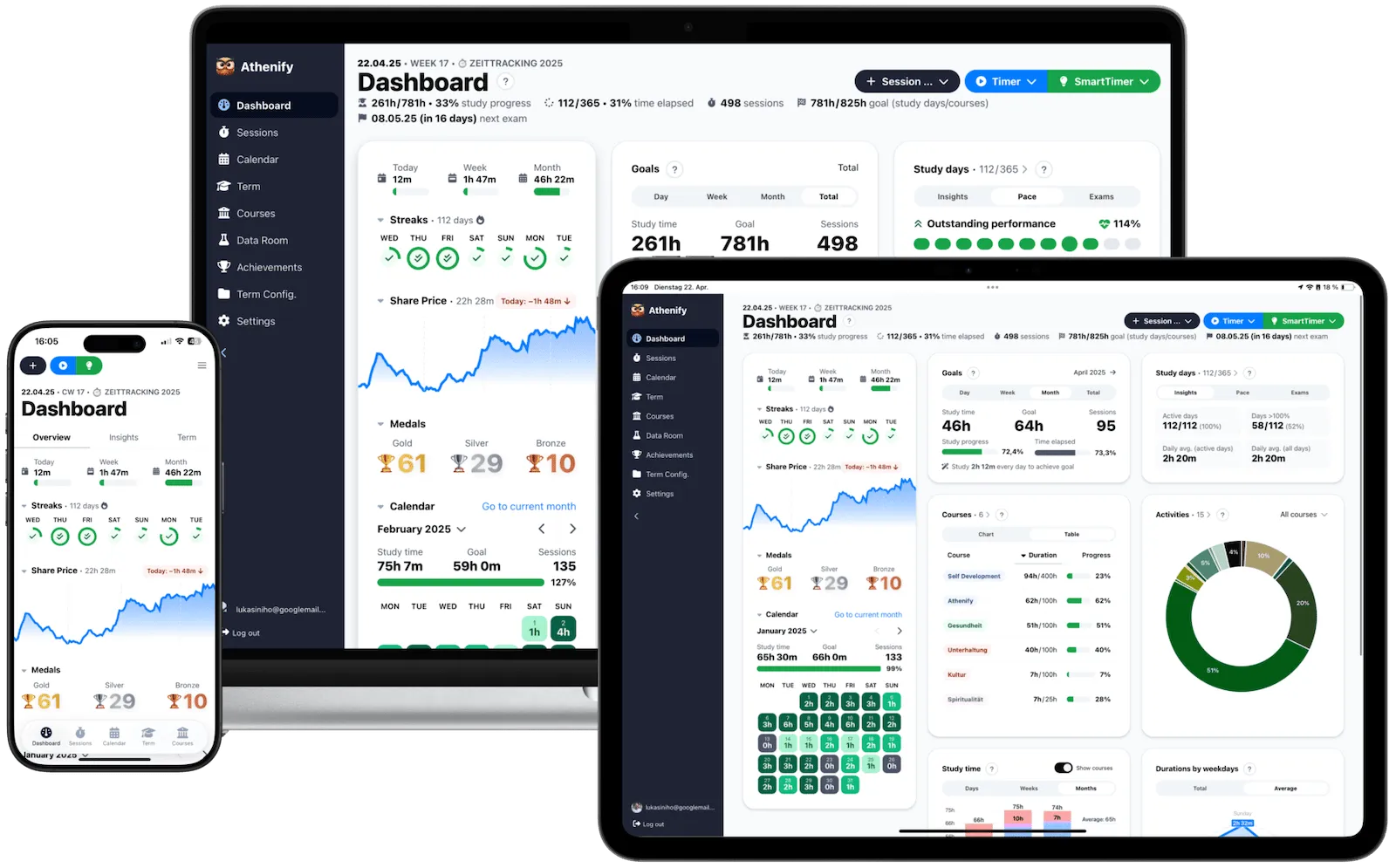
Track your 500+ hours of bar prep by subject, monitor your MBE accuracy trends, and stay accountable over 10–12 weeks with daily goals and progress visualization.
No credit card required.
No credit card required.
Commercial bar prep vs. self-study
The case for commercial courses
Commercial bar prep courses (Barbri, Themis, Kaplan, Quimbee) offer substantial advantages that justify their cost for most candidates. A structured curriculum with daily assignments eliminates decision fatigue – you know exactly what to study each day without spending mental energy planning. The comprehensive materials include outlines, lectures, and practice questions for all subjects, ensuring you don't miss critical topics. Access to thousands of licensed NCBE questions provides authentic practice that third-party materials can't replicate. Essay grading from trained graders offers feedback on your writing that self-assessment simply cannot match. Some platforms feature adaptive learning that adjusts to your weaknesses, directing your attention where it's most needed. And peer comparison features let you see how your progress compares to other students, providing valuable context for your performance.
Costs: $2,000–$4,000 for full courses; $500–$1,500 for self-paced options
The case for self-study
Self-study can work, but only for a specific type of candidate. You need strong self-discipline and time management skills – the kind that got you through law school without external structure. Having performed well in law school (top 25% of your class) suggests you have the foundational knowledge and study skills to succeed independently. You must be able to source quality practice materials on your own, which requires research and sometimes significant expense anyway. And prior experience with self-directed high-stakes exam prep – perhaps the LSAT or another professional certification – demonstrates you can maintain focus and accountability over months of solitary work.
The risks of self-study are significant. You might miss critical topics that commercial courses explicitly highlight as high-yield. Your practice question volume will likely be insufficient without access to large question banks. You'll receive no feedback on essay writing, leaving blind spots unaddressed. And the isolation and motivation challenges of solo preparation cause many self-study candidates to fall behind schedule without realising it until too late.
How Athenify complements commercial prep
Commercial courses tell you what to study. Athenify helps you track whether you're actually doing it – and the gap between intention and execution is where most bar prep failures originate.
Create categories for each MBE subject plus MEE-only topics to track time by subject. After 3–4 weeks, your data reveals whether your actual time allocation matches your intended allocation. Most students discover they're overweighting comfortable subjects (Contracts feels productive because you understand it) and underweighting difficult ones (Evidence is frustrating, so you avoid it). This insight alone can redirect your preparation before imbalances become entrenched.
Bar prep rewards consistent daily effort over sporadic cramming, making daily consistency monitoring essential. Athenify's streak feature keeps you accountable to your daily goals in a way that willpower alone cannot. Missing one day is recoverable; missing three in a row derails momentum and makes the fourth day feel impossible.
After tracking for two weeks, you'll identify your peak study times through clear patterns in your data. Do you answer MBE questions more accurately in the morning or afternoon? Does your essay writing quality decline after 4 PM? Use this information to schedule your hardest tasks during peak hours and save administrative work for energy troughs.
Perhaps most importantly, Athenify maintains motivation through visibility. 500 hours of studying feels abstract and insurmountable at the beginning. But watching your logged hours climb – 100, 200, 300 – provides tangible proof of progress. When motivation wanes in Week 6 (and it will), your data shows you're already halfway there, transforming an abstract goal into a concrete achievement you're building day by day.
For a deeper exploration of how tracking enables deep work, see our guide on the practice of focused, distraction-free study sessions.
MBE mastery: practice question strategy
The MBE demands volume. There's no substitute for completing thousands of practice questions.
Question volume targets
| Timeline | Weekly Questions | Total Questions |
|---|---|---|
| Weeks 1–3 | 300–350 | 900–1,050 |
| Weeks 4–6 | 500–600 | 1,500–1,800 |
| Weeks 7–8 | 400–500 | 800–1,000 |
| Weeks 9–10 | 200–300 | 400–600 |
| Total | – | 3,000–4,000 |
The first 1,000 questions teach you the format. The next 1,000 build speed. The final 1,000 develop the pattern recognition that separates passing from failing.
The review process
Completing questions without thorough review builds bad habits rather than skills. For every hour of practice questions, spend 30–45 minutes reviewing – this ratio may feel excessive, but it's where the actual learning happens.
For each missed question, work through a systematic analysis. First, identify the legal issue being tested – was it hearsay, personal jurisdiction, or something else entirely? Then re-read the correct rule in your outline, reinforcing the proper statement of law. Understand specifically why your answer was wrong: did you misstate the rule, misread the facts, or get attracted to a cleverly worded distractor? Finally, note the question type and rule in an error log that you review weekly to identify patterns in your mistakes.
For questions you guessed correctly, review anyway. Lucky guesses mask knowledge gaps that will surface on exam day when luck runs out. Confirm that you actually understood the rule rather than simply eliminating wrong answers through process of elimination. If you can't articulate why the correct answer is correct, you didn't really know it – and the next question on that topic will expose the gap.
Subject-specific MBE tips
Evidence: Hearsay questions dominate. Master the hearsay definition, all exceptions, and the FRE 403 balancing test. Character evidence rules appear frequently – know when character is admissible and in what form.
Civil Procedure: Personal jurisdiction and summary judgment questions are high-yield. Know Erie doctrine inside and out. Claim and issue preclusion appear in approximately 3–4 questions per exam.
Constitutional Law: Individual rights questions (1st, 4th, 5th, 14th Amendments) dominate. Master the levels of scrutiny and when each applies. Commerce Clause and state action doctrine are reliable question sources.
Contracts: UCC Article 2 vs. Common Law differences generate many questions. Know the statute of frauds exceptions cold. Parol evidence rule questions require careful analysis.
Criminal Law & Procedure: Homicide distinctions (murder vs. manslaughter degrees) are heavily tested. 4th Amendment search and seizure appears in almost every exam. Miranda and its exceptions are reliable content.
Property: Future interests and RAP remain tested despite being rarely encountered in practice. Landlord-tenant law and easements are high-frequency topics. Recording acts require precise analysis.
Torts: Negligence per se and comparative/contributory negligence questions appear constantly. Know strict liability triggers. Intentional torts require element-by-element analysis.
Essay excellence: MEE strategy
The 30-minute essay timeline
| Phase | Time | Activity |
|---|---|---|
| Read & analyze | 5 min | Read fact pattern; identify all issues |
| Outline | 5 min | Structure your IRAC for each issue |
| Write | 18 min | Draft your answer |
| Review | 2 min | Check for missed issues; fix obvious errors |
This timeline is tight. Practice until 30 minutes feels comfortable – then you'll have buffer for difficult questions on exam day.
IRAC execution
Issue: State the legal question precisely. "The issue is whether the defendant's confession was voluntary under the Fifth Amendment" is better than "The issue is the confession."
Rule: State the governing rule accurately and completely. Include elements, standards, and any relevant exceptions. This is where memorization matters – graders look for specific rule statements.
Application: Apply each element to the specific facts. Don't just restate facts – analyze them. "Because the defendant was questioned for 18 hours without food or sleep, a court would likely find that the confession was coerced" demonstrates analysis.
Conclusion: Answer the question asked. Be definitive when the facts support it; acknowledge uncertainty when reasonable people could disagree.
Practice essay targets
| Week | Essays Written | Focus |
|---|---|---|
| 1–3 | 5–10 | Untimed; focus on rule statements |
| 4–5 | 10–15 | Timed (35 min); improve speed |
| 6–7 | 10–15 | Strictly timed (30 min); simulate pressure |
| 8–10 | 10–15 | Full exam simulations; mixed subjects |
| Total | 35–50 | – |
Submit essays for grading through your commercial prep course. Self-grading misses blind spots – you need external feedback to identify weaknesses in rule statements, organization, and analysis depth.
MPT performance: practical skills
The 90-minute MPT timeline
| Phase | Time | Activity |
|---|---|---|
| Read task memo | 5 min | Understand exactly what you're producing |
| Skim Library | 15 min | Extract relevant rules and standards |
| Analyze File | 15 min | Organize facts by legal issue |
| Outline | 10 min | Structure your document |
| Write | 40 min | Draft your response |
| Review | 5 min | Check format compliance; fix errors |
Common MPT pitfalls
Ignoring format instructions: If the task says "draft a persuasive brief," don't write an objective memo. If it says "use the attached format," use that exact format.
Over-reading the Library: You don't need to understand every nuance of the provided cases. Extract the holdings and move on.
Missing File facts: The File often contains facts buried in deposition transcripts or correspondence. Read carefully – missing a key fact can derail your analysis.
Poor time management: Students who spend 50 minutes reading and only 35 minutes writing produce incomplete answers. Trust your reading – start writing earlier.
MPT practice schedule
Practice 8–12 MPTs before your exam:
- Weeks 5–6: 2 MPTs (untimed, focus on format and organization)
- Weeks 7–8: 4 MPTs (timed at 100 minutes, building speed)
- Weeks 9–10: 2–4 MPTs (strictly timed at 90 minutes)
Mental health and burnout prevention
Bar prep is a marathon that many treat like a sprint. Burnout – characterized by exhaustion, cynicism, and reduced effectiveness – derails more bar exam attempts than lack of ability.
Sustainable study practices
Even during intensive prep, protect one day weekly by taking a half or full day completely off from bar materials. Mental recovery isn't optional or a sign of weakness – it's physiologically necessary for memory consolidation. Your brain processes and organises information during rest, and denying it that opportunity undermines the studying you've done.
Exercise daily for at least 30 minutes. Physical activity improves cognitive function, reduces anxiety, and improves sleep quality. A 30-minute run isn't "time away from studying" – it's study optimisation. The mental clarity you gain in the hours after exercise more than compensates for the time invested.
Complete isolation for 10 weeks increases anxiety and reduces motivation, so maintain social connections throughout your preparation. Schedule brief social activities – dinner with friends, phone calls with family – to maintain psychological balance. These aren't distractions from your goal; they're essential support structures that keep you functional.
Sleep 7–8 hours minimum, without exception. Sleep deprivation reduces learning efficiency by 30–40%, meaning an 8-hour sleep followed by 7 hours of study beats a 5-hour sleep followed by 10 hours of diminished-quality study. The math is unambiguous: cutting sleep to gain study hours is a losing trade.
For detailed strategies on managing study anxiety, our guide on overcoming test anxiety covers evidence-based techniques that apply directly to bar prep.
Recognizing burnout
Watch for warning signs that indicate you need to adjust your approach. Declining MBE accuracy despite continued practice suggests your brain is no longer absorbing information effectively. Inability to focus for more than 30–40 minutes, when you previously managed 90-minute sessions, indicates cognitive exhaustion. Persistent fatigue that sleep doesn't resolve points to accumulated stress that rest alone won't fix. Increasing irritability or emotional volatility – snapping at loved ones, crying over small setbacks – reveals that your psychological reserves are depleted. And dreading study sessions you previously tolerated, or even enjoyed, suggests you've pushed past sustainable limits.
If you experience these symptoms, take 2–3 days completely off from bar prep. Don't study "just a little" or review flashcards casually. Do something genuinely restorative. The hours you lose to rest will be recovered – and then some – through improved efficiency when you return.
The goal isn't maximum hours. The goal is maximum effective hours. Burned-out studying produces burned-out results.
The Pomodoro Technique for bar prep
The Pomodoro Technique – 25 minutes of focused work followed by 5-minute breaks – helps maintain concentration during long study days.
Bar prep Pomodoro structure:
- 4 Pomodoros (2 hours) → 15-minute break
- 8 Pomodoros (4 hours) → 30-minute lunch break
- 4 more Pomodoros (2 hours) → 15-minute break
- 4 final Pomodoros (2 hours) → done for the day
This structure produces 8 hours of tracked, focused study time with adequate recovery. Track your Pomodoros in Athenify to ensure you're actually completing the sessions you intend.
Final week strategy
The week before your exam requires careful calibration between maintaining sharpness and avoiding exhaustion.
Final week schedule
| Day | Activity | Hours |
|---|---|---|
| 7 days out | 50 MBE questions + rule review | 5–6 |
| 6 days out | 2 timed essays + MBE weak subjects | 5–6 |
| 5 days out | Light MBE (25 Qs) + outline review | 4–5 |
| 4 days out | 1 MPT + flashcard review | 4–5 |
| 3 days out | Rule review only – no practice Qs | 3–4 |
| 2 days out | Very light review + logistics prep | 2–3 |
| 1 day out | Complete rest – no studying | 0 |
Logistics preparation
Three days before your exam, handle all administrative details so they don't create stress later. Confirm your testing location and the exact route you'll take – drive it if possible to identify parking and potential delays. Check the admission requirements for your jurisdiction, ensuring your ID is current and your admission ticket is printed. Review the list of permitted items (analog watch, pens, pencils) and prohibited items (phones, smart watches, certain calculator types) so there are no surprises at check-in.
One day before the exam, prepare everything you'll bring and lay it out visibly. Set multiple alarms on different devices – this is not the morning to oversleep. Eat a normal dinner with foods your body knows how to process; experimenting with new cuisine the night before a high-stakes exam is unnecessarily risky. And get 8+ hours of sleep, even if anxiety makes falling asleep difficult. Lying in bed with your eyes closed still provides rest, even without deep sleep.
Bar exam day execution
Day 1: MEE and MPT
Arrive 45 minutes early for the morning MEE session to handle check-in calmly and settle into your seat without rushing. Bring water and snacks for the break – your brain needs fuel, and you won't want to hunt for vending machines. As you work through the six essays, read each call carefully before the fact pattern so you know what legal issues to look for as you read the facts. Allocate time strictly at 30 minutes per essay with no exceptions; finishing one essay "perfectly" while leaving another blank is a losing strategy. If you get stuck on one essay, move to the next and return with whatever time remains at the end.
For the afternoon MPT, eat a moderate lunch with protein and complex carbohydrates – not heavy foods that will make you sluggish. Start each MPT by reading the task memo to understand exactly what you're producing before diving into the Library and File. Don't overthink; the MPT tests competency, not brilliance, and a complete adequate answer beats an incomplete excellent one. Watch your time ruthlessly – incomplete answers score poorly regardless of the quality of what you did write.
Day 2: MBE
During the morning session of 100 questions over 3 hours, budget approximately 1:48 per question, but don't obsess over individual timing. Mark difficult questions with a flag and return to them rather than getting stuck. If you don't know an answer, eliminate what you can and make an educated guess – then move on without looking back. Don't let one confusing question affect your approach to the next; each question is independent.
The afternoon session brings another 100 questions in 3 hours. Maintain the same pace you established in the morning, resisting the urge to either rush or slow down. Fatigue is normal and universal – everyone feels it by hour five, so your task is to execute despite the fatigue, not to eliminate it. Trust your preparation and the pattern recognition you've built over thousands of practice questions. Answer every question before time expires, as there's no penalty for guessing.
On exam day, you're not learning new law. You're executing the skills you've built over 10 weeks and 500 hours. Trust the process.
What to do if you don't pass
Approximately 20–25% of first-time takers don't pass. If you're in this group, you're not alone – and your legal career isn't over.
Immediate steps
The first 2–3 weeks after failing should be spent completely away from bar materials. This isn't avoidance – it's necessary recovery. Process the disappointment, because it's real and valid; you invested months of your life and didn't get the result you worked for. Don't make major decisions about your career or your next attempt while emotions are raw. Give yourself permission to feel frustrated, sad, or angry before shifting into analytical mode.
Once you've had some distance, analyse your results systematically. Request your score breakdown, which is available in most jurisdictions and reveals exactly where you fell short. Identify which components failed – was it the MBE, the essays, the MPT, or some combination? Compare your score to the passing threshold to understand how close you were. A candidate who missed by 5 points needs a different retake strategy than one who missed by 25.
Retake strategy
The lower repeat-taker pass rate reflects two groups: those who didn't prepare adequately the first time and simply repeat the same approach, and those who address their specific weaknesses systematically. Be in the second group.
If your MBE was weak, your retake preparation should centre on completing 1,500–2,000 additional practice questions with thorough review of every error. Focus disproportionately on your lowest-scoring subjects rather than spreading effort evenly. Consider MBE-specific supplemental courses that drill question-answering technique rather than just reviewing substantive law.
If your essays were weak, write 30+ additional practice essays and get grading feedback on each one – self-assessment won't identify your blind spots. Focus heavily on rule memorisation, because essays require precise rule statements that you must reproduce from memory under time pressure. Practice outlining separately from writing to improve your issue-spotting speed; many weak essay scores reflect missed issues rather than poor analysis.
If your MPT was weak, complete 10+ additional MPT practices under timed conditions. Focus specifically on time management and format compliance, as these are the most common MPT failure points. Read model answers carefully to understand what graders expect – many candidates produce adequate legal analysis but fail to deliver it in the requested format.
Timeline for retake
Most jurisdictions offer the bar exam twice yearly (February and July). If you fail in July, the February exam gives you 5–6 months to prepare. This timeline allows for:
- 1 month recovery and analysis
- 3–4 months targeted preparation
- 1 month intensive practice
Don't rush to retake. A well-prepared February attempt beats a poorly-prepared one. Track your retake hours in Athenify separately – you'll want to compare your preparation volume to your first attempt.
Conclusion: from law student to licensed attorney
The bar exam is conquerable. It's not a test of brilliance or natural ability. It's a test of systematic preparation, consistent effort, and strategic execution.
The proven formula requires committing adequate hours – 400–600 over 10–12 weeks – with no shortcuts. Use quality materials, typically a commercial course supplemented by extensive practice questions from official sources. Track every session using Athenify to ensure accountability and honest measurement of your preparation. Allocate time strategically, directing 50–60% toward MBE subjects, 25–30% toward essays, and 15–20% toward the MPT based on your diagnostic performance. Practice under exam conditions with strict timing in a simulated environment, because untimed practice doesn't prepare you for test-day pressure. Maintain your wellbeing through adequate sleep, regular exercise, and protected rest days, recognising that sustainable preparation beats burnout-inducing intensity. And on exam day, trust your preparation – the time for second-guessing is past.
The path from law school to bar passage is well-traveled. Thousands of people complete it every year – many with less preparation time, less academic background, or less support than you have.
Set up your Athenify categories today: MBE subjects, MEE-only subjects, practice tests, essay writing. Set your 500-hour goal. Log your first session. Watch your preparation accumulate into the confidence that carries you through exam day.
Every licensed attorney passed the bar exam. They weren't born lawyers – they prepared systematically and executed effectively. You can do the same.
The bar exam is the last academic hurdle of your legal education. On the other side: your career, your clients, and the practice of law you've spent years preparing to enter.
Start your preparation today.