


Why most study schedules fail
Most study schedules collapse within the first week, and discipline is almost never the real issue. The root cause is almost always an unrealistic plan. Students sit down on Sunday evening, divide their waking hours into color-coded study blocks, and commit to a 40-hour study week. By Tuesday, the plan has collapsed. The problem is not willpower; it is that the schedule was built on fantasy rather than data. Without tracking how your time is actually spent, you are guessing at capacity -- and most people guess high.
The best study schedule is not the most ambitious one — it is the one you can actually follow.
The second failure mode is the "set and forget" mentality. A schedule is not a static artifact you create once and follow forever. Your life changes week to week: assignment deadlines shift, social obligations arise, energy levels fluctuate. A schedule that does not adapt to these realities is a schedule that breaks. The students who succeed treat their schedule as a living document, reviewed and revised every week based on what actually happened -- not what they wished had happened. If you are starting from scratch, our guide on how to create a study schedule walks you through the entire process step by step.
The third and most insidious problem is the absence of feedback. Without tracking your actual study hours, you have no way to know whether your schedule is working. You cannot improve what you do not measure. Many students believe they studied "all day" when the actual focused time was under two hours. This self-deception perpetuates ineffective schedules because the student never confronts the gap between intention and reality.
The science of time blocking
Picture your calendar with every study session pre-assigned: "Chemistry from 9 to 11 AM, Literature essay from 1 to 3 PM." That is time blocking—assigning specific tasks to specific time slots instead of maintaining a vague to-do list and hoping for the best. Cal Newport, author of Deep Work, argues that time blocking is the single most effective productivity technique available because it eliminates the constant decision-making about what to work on next -- what researchers call decision fatigue.
Decision fatigue is well-documented in cognitive psychology. Every time you ask yourself "What should I study now?", you expend mental resources that could be directed toward actual learning. A study published in the Journal of Personality and Social Psychology demonstrated that people who made fewer decisions throughout the day performed significantly better on tasks requiring concentration and self-control. Time blocking frontloads all scheduling decisions to one planning session, freeing your cognitive resources for the work itself.
For students, time blocking has an additional benefit: it makes deep focus possible. When you know exactly what you are working on and for how long, there is no ambiguity. You can close unnecessary tabs, silence your phone, and commit fully to the task at hand. Research suggests that it takes approximately 23 minutes to regain full focus after a distraction, so the protected boundaries that time blocking creates are essential for genuine deep work. Start with 90-minute blocks separated by 15-minute breaks for optimal results.
How to audit your real available time
The time audit is the most important -- and most humbling -- step in the scheduling process. Before you can build anything, you need an honest picture of where your time actually goes. For one full week, track every activity in 30-minute increments. Do not change your behavior; simply observe and record. Include everything: classes, commuting, meals, scrolling social media, watching Netflix, socializing, sleeping, errands, and actual study time.
Before building any schedule, track how you actually spend your time for one full week. Most students discover they have 2 to 3 more available hours than they thought — and waste 1 to 2 hours daily on unplanned distractions.
At the end of the week, categorize your hours into three buckets: fixed obligations (classes, work, commute, sleep), maintenance (meals, hygiene, chores, errands), and discretionary time (everything else). Your true available study time comes from the discretionary bucket -- and it is almost always smaller than you expected. A full-time student with a part-time job might discover they have only 20--25 discretionary hours per week, not the 40+ they imagined. Understanding how many hours you should study per day helps you set targets that match your real capacity.
This baseline week gives you the data foundation for a realistic schedule. When you know that Monday afternoons are consistently lost to errands, you stop scheduling study blocks there. When you see that your most productive hours are weekday mornings, you protect those slots fiercely. The audit transforms scheduling from guesswork into engineering -- and the resulting schedule is one you can actually follow because it is built on evidence, not aspiration. For those managing a job alongside coursework, our article on how to study while working full time shows how to find realistic windows in even the busiest weeks. Use Athenify's time tracking to make this audit effortless.
Energy management vs time management
An hour of studying at 9 AM when you are fresh produces dramatically more learning than an hour at 11 PM when you are exhausted. Yet most study schedules treat every hour as interchangeable, distributing work evenly across the day without considering the student's cognitive state. This is a fundamental mistake. Effective scheduling requires managing energy, not just time.
Your chronotype determines your peak cognitive hours. Morning types perform best from 8 AM to noon; evening types peak from 4 PM to 8 PM. Schedule your hardest material during your biological prime time for maximum retention.
Chronobiology research identifies distinct chronotypes -- individual patterns of alertness and fatigue across the day. While most students experience peak cognitive performance 2--4 hours after waking (making mid-morning ideal for challenging material), some are genuinely more alert in the evening. The only way to know your pattern is to track it. Pay attention to when you feel sharpest and when your concentration falters, then design your schedule accordingly.
Beyond daily chronotype, your brain operates in ultradian rhythms -- roughly 90-minute cycles of higher and lower alertness. This is why studying for 90 minutes followed by a 15--20 minute break often feels more sustainable than pushing through for three hours straight. These natural cycles also explain why some study sessions feel effortless while others are a slog. Align your schedule with these rhythms: tackle your most demanding subjects during peak alertness windows, and reserve review, note organization, and administrative tasks for the natural dips between cycles.
Common scheduling mistakes students make
One of the most expensive mistakes? Giving every subject the same number of hours. Not all subjects require the same effort. A course you find intuitive might need half the study time of one that challenges you deeply. Your schedule should weight time by difficulty, upcoming deadlines, and the grade impact of each exam -- and knowing how long to study for an exam gives you a concrete starting point. Spending three hours reviewing material you already know while neglecting a subject you are struggling with is a misallocation that shows up directly in your GPA.
Failing to build buffer time into your schedule leads to cascading failures. One delayed task pushes everything back, creating stress and missed deadlines. Build 20% buffer into every week — it is not wasted time, it is insurance.
The second trap is leaving no buffer time. Schedules that account for every minute look impressive on paper but shatter at the first disruption. A friend calls, a lecture runs late, you feel unwell -- and suddenly the entire week's plan cascades into failure. Build in at least 20--30% buffer by leaving gaps between study blocks. These buffers absorb the inevitable disruptions without derailing your overall plan, and on the rare week when nothing goes wrong, you get bonus study time.
Perhaps the most damaging mistake is never tracking actual hours, because it blocks all improvement. Without data, you cannot identify what is working and what is not. You repeat the same broken schedule week after week, blaming yourself for lacking discipline when the real problem is a poorly designed plan. Tracking closes the feedback loop: you see exactly how many hours you studied, which subjects got attention, and where time was lost. This information is the raw material for every meaningful schedule improvement.
Advanced scheduling: the weekly review system
Set aside 20--30 minutes every Sunday. That half-hour separates students whose schedules actually improve from those who repeat the same failing plan indefinitely. The weekly review is the mechanism through which your schedule adapts over time -- skip it, and you are essentially rerunning a broken experiment each week.
The review process has three phases. First, compare planned vs actual: look at what you intended to study and what you actually studied. Calculate your completion rate for each subject. If you planned 10 hours of Chemistry and tracked 6, that is a 60% completion rate -- useful data. Second, identify patterns: did you skip the same time slots consistently? Did certain subjects always get less time than planned? Were there days that worked well every week? These patterns reveal structural issues in your schedule that willpower alone cannot fix.
Third, adjust and recommit. Based on your analysis, modify next week's schedule. Move study blocks that consistently fail to times that consistently work. Reduce hours for subjects where you are ahead and increase them where you are behind. Set specific, measurable goals for the coming week -- not "study more Chemistry" but "complete 4 hours of Chemistry problem sets by Thursday." If you are juggling several tests at once, our guide on studying for multiple exams at once offers a prioritization framework that pairs well with this review process. This iterative approach means your schedule gets better every week, converging on a plan that genuinely fits your life and exam preparation needs.
How Athenify makes scheduling work
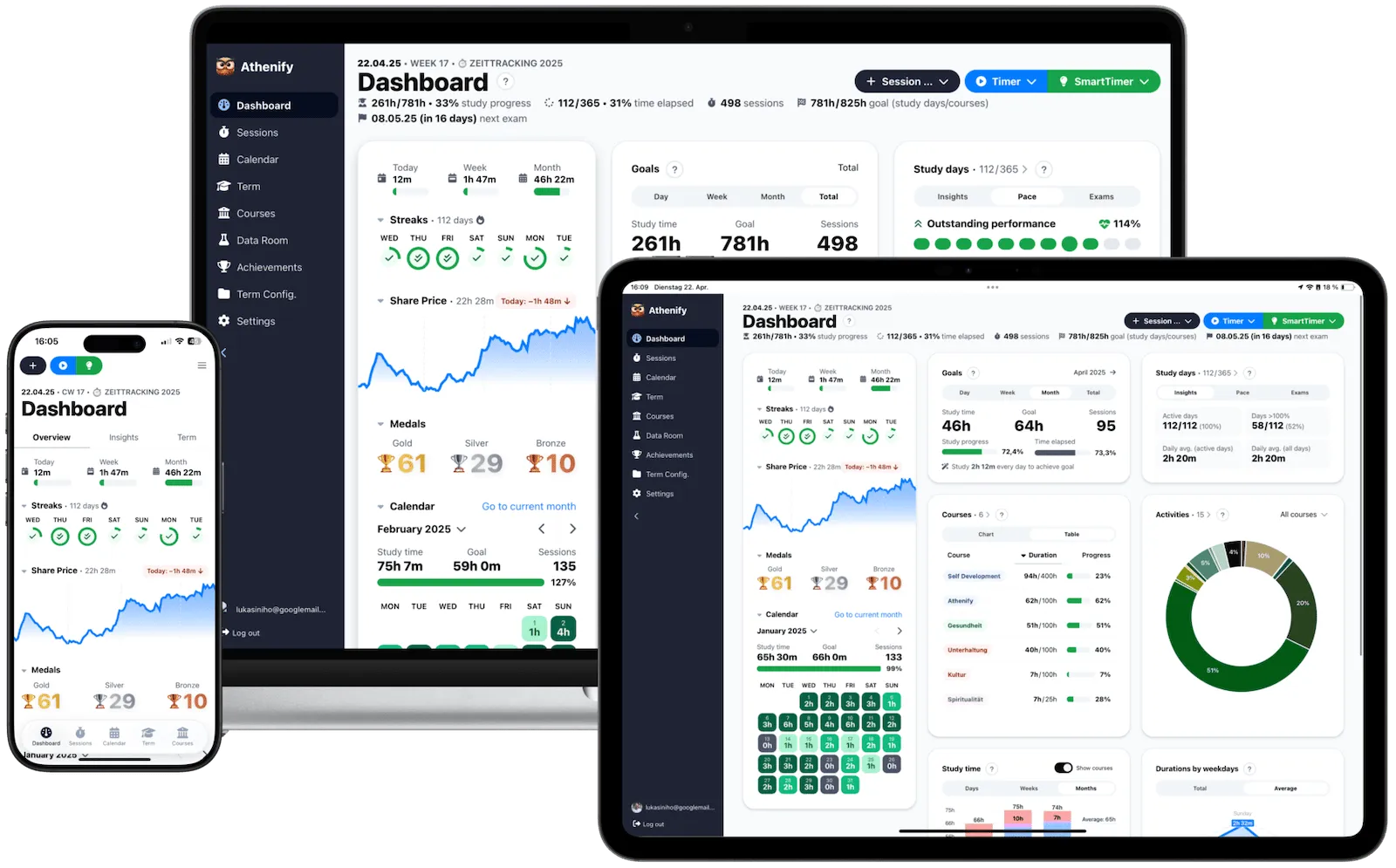
Every failure mode described above -- unrealistic targets, missing data, no feedback loop -- is something Athenify was designed to eliminate. The Exam Planner lets you input your exam dates and target grades, then calculates the daily study requirements for each subject. Instead of guessing how much time you need, you get data-driven targets that account for difficulty and deadline proximity. The Magic Prediction feature uses your tracked study patterns to forecast whether you are on pace for your goals -- giving you early warnings when you are falling behind, not after it is too late.
The built-in study timer integrates directly with your schedule. Start a timer, and every minute is automatically logged to the correct subject. At the end of the week, your dashboard shows planned hours vs actual hours for every subject -- the exact data you need for your Sunday review. This seamless connection between planning, execution, and review eliminates the friction that causes most scheduling systems to break down. Combined with streak tracking and progress visualization, Athenify transforms scheduling from a chore into a rewarding feedback loop that improves your results every week.
Getting started with your first schedule
Your first schedule should be embarrassingly simple. This week, commit to just three actions: (1) run a time audit by tracking everything you do for 7 days using Athenify's tracker, (2) identify your three most consistent free time blocks, and (3) schedule one subject per block with a specific goal. That is your starter schedule -- deliberately modest, highly achievable.
Next Sunday, review what happened. Did you complete all three blocks? If yes, add one more block the following week. If not, figure out why and adjust. Repeat this weekly cycle, gradually building up to a full schedule that covers all your subjects with appropriate time weightings. Within a month, you will have a personalized, battle-tested schedule that reflects your real life -- not someone else's ideal. The students who follow this incremental approach consistently outperform those who try to build the "perfect" schedule from day one, because they build on evidence instead of ambition. Start today, and let the data guide you to a schedule that actually works.
Try Athenify for free
Build your perfect study schedule with Athenify
No credit card required.
No credit card required.