Evidence-based study methods
The science of studying: 11 evidence-based methods
You track your steps, your sleep, your calories – but what about your study time? Research clearly shows: Those who understand the science behind learning and track their study time learn more effectively.


The power of the game
Gamification
Gamification uses game mechanics like achievements, accomplishments, and medals to motivate users. You may already know it from apps like Duolingo. Research shows gamification significantly increases motivation and engagement in educational contexts.
🏅 Achievements & Badges
Collect badges for reaching milestones – just like in Steam, Xbox Live, or PSN. Each achievement reinforces your progress and builds self-efficacy.
🔥 Streaks
The 'Don't break the chain' principle leverages loss aversion. Seeing your consecutive study days grow creates powerful motivation to continue.
🥇 Daily Medals
Earn bronze, silver, or gold medals for productive study days. This immediate feedback creates a positive reinforcement loop.
The power of habit
Quantified Self
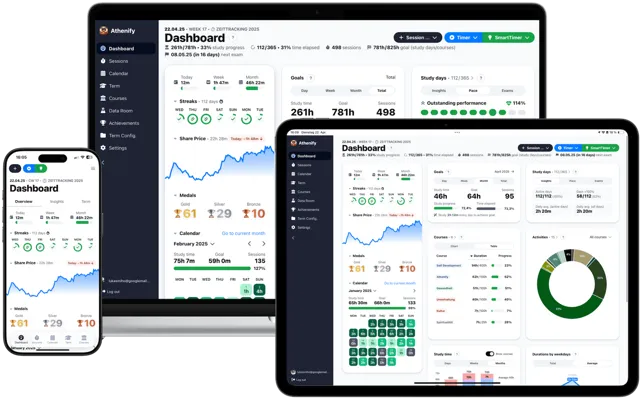
With digital tools like the Apple Watch and fitness trackers, measuring personal progress has never been easier. Athenify brings Quantified Self to learning – because what gets measured, gets managed.
📊 Complete Tracking
Keep a complete record of your entire semester. Every session is documented, giving you an honest picture of your net study time.
📈 Beautiful Statistics
Daily, weekly, and semester views help you understand your patterns. See which subjects need more attention and when you're most productive.
💡 Actionable Insights
The Share Price visualizes your cumulative over- or under-achievement. Know at a glance whether you're on track to reach your goals.
The power of observation
Self-monitoring & reactivity
Psychological research reveals a fascinating phenomenon: Simply observing a behavior changes that behavior. When you know you're tracking your study time, you automatically study more and with more focus.
⚡ The Reactivity Effect
A meta-analysis across 138 studies with nearly 20,000 participants confirmed that progress monitoring significantly improves goal attainment.
🎯 Increased Awareness
The running timer becomes a gentle reminder to stay on task. You transform from a passive learner to an active pilot of your learning process.
The power of routine
Habit formation
Habits follow a simple pattern: Cue → Routine → Reward. Study time tracking utilizes all three elements, helping you build automatic study behaviors that stick.
🔄 The Habit Loop
Open the app (cue), start the timer and study (routine), watch your streak grow (reward). This cycle, repeated consistently, builds lasting habits.
📅 Consistency Over Intensity
Research shows that performing behavior in a stable context (same time, same place) is more important than intensity. Regular short sessions beat occasional marathons.
Each concept is backed by peer-reviewed studies
11 evidence-based concepts
| # | Concept | Key Takeaway |
|---|---|---|
| 1 | Best Time to Study | 10 AM – 2 PM is peak learning time for most; match study to your chronotype |
| 2 | Metacognition | Tracking promotes reflection on your own learning process |
| 3 | What Gets Measured | Measurement enables management and optimization |
| 4 | Self-Monitoring | Simply observing your behavior improves it |
| 5 | Goal-Setting Theory | Specific goals lead to 10–25% better performance |
| 6 | Feedback Loops | Timely feedback enables adjustment and improvement |
| 7 | Self-Determination | Tracking strengthens autonomy and competence experience |
| 8 | Habit Formation | Streaks leverage the mechanisms of habit building (66 days average) |
| 9 | Spacing Effect | Distributed learning dramatically beats cramming (96% of studies) |
| 10 | Self-Efficacy | Documented successes strengthen belief in yourself |
| 11 | Time-on-Task | More active study time = more learning success |
Questions about the science behind Athenify