"How long do I need to study for this exam?" Every student asks this question before every test. The answers you get range from "a week is plenty" to "I've been studying for three months." But what's actually realistic? The answer depends on three factors: the scope of material, the exam format, and your prior knowledge. Without understanding how these factors interact, you're essentially guessing – and guessing usually means either panic-cramming at the end or wasting hours on material you've already mastered.

Most students overestimate their effective study time by 30–40%.
In this article, you'll get concrete hour estimates for different exam types – from university finals to standardized tests like the SATScholastic Assessment Test, LSATLaw School Admission Test, and MCATMedical College Admission Test. These recommendations draw on credit hour guidelines, empirical research, and practical experience from thousands of students who've walked this path before you. For a comprehensive approach to your test preparation, see our complete guide to exam preparation.
Understanding credit systems: Your first reference point
Universities around the world use credit systems to indicate expected workload. Understanding these systems gives you an official baseline for study time estimation.
United States: Credit hours
In the US, the credit hour is the standard unit. The Carnegie Unit definition states:
1 credit hour = 1 hour of instruction + 2–3 hours of outside work per week
For a 15-week semester, this means:
| Credits | In-Class Time | Outside Work | Total Semester Hours |
|---|---|---|---|
| 3 credits | 45 hours | 90–135 hours | 135–180 hours |
| 4 credits | 60 hours | 120–180 hours | 180–240 hours |
| 5 credits | 75 hours | 150–225 hours | 225–300 hours |
Other credit systems around the world
Canadian universities largely follow the US credit hour system, with most courses worth 3 credits for a single semester or 6 credits for a full year. The UK uses a different scale where 10 UK credits represent approximately 100 hours of total student effort – meaning a standard 20-credit module expects 200 hours of work, roughly equivalent to a 3-credit US course.
Australian universities typically assign 6 credit points to a standard unit, representing 150–180 hours of total work – again comparable to a 3–4 credit US course. Across Europe, the ECTSEuropean Credit Transfer System system assigns 1 ECTS credit for every 25–30 hours of student workload. A typical 6 ECTS course therefore expects 150–180 total hours, with exam preparation accounting for roughly 30–50 of those hours.
Regardless of which system your university uses, the underlying ratio is remarkably consistent: for every hour of instruction, expect 2–3 hours of independent work. This consistency means you can translate between systems and still arrive at realistic study estimates.
Time estimates by exam type
1. Regular university exam (3–4 US Credits / 6–7.5 ECTS)
This is the typical semester final in an introductory or intermediate course – the kind most students take four or five of each semester. The good news: if you've been reasonably engaged throughout the term, these exams are manageable with focused preparation.
Recommendation: 20–50 hours of pure exam preparation
The range is wide because your starting point matters enormously. A student who attended lectures, took decent notes, and reviewed material periodically might need just 15–25 hours to consolidate and practice. But someone who's been coasting – attending class but never opening the textbook outside of it – should plan for 25–40 hours to actually learn the material, not just review it.
| Starting Point | Hours Needed | Time Period |
|---|---|---|
| Attended class, took notes | 15–25 hours | 1–2 weeks |
| Attended class, didn't review | 25–40 hours | 2–3 weeks |
| Missed some classes | 40–60 hours | 3–4 weeks |
| Missed most classes | 60–80 hours | 4–5 weeks |
The "missed most classes" row deserves special attention. Students in this situation often think they can cram everything in a week. They can't. What a professor explained over 30 lecture hours cannot be self-taught in 10. If you're significantly behind, start early and be honest about the hole you're climbing out of.
2. Large/comprehensive exams (4–5 US Credits / 9–12 ECTS)
These are the courses that dominate your semester: Organic Chemistry, Calculus III, Constitutional Law, Anatomy & Physiology. High-credit courses with extensive content, common in STEMScience, Technology, Engineering, Mathematics, pre-law, and pre-med tracks. They're called "weed-out" courses for a reason – they separate students who can handle the workload from those who can't.
Recommendation: 50–100 hours of exam preparation
| Starting Point | Hours Needed | Time Period |
|---|---|---|
| Strong throughout semester | 40–60 hours | 3–4 weeks |
| Average engagement | 60–80 hours | 4–5 weeks |
| Significant catching up | 80–120 hours | 5–6 weeks |
The jump from 3-credit to 5-credit courses isn't just 67% more content – it's often a step up in complexity and integration. These exams don't just test whether you remember concepts; they test whether you can apply them to novel problems under time pressure. Budget time not just for learning, but for practice.
3. Graduate-level qualifying exams
PhD qualifying exams and comprehensive exams require a different scale entirely. These aren't tests of what you learned last semester – they're tests of whether you've internalized an entire field well enough to contribute to it.
Recommendation: 200–500 hours over 2–4 months
Most programs give students a reading list spanning dozens of books and hundreds of articles. The preparation feels less like studying and more like becoming a different person – someone who can speak fluently about decades of scholarship in their discipline. If you're facing quals, block off your calendar and treat preparation as a part-time job.
Qualifying exams test mastery of an entire field – not just one semester's material.
Standardized test preparation times
Standardized tests require a fundamentally different approach than course exams. You're not memorizing a semester's worth of lectures – you're building skills that take months to develop. The timeline stretches longer, but so does the payoff: a strong standardized test score can open doors that stay open for years.
SAT (College Admissions)
The SAT doesn't test what you learned in any particular class. It tests reading, writing, and math skills you've been developing since elementary school. That's both good news and bad news: good because you already have a foundation, bad because you can't cram your way to a higher score.
Recommendation: 40–200 hours over 2–4 months
The wide range reflects the law of diminishing returns. An above-average student aiming for a 50–100 point improvement might need just 40–80 hours of focused practice. An average student targeting 100–150 points should budget 80–120 hours. And if you're starting below average or need a major improvement of 150–200 points, plan for 120–200 hours of dedicated work.
Going from 1000 to 1100 is mostly about learning the test format and eliminating careless errors. Going from 1400 to 1500 requires mastering subtle distinctions and developing genuine speed. Each additional point gets harder to earn.
For a detailed SAT study plan, see our comprehensive guide: SAT Preparation: Time Management & Study Strategies.
LSAT (Law School Admissions)
The LSAT is unlike any test you've taken before. It doesn't test knowledge – it tests how you think. Logical reasoning, analytical reasoning (the infamous "logic games"), and dense reading comprehension. These are skills that improve with deliberate practice, which is why preparation takes months, not weeks.
Recommendation: 250–400 hours over 4–6 months
The hours scale with your target score. Students aiming for 155–160 typically need 150–250 hours over 3–4 months. Those targeting 160–165 should budget 250–350 hours over 4–5 months. For the competitive 165–170 range, expect 350–450 hours over 5–6 months. And breaking into the 170s – the threshold for T14 law schools – often requires 400–600+ hours over six months or more.
Students who invest 250–400 hours of focused LSAT preparation typically improve their scores by 10–15+ points.
The difference between a 160 and a 170 might seem like just ten points, but it's the difference between a regional law school and a T14. Students who break into the 170s typically treat LSAT prep like a part-time job – 20+ hours per week for months. It's an investment, but for those aiming at top schools, the return justifies the effort.
For a complete breakdown of LSAT preparation strategies, read our in-depth guide: LSAT Preparation: The Ultimate Study Schedule.
MCAT (Medical School Admissions)
The MCAT is a marathon disguised as a test. At 7.5 hours including breaks, it's one of the longest standardized exams in the world – and the content scope matches. Biology, chemistry, organic chemistry, biochemistry, physics, psychology, sociology, and critical reasoning. Most pre-med students spend an entire summer doing nothing but MCAT prep.
Recommendation: 300–500 hours over 4–6 months
A reasonable starting point is to divide your time equally among the four sections: Chemical & Physical Foundations, Critical Analysis & Reasoning Skills (CARS), Biological & Biochemical Foundations, and Psychological & Social Foundations. Each section deserves roughly 25% of your preparation time.
The key is diagnostic testing: take full-length practice exams early and often to identify where your hours will have the most impact. A 510+ score typically requires 300–500 hours of dedicated preparation – there's simply no shortcut when the exam covers this much ground.
For a complete MCAT study plan with week-by-week breakdowns, see: MCAT Preparation: The Complete Study Plan.
GMAT (Business School Admissions)
The GMATGraduate Management Admission Test tests quantitative reasoning, verbal reasoning, and integrated reasoning – a mix that rewards both analytical thinking and mental endurance. For many business school applicants, it's been years since they last took a standardized test, which means the learning curve includes relearning how to take tests at all.
Recommendation: 100–200 hours over 2–4 months
The hours required scale predictably with your target score. A 600–650 typically requires 80–120 hours of preparation. Reaching 650–700 demands 120–160 hours. The elite 700–750 range needs 160–220 hours, while breaking 750 often requires 200–300+ hours of dedicated practice.
The quantitative section trips up many applicants who haven't touched algebra or geometry since high school. If that's you, budget extra time for math fundamentals before diving into GMAT-specific strategies. The verbal section, meanwhile, rewards careful reading over speed – a shift from how most professionals process information in their daily work.
For detailed GMAT strategies, check out: GMAT Preparation: Time Management Guide.
GRE (Graduate School Admissions)
The GREGraduate Record Examination is the default admissions test for graduate programs outside of law, medicine, and business. It's generally considered more forgiving than the LSAT or MCAT, but that doesn't mean it's easy – especially the verbal section, which tests vocabulary at a level most native speakers find challenging.
Recommendation: 100–200 hours over 2–3 months
For non-native English speakers, the verbal section often requires 50% more preparation time than the quantitative section. Vocabulary can't be crammed; it needs to be absorbed through repeated exposure over weeks. If English isn't your first language, start with vocabulary work immediately and maintain it throughout your preparation.
For detailed GRE preparation strategies, see: GRE Preparation: Complete Study Plan.
CFA (Chartered Financial Analyst)
The CFAChartered Financial Analyst exams are among the most demanding professional certifications in finance. The program consists of three levels, each requiring extensive preparation. The breadth of material – covering ethics, quantitative methods, economics, financial reporting, corporate finance, portfolio management, and more – makes this a marathon, not a sprint.
Recommendation: 300–400 hours per level over 4–6 months
Most candidates spread their preparation across 4–6 months per level, studying 15–20 hours per week. The CFA Institute itself suggests a minimum of 300 hours per level, but candidates targeting a pass on the first attempt often invest closer to 400 hours. Given that pass rates hover around 40–50% for each level, thorough preparation isn't optional – it's essential.
For a complete breakdown of CFA preparation strategies, read: CFA Preparation: Study Plan & Time Management.
Quick reference: Standardized test comparison
| Test | Purpose | Hours Needed | Timeline | Key Challenge |
|---|---|---|---|---|
| SAT | College admission | 40–200 h | 2–4 months | Time management |
| ACTAmerican College Testing | College admission | 40–200 h | 2–4 months | Science section speed |
| LSAT | Law school | 250–400 h | 4–6 months | Logic games |
| MCAT | Medical school | 300–500 h | 4–6 months | Content volume |
| GMAT | Business school | 100–200 h | 2–4 months | Quantitative reasoning |
| GRE | Graduate school | 100–200 h | 2–3 months | Vocabulary |
| CFA | Finance certification | 300–400 h/level | 4–6 months/level | Breadth of material |
The factors behind the numbers
The hour estimates above are guidelines, not guarantees. Three factors determine whether you'll need more or less time than the baseline suggests.
Factor 1: Content scope and complexity
Not every exam is equally difficult. A 3-credit "Introduction to Philosophy" course requires different preparation than 3 credits of "Organic Chemistry II." The credit value tells you the expected workload, but the actual difficulty depends on the nature of the content.
| 🔴 High-effort indicators | 🟢 Lower-effort indicators |
|---|---|
| Heavy mathematical/formula content | Primarily comprehension-based questions |
| Extensive factual knowledge (pre-med, pre-law) | Multiple-choice format with limited options |
| Complex conceptual understanding required | Good study materials readily available |
| Application-based exams (case studies, problem sets) | Exams follow predictable patterns |
Courses with cumulative content – where each concept builds on the last – require more study time than courses with modular content you can learn in any order. If you're behind in a cumulative course, you can't just skip to the final chapters; you'll need to work through the foundations first.
Factor 2: Your starting point
Your baseline knowledge dramatically affects required study time. Two students sitting next to each other in the same exam might need vastly different preparation – not because one is smarter, but because one has been keeping up all semester while the other has been coasting.
Study time multipliers based on your starting point:
- Attended class, took notes, reviewed → Use baseline estimates (1x)
- Attended but never reviewed → Multiply by 1.3–1.5x
- Partial attendance → Multiply by 1.5–2x
- Rarely or never attended → Expect 2–3x the baseline hours
A professor who spent 45 minutes explaining a difficult concept did so because it requires 45 minutes of explanation. You won't absorb it faster on your own.
Be honest with yourself about where you stand. These multipliers might seem harsh, but they reflect reality: students who skip lectures consistently underestimate the catch-up required.
Factor 3: Exam format
The format determines not just how you should study, but how much uncertainty you're facing. Essay exams reward deep understanding of key themes; multiple choice exams demand broad coverage with attention to detail.
Study approach by exam format:
- Multiple choice – Requires broad coverage and repetition; don't underestimate the detail it tests
- Short answer – Demands deep understanding plus practice articulating concise responses
- Essay exams – Highest effort: mastering argumentation, practicing structure, building writing stamina
- Problem sets – Straightforward principle (practice, practice, practice) but time-consuming
- Oral exams – Tests knowledge plus articulation and quick thinking under social pressure
Many students make the mistake of thinking multiple choice is easier to prepare for. In practice, MC exams often test the kind of granular detail that essay exams let you gloss over. If you're facing a multiple choice final, don't assume you can skim – plan for thorough coverage of all material.
The math: Backward planning your exam prep
The most reliable way to plan exam preparation is to work backward from your exam date. This three-step process takes the guesswork out of scheduling. For detailed guidance on building your timeline, see our guide on creating a study schedule.
Step 1: Calculate available time
When is your exam? How many days until then? How many hours can you realistically study each day? Be honest – "realistic" means accounting for other classes, work, and the fact that you won't study productively for 12 hours straight.
For example, if your exam is in 21 days and you can realistically study 4 hours per day with 2 rest days per week, you have 18 available study days and approximately 72 total hours.
Step 2: Estimate content requirements
Break down the material into topics and estimate effort for each. Foundations might need 10 hours. Core content – the bulk of the exam – could require 25 hours. Advanced material another 15. Then add practice exams (15 hours) and final review (10 hours). In this example, you'd need roughly 75 hours total.
Step 3: Reality check
Compare required time to available time. If required exceeds available, you'll need to prioritize ruthlessly or increase daily hours. If they're roughly equal, it works – but add a buffer for safety. If required is less than available, use the extra time for additional practice problems and review.
Common planning mistakes
Even with good estimates, students sabotage their own preparation in predictable ways. The four mistakes that derail exam prep most often:
- Underestimating the material – Confusing familiarity with mastery
- Overestimating study time – What feels like 8 hours is often 4–5
- No time for review – One pass isn't enough for retention
- No buffer for the unexpected – Something always comes up
Mistake 1: Underestimating the material
"I can finish this in a week" – famous last words before every exam period.
When you flip through a textbook, the material looks manageable. But reading is not the same as understanding, and understanding is not the same as being able to apply concepts under exam pressure. Most students systematically underestimate content scope because they confuse familiarity with mastery. Add 30–50% to your initial time estimate – you'll almost certainly need it.
Mistake 2: Overestimating your study time
Research shows students overestimate their effective study time by 30–40%. What feels like "8 hours in the library" is often 4–5 hours of actual studying. The rest disappears into phone checks, conversations, snack breaks, and staring at the same paragraph for ten minutes without absorbing anything.
This isn't a character flaw – it's human nature. The solution isn't willpower; it's measurement. When you track your time honestly, you can plan based on reality instead of fantasy. Learn more about effective study time tracking to get accurate data on your actual productivity.
Mistake 3: No time for review
One pass through the material isn't enough. Memory research consistently shows that we forget most of what we learn within days unless we review it. The spacing effect – reviewing material at increasing intervals – is one of the most robust findings in cognitive psychology.
Plan at least 20–30% of your study time for review, and schedule it deliberately rather than hoping you'll "go over everything" the night before.
Mistake 4: No buffer for the unexpected
Illness, family obligations, technical problems, that group project that suddenly requires twice as much work as planned – something always comes up. Students who schedule every hour of their preparation leave no room for life to interfere. A 20% buffer protects against nasty surprises and gives you flexibility to adjust when your initial estimates prove wrong (and they will).
Putting it into practice
Using Athenify for exam preparation
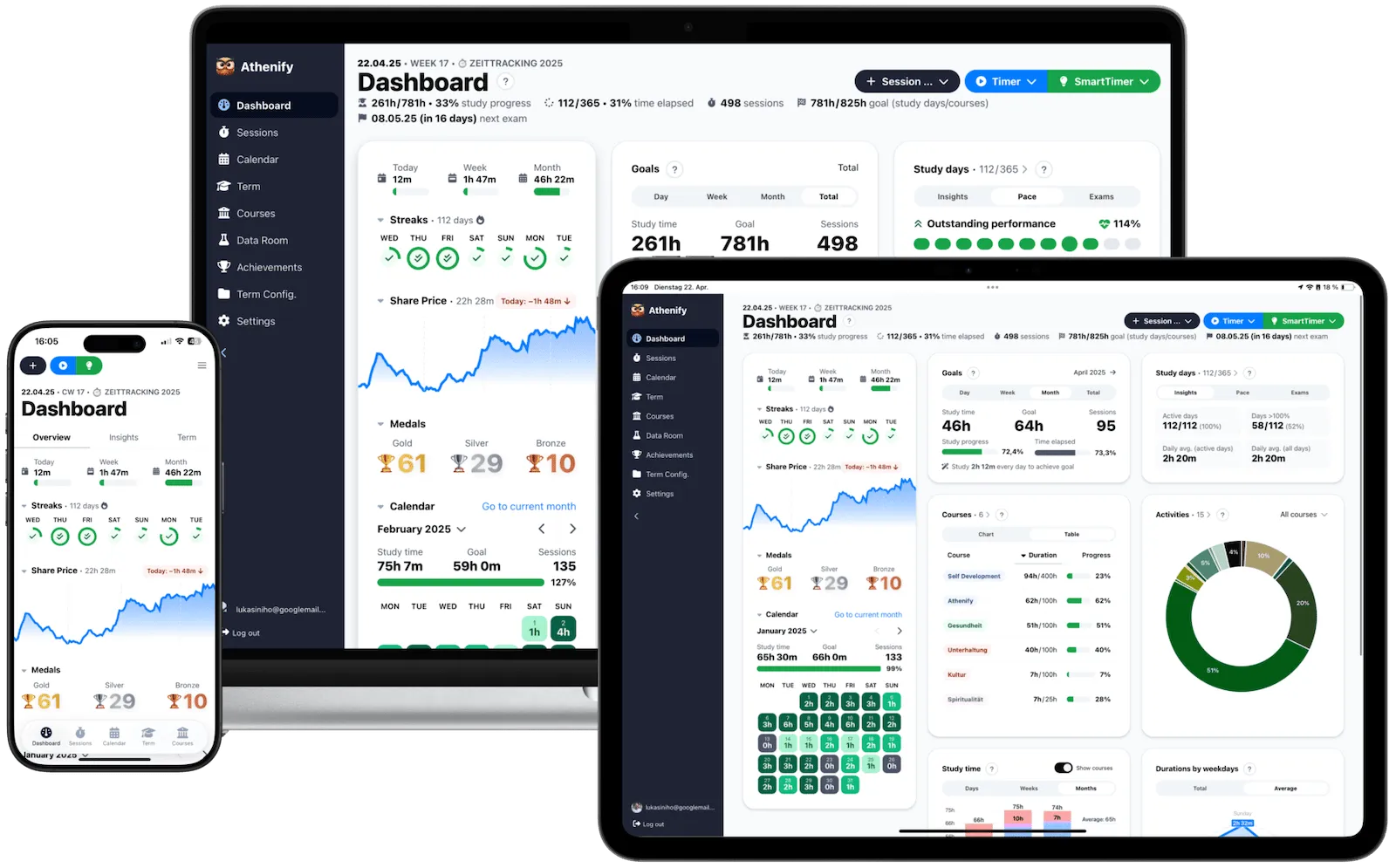
Athenify was designed to answer exactly these questions: How much am I actually studying, and how can I optimize?
1. Set daily goals
Define your daily study target in minutes. The dashboard shows you whether you've reached your goal, how much is left for the day, and your trend over recent days – all at a glance.
2. Track by subject
Athenify lets you log time by subject, so you can see which topics are getting attention and which are being neglected.
3. The Share Price indicator
The Share Price shows your cumulative over- or under-achievement against your goals. Rising = on track. Falling = time to adjust.
Try Athenify for free
Track your exam prep hours by subject, see if you're on pace, and build the data that makes planning your next exam effortless.
No credit card required.
No credit card required.
Quick reference: Study times at a glance
University exams
| Exam Type | Hours | Recommended Period |
|---|---|---|
| Small exam (3 US credits) | 15–25 h | 1–2 weeks |
| Standard final (3–4 credits) | 30–50 h | 2–3 weeks |
| Large final (4–5 credits) | 60–100 h | 4–6 weeks |
| Qualifying exam (PhD) | 200–500 h | 2–4 months |
Standardized tests
| Test | Hours | Recommended Period |
|---|---|---|
| SAT/ACT | 40–200 h | 2–4 months |
| GRE | 100–200 h | 2–3 months |
| GMAT | 100–200 h | 2–4 months |
| LSAT | 250–400 h | 4–6 months |
| MCAT | 300–500 h | 4–6 months |
Remember: these numbers are guidelines, not gospel. Your actual needs may vary significantly based on prior knowledge, learning style, and the specific exam format. Use them as starting points, then adjust based on your own experience.
Conclusion: The answer to "How long should I study?"
The honest answer: It depends. But with the credit hour guidelines and factors from this article, you can create a realistic estimate.
Start with the credit hour baseline: 2–3 hours of outside work per credit hour per week, with exam prep representing roughly 20–30% of your total course workload. Then plan generously – add 30–50% more time than your initial estimate, because content scope is almost always larger than expected. Most importantly, track your actual study time. Only by measuring honestly will you know how much you really study, and that data becomes invaluable for planning your next exam.
The best investment in your next exam: honest time tracking during your current one.