
Why time management is the number one student skill
Every other academic skill depends on this one. Without the ability to allocate your hours intentionally, even the best study techniques, note-taking systems, and memorization strategies fall flat. A comprehensive meta-analysis published in Psychonomic Bulletin & Review found that students who receive structured time management training show a 25% improvement in academic performance, along with measurable reductions in anxiety and stress.
Students who practice time management are 2.5 times more likely to graduate on time.
The impact extends beyond grades. A longitudinal study in the Journal of College Student Retention found that students with strong time management skills are 2.5 times more likely to graduate on time compared to peers who struggle with scheduling. When you manage your time effectively, you create a positive feedback loop: better preparation leads to better performance, which builds confidence, which fuels motivation. The opposite spiral -- procrastination, cramming, anxiety, poor results -- is equally self-reinforcing.
Perhaps most importantly, time management reduces stress not by eliminating workload but by removing uncertainty. When you know exactly what you need to do and when you will do it, the constant background hum of "I should be studying" disappears. You can genuinely enjoy your free time because your study schedule already accounts for everything. This mental freedom is what separates students who thrive from those who merely survive.
The awareness problem: you study less than you think
The bottleneck is almost never a lack of hours -- it is a lack of honest measurement. A landmark study published in Learning and Instruction found that university students overestimate their study time by 50% or more. They believe they studied for four hours, but when distractions, phone checks, social media scrolling, and unfocused staring at a textbook are subtracted, the real productive time was closer to two hours. This discrepancy is not dishonesty; it is a well-documented cognitive bias called the planning fallacy.
The only reliable antidote to this bias is objective measurement. When you track your study time with an external tool, you create a record that cannot be distorted by memory or wishful thinking. The data reveals your real patterns: which days are productive, which subjects eat more time than expected, and where your focus breaks down. This information is the raw material for every improvement that follows.
Interestingly, the act of tracking itself changes behavior -- a phenomenon psychologists call the Hawthorne effect. Simply starting a timer creates a subtle commitment to stay focused. Students consistently report that pressing "start" on a study timer shifts them into a more intentional state of mind. The timer becomes a gentle accountability partner: not judgmental, just honest. For practical tips on building this habit, read our guide on time tracking as a student. Over weeks and months, this awareness compounds into dramatically better time allocation without requiring heroic willpower.
This is exactly why the first step in any time management system should be a full audit week -- seven days of tracking everything without trying to change anything. The data from that single week will reveal more about your habits than months of guessing ever could.
Time management methods compared
Not every time management method suits every student. Understanding the strengths and limitations of each approach helps you choose -- or combine -- the right tools for your situation. Here is an honest comparison of the four most popular methods:
Time blocking assigns every hour of your day to a specific task or category. It works beautifully for students with predictable schedules because it eliminates decision fatigue -- you never wonder "what should I do next?" The downside is rigidity: unexpected events can cascade through your entire day. To make time blocking work, always include buffer blocks and accept that some days will need real-time adjustments. For a deeper look at building a structured routine, see our guide on study habits.
The most effective approach combines Pomodoro technique (for focus) with time blocking (for planning). Use time blocks to allocate your week, then fill each block with Pomodoro sessions. This gives you both the big picture and the moment-to-moment structure.
The Pomodoro technique breaks work into 25-minute focused sessions separated by 5-minute breaks (with a longer 15 -- 30 minute break after four cycles). It excels at overcoming procrastination because committing to "just 25 minutes" feels manageable -- our complete Pomodoro technique guide walks you through the method step by step. The structured breaks also prevent the mental fatigue that comes from marathon study sessions. However, some tasks -- deep mathematical proofs, long-form writing -- need more than 25 uninterrupted minutes, so you may need to adapt the intervals.
The Eisenhower matrix classifies tasks into four quadrants based on urgency and importance. It is excellent for prioritization -- forcing you to distinguish between what feels urgent and what actually matters. Students who use it regularly find they spend less time on busywork and more on high-impact studying. The limitation is that it does not address when to do things, so it pairs well with time blocking or Pomodoro rather than replacing them.
Getting Things Done (GTD) by David Allen is a comprehensive system for capturing, organizing, and reviewing all your commitments. Its "mind like water" philosophy -- getting everything out of your head and into a trusted system -- reduces stress significantly. The challenge is that GTD has a steep learning curve and requires consistent weekly reviews to function. For students who invest the setup time, it can be transformative -- graduate students especially benefit from these advanced frameworks, as explored in our guide on PhD time management strategies. For those who want something simpler, Pomodoro or time blocking is a better starting point.
Energy management: the missing piece
Scheduling your hardest work during your lowest energy hours wastes the schedule entirely. Your cognitive resources fluctuate dramatically throughout the day, and aligning your study schedule with your natural energy cycles can double the effectiveness of each hour. Chronobiology research identifies distinct chronotypes -- some students peak at 8 AM, others do not hit their stride until evening. Neither is superior; what matters is knowing your pattern and scheduling accordingly.
Your body operates on ultradian rhythms — roughly 90-minute cycles of high and low alertness throughout the day. Schedule demanding cognitive work during high-alertness phases and use low phases for review, email, or administrative tasks.
Beyond chronotypes, all humans experience ultradian rhythms -- 90-minute cycles of high and low alertness that repeat throughout the day. During the high phase, complex problem-solving and creative thinking come naturally. During the low phase, your brain needs lighter tasks or rest. Ignoring these cycles means you might spend your sharpest hours answering emails and your foggiest hours attempting organic chemistry. Learning to focus during peak periods and rest strategically during dips is the key to sustainable productivity.
The notorious post-lunch dip -- typically between 1 PM and 3 PM -- is a universal low point regardless of chronotype. Rather than fighting through it with caffeine, schedule low-demand tasks like organizing notes, reviewing flashcards, or administrative work during this window. Save your demanding subjects for the morning or late afternoon when your brain is ready for heavy lifting. This single adjustment often yields more improvement than any productivity app or technique.
The biggest time wasters for students
Social media and streaming get blamed constantly, but the most damaging time wasters operate beneath your awareness entirely. Context switching tops the list: research from the University of California, Irvine found that it takes an average of 23 minutes and 15 seconds to fully regain focus after an interruption. If you check your phone just six times during a study session, you lose over two hours of effective focus time -- even if each glance lasted only 30 seconds. One effective countermeasure is breaking tasks into focused chunks so each block has a clear, singular objective.
Context switching — jumping between tasks, apps, or subjects — costs an average of 23 minutes per switch to regain full focus. A student who checks their phone 10 times during a study session loses nearly 4 hours of cognitive capacity. Batch your focus and protect it fiercely.
Unclear priorities are the second major drain. Without a system for deciding what matters most, students default to whatever feels easiest or most urgent -- answering emails, rewriting already-neat notes, or organizing color-coded folders. These activities feel productive but rarely move the needle on actual learning. The solution is to stop procrastinating on the hard work by using frameworks like the Eisenhower matrix to ruthlessly separate high-impact tasks from comfortable busywork.
Low-value busy work deserves special attention. Recopying notes without active recall, attending optional meetings out of obligation, and perfecting formatting on assignments worth 2% of your grade are all traps. A useful filter: before starting any task, ask "will this directly improve my understanding or my grade?" If the answer is no, either skip it, delegate it, or batch it into a low-energy time slot. Finally, consider that the average person checks their phone 96 times per day -- nearly once every ten waking minutes. Airplane mode during study blocks is not extreme; it is essential.
How to balance studying with work and life
Aiming for equal time across every area of your life is a losing strategy. For students juggling coursework with part-time jobs, family responsibilities, or athletic commitments, the goal is not equal time for everything -- it is strategic allocation based on current priorities. During exam periods, studying takes precedence. During lighter weeks, you can invest more in work, hobbies, or rest. Flexibility is not failure; it is intelligent adaptation.
The key principle is protecting study blocks the same way you protect work shifts. When your boss schedules you for Thursday 2 -- 6 PM, you show up -- no negotiation. Apply the same non-negotiable standard to your study sessions. Put them in your calendar, communicate them to friends and family, and treat them as appointments you cannot cancel. This mental shift from "I should study sometime today" to "I study from 9 -- 11 AM every weekday" eliminates the daily willpower drain of deciding when to start. For detailed strategies on making this work, see our article on how to study while working part-time.
When time is genuinely scarce, quality trumps quantity. A student with 15 free hours per week who uses every minute with full focus and proven techniques like timed study sessions, active recall, and spaced repetition will outperform a student with 30 free hours who studies passively and inconsistently. Use your limited time to do fewer things at a higher standard rather than spreading yourself thin across everything. Build a study schedule that honestly reflects your constraints, and then execute it with total commitment during the hours you have.
How Athenify revolutionizes student time management
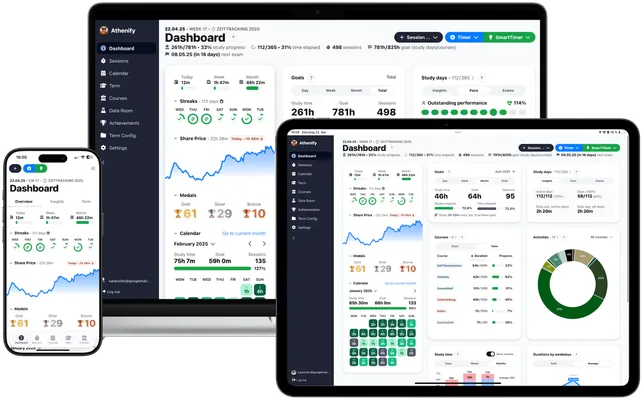
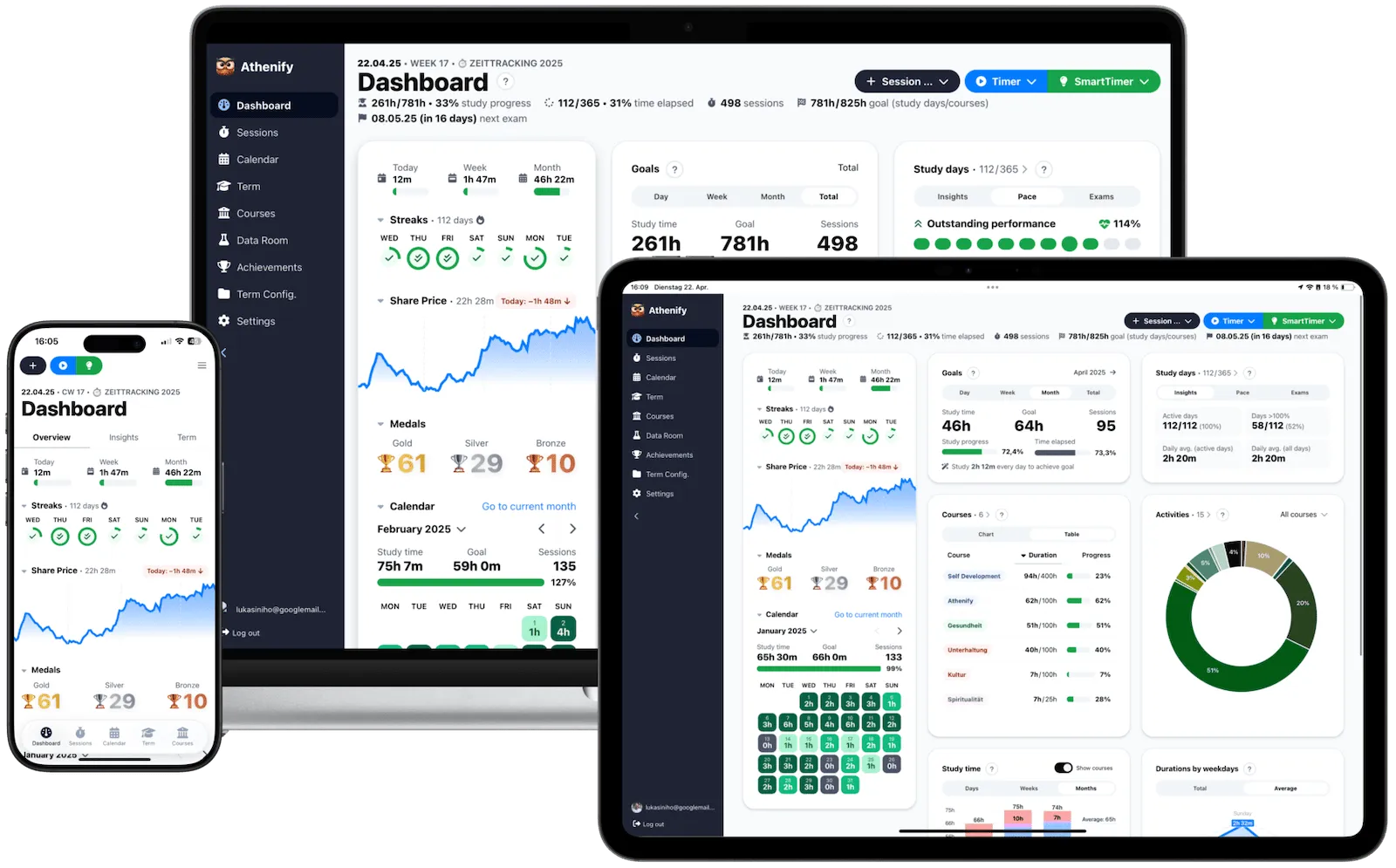
Generic time trackers miss the point -- student life has constraints that freelancer tools were never designed to handle. Unlike generic time tracking apps designed for freelancers or businesses, every feature in Athenify addresses a real student problem. The built-in study timer lets you start tracking with one tap -- no complex project setup required. Choose between a standard stopwatch for flexible sessions or Pomodoro mode for structured focus intervals with automatic break reminders.
Where Athenify truly shines is per-subject analytics. Instead of seeing one vague "total hours" number, you get granular breakdowns showing exactly how much time you spent on each course. This reveals imbalances instantly -- perhaps you are spending 60% of your time on your easiest class while neglecting the one that actually needs attention. The weekly analytics dashboard makes study time tracking effortless, providing the data you need for your Sunday review session. Streaks and medals add a layer of positive reinforcement, transforming consistency from a chore into a game. Students who use Athenify report feeling more in control, studying more consistently, and experiencing less pre-exam panic.
Your time management starter plan
Week one is your audit week. Change nothing about your routine -- simply track every study session, every class, every break. Use Athenify's timer to log each activity as it happens. At the end of the week, review your data: how many hours did you actually study? Which subjects got the most time? When were you most focused? The answers will probably surprise you, and that surprise is the foundation for everything that follows.
Week two is your planning week. Using your audit data, build a weekly study schedule that reflects reality. Assign your hardest subjects to your peak energy hours. Block two to three hours for deep work on your most demanding courses. Include buffer time for the unexpected, and schedule genuine rest so you can recharge without guilt. Write everything down -- a schedule that exists only in your head is not a schedule.
Week three and beyond: track and adjust. Follow your plan, track your actual hours, and compare planned versus actual every Sunday. Did you hit your targets? Where did you fall short, and why? Adjust the schedule, try again, and repeat. Within a month, you will have a personalized time management system refined by real data -- not generic advice -- that fits your unique life, courses, and energy patterns. The students who succeed are not those with the most time but those who use their time with the most intention.
Try Athenify for free
Master time management with Athenify
No credit card required.
No credit card required.