





Why the MCAT is different from every other test you have taken
The MCAT is not a memorization exam. It is a 7-hour reasoning marathon that tests your ability to apply scientific knowledge to novel situations. The Association of American Medical Colleges (AAMC) designed it to predict performance in medical school, where you will face enormous volumes of information and need to think critically under pressure. Understanding this distinction changes how you should prepare: raw content knowledge is necessary but insufficient. You also need to develop the analytical skills that let you apply that knowledge to unfamiliar passages and experimental scenarios.
The MCAT has four sections: Chemical and Physical Foundations of Biological Systems (Chem/Phys), Critical Analysis and Reasoning Skills (CARS), Biological and Biochemical Foundations of Living Systems (Bio/Biochem), and Psychological, Social, and Biological Foundations of Behavior (Psych/Soc). Each section is scored 118--132, producing a total score of 472--528 with a median of 500. The entire test takes approximately 7 hours and 30 minutes including breaks. For a detailed study plan, see our MCAT preparation guide.
Content review: building the foundation
You need a solid content foundation before you can reason effectively. The MCAT covers biology, biochemistry, general chemistry, organic chemistry, physics, psychology, and sociology--an enormous range. The temptation is to spend months on content review, reading textbook after textbook. Resist this temptation. Content review should be systematic and time-bounded. Use a structured resource (Kaplan, Princeton Review, or the AAMC's own materials) and limit your content review phase to 6--8 weeks.
About 80% of MCAT content questions draw from 20% of the material. Focus on high-yield topics: amino acids, enzyme kinetics, the cardiovascular system, optics, acid-base chemistry, and key psychology theories. Master these before moving to lower-yield topics.
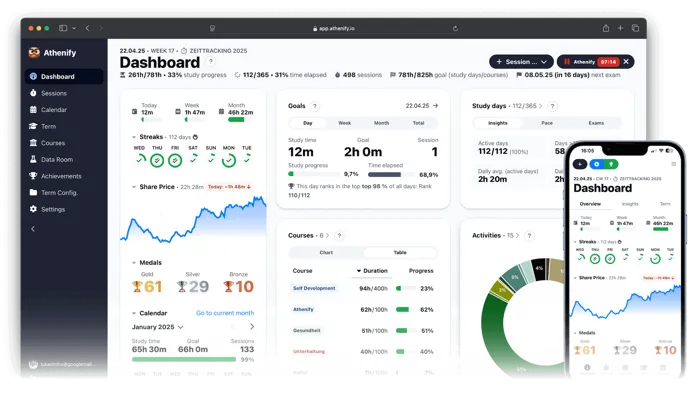
Active learning dramatically outperforms passive reading. Instead of highlighting textbooks, create flashcards (physical or Anki), teach concepts to study partners, and test yourself constantly. The science on effective study techniques is clear: active recall and spaced repetition produce superior retention compared to rereading. Use Athenify to track your content review hours by subject--this prevents the common mistake of over-studying comfortable subjects while neglecting weak areas.
Mastering CARS: the section that scares everyone
CARS is the most feared MCAT section, and for good reason. Unlike the science sections, CARS does not test any specific content knowledge. It presents dense passages from humanities and social sciences and asks you to analyze arguments, identify assumptions, and draw inferences. You cannot cram for CARS--improvement comes from developing reading and reasoning skills over months of consistent practice. This is why starting early is critical.
CARS separates students who can think critically from those who can only memorize. Medical schools know this, which is why many weigh CARS scores heavily in admissions decisions.
Practice exclusively with AAMC CARS materials when possible. Third-party CARS passages often differ significantly in tone, difficulty, and logic from official materials. The AAMC's question packs and full-length practice tests are your best preparation tools. When practicing, read each passage for structure and main argument before looking at questions. Summarize each paragraph in a few words mentally as you read. Time yourself strictly--you have about 10 minutes per passage. If CARS anxiety is overwhelming your preparation, our article on managing MCAT anxiety offers specific coping strategies.
Building your MCAT study schedule
Most successful MCAT students study 3--6 months, investing 20--40 hours per week. Full-time summer preparation (10--12 weeks, 40+ hours per week) is common among students who take the exam between classes. Part-time preparation alongside coursework typically requires 4--6 months at 15--25 hours per week. Both approaches work--the key is total hours invested and how strategically those hours are distributed.
Structure your timeline in three phases. Phase 1 (content review, 6--8 weeks): systematically review all tested subjects. Use Athenify to ensure balanced coverage--track hours per subject and adjust when you notice imbalances. Phase 2 (practice and application, 4--6 weeks): shift from reading to doing. Work through AAMC question banks, section banks, and third-party practice problems. Phase 3 (full-length tests and review, 3--4 weeks): take 5--7 full-length practice tests under real conditions. Review every question--correct and incorrect--to maximize learning. Build a study schedule that accounts for all three phases.
Practice tests: your most valuable tool
Take at least 5--7 full-length practice tests, and save AAMC tests for last. Start with third-party tests (Kaplan, Blueprint, Princeton Review) during weeks 4--8 of your preparation. These tests tend to be harder than the real MCAT, which builds resilience. Save the 4 official AAMC practice tests for the final month--they are the most accurate predictors of your real score. Your AAMC practice test average, taken under realistic conditions, is usually within 2--3 points of your actual score.
Every official AAMC practice test is irreplaceable--once you have seen the questions, their predictive value drops. Take them under strict test conditions: full length, timed, at a desk, with proper breaks. Review every question thoroughly afterward. Never take an AAMC test "just to see where you are" without proper preparation.
The review is more important than the test itself. After each full-length test, spend 4--8 hours reviewing every question. For wrong answers, understand exactly where your reasoning went wrong. For correct answers you were unsure about, solidify your understanding. Categorize mistakes: content gap, reasoning error, or careless mistake. This analysis directs your remaining study time with surgical precision. Track these review sessions with a focus timer--they are as important as the tests themselves.
The mental marathon: endurance and self-care
The MCAT is a physical and mental endurance test. Seven and a half hours of concentrated thinking depletes your cognitive resources. Build stamina gradually--start with single timed sections, progress to half-length tests, then full-length tests. Practice your break routine: what will you eat, how will you stretch, how will you mentally reset between sections? These details matter more than most students realize.
Burnout is the hidden enemy of MCAT preparation. Studying 10+ hours per day, 7 days per week is unsustainable. Build rest days into your schedule. Maintain relationships, exercise, and sleep 7--8 hours per night. Read about recognizing and recovering from study burnout before it derails your preparation. Athenify helps you maintain sustainable habits--the streak feature rewards daily consistency, not daily marathons. Thirty minutes of daily CARS practice is infinitely more valuable than a single 8-hour CARS binge followed by a week of avoidance.
Your medical school application in context
The MCAT is the most standardized element of your medical school application. While GPA varies by school, course rigor, and grading curves, the MCAT provides a level comparison across all applicants. This is why admissions committees weight it heavily--a 515+ demonstrates the scientific reasoning and critical thinking abilities that predict success in medical school and beyond. Every point matters, and every tracked hour of preparation brings you closer to the score that makes your application competitive.
Track your entire preparation journey with Athenify. When you have 400+ documented hours of balanced, strategic preparation across all four sections, you approach test day with the confidence that comes from knowing--not hoping--that you are ready.
Try Athenify for free
Start tracking your MCAT preparation with Athenify
No credit card required.

No credit card required.