It's 11pm on a Sunday night. Your first final is in 5 days, your last one is in 12. You have four exams covering an entire semester's worth of material. The stack of notes on your desk looks insurmountable. Your friends are posting library selfies at 2am like it's a competition.

Finals week isn't won by whoever studies the longest – it's won by whoever studies the smartest.
Here's the truth that took me too long to learn: the students who ace finals aren't necessarily the ones pulling all-nighters. They're the ones who started earlier, studied more efficiently, and walked into each exam rested and confident. The good news? You can be one of them – starting now.
Why Finals Week Matters More Than You Think
Your final exams often account for 25–40% of your course grade. In some classes, a single final can make the difference between an A and a B – or between passing and failing. Unlike midterms, there's no recovery opportunity. What happens during finals week is permanent.
But finals aren't just about grades. They're about proving to yourself that you can perform under pressure, synthesize a semester's worth of knowledge, and execute when it counts. The study habits and systems you develop now will serve you through graduate school, professional certifications, and your entire career.
When to Start Studying for Finals
The single biggest determinant of finals success isn't intelligence or even study hours – it's when you start.
The 2–3 Week Timeline
Ideally, begin serious finals preparation 2–3 weeks before your first exam. This timeline allows for:
- Spaced repetition: Reviewing material multiple times over days dramatically improves retention compared to cramming everything the night before. The spaced repetition method leverages how memory actually works.
- Gap identification: Time to discover what you don't know and actually address it.
- Schedule flexibility: Room to adjust when a topic takes longer than expected.
- Stress management: Reduced panic means better sleep, which means better performance.
The Minimum Viable Timeline
At the very least, start 1 week before your first exam. Anything less forces you into pure cramming mode, which research consistently shows produces worse outcomes than distributed study.
What "Starting" Actually Means
Starting doesn't mean casual review while half-watching Netflix. It means creating a comprehensive study plan that maps out every day between now and your last exam. It means gathering all materials – notes, textbooks, past exams, study guides – so you're not hunting for resources when you should be learning. It means identifying your priority exams and allocating time accordingly, because not all finals deserve equal attention. And it means beginning active study with techniques that actually work, not the passive re-reading that feels productive but produces minimal retention.
The best time to start studying for finals was three weeks ago. The second best time is right now.
How Many Hours to Study Per Final
This question has no universal answer – but there are useful guidelines.
The Base Calculation
For a standard 3-credit course, plan for 10–15 hours of total study time spread over 1–2 weeks. Adjust this baseline based on several factors.
| Factor | Adjustment |
|---|---|
| 4-credit course | +25–50% more time |
| 2-credit course | -25% less time |
| Currently struggling (C or below) | +50% more time |
| Currently excelling (A) | -25% less time |
| Cumulative final | +25–50% more time |
| Non-cumulative (recent material only) | Standard or -10% |
| Heavy problem-solving (math, physics) | +25% for practice |
| Memorization-heavy (history, biology) | +25% for review cycles |
Sample Allocation
For a student with four finals:
| Course | Credits | Current Grade | Final Type | Estimated Hours |
|---|---|---|---|---|
| Organic Chemistry | 4 | C+ | Cumulative | 20–25h |
| Statistics | 3 | B | Cumulative | 12–15h |
| Psychology | 3 | A- | Non-cumulative | 8–10h |
| History | 3 | B+ | Cumulative | 10–12h |
Total: 50–62 hours over roughly 2 weeks, or approximately 4–5 hours per day.
Quality Over Quantity
These hours assume focused, active study – not passive rereading with your phone buzzing every few minutes. Three hours of genuine concentration beats six hours of distracted "studying." If you're struggling to focus, see our guide on how to focus when studying.
Creating Your Finals Study Schedule
A finals study schedule isn't a wishful to-do list. It's a strategic allocation of your most limited resource: time.
Step 1: Map Your Exams
Start with the facts. List every final with its date, time, and location. Add the percentage of your grade each final represents and note whether it's cumulative or covers only recent material.
| Exam | Date | Time | Weight | Type |
|---|---|---|---|---|
| Organic Chem | Dec 12 | 9am | 35% | Cumulative |
| Statistics | Dec 14 | 2pm | 30% | Cumulative |
| History | Dec 16 | 9am | 40% | Cumulative |
| Psychology | Dec 17 | 11am | 25% | Non-cumulative |
Step 2: Work Backward
From each exam date, count backward and block out study phases:
- Days 1–3 before exam: Review only. No new material. Practice tests, flashcard review, consolidation.
- Days 4–7 before exam: Deep practice. Problem sets, practice questions, addressing weak spots.
- Days 8–14 before exam: Initial learning. Working through difficult concepts, creating study materials.
For the schedule above, if today is December 1st, you have 11 days until your first exam. That's enough time for the full cycle – but only if you start now.
Step 3: Allocate Daily Hours
Be realistic. Most students can sustain 5–7 hours of effective study per day during finals week. More than that leads to diminishing returns and exhaustion.
Step 4: Build in Rotation
Don't spend entire days on a single subject. Rotate between subjects to leverage interleaving benefits and keep all exams fresh. A sample day might look like:
| Time | Activity |
|---|---|
| 8:00–10:00 | Organic Chemistry (primary focus) |
| 10:15–11:45 | Statistics (secondary focus) |
| 12:00–1:00 | Lunch + break |
| 1:00–2:30 | History (review) |
| 2:45–4:15 | Organic Chemistry (practice problems) |
| 4:30–5:30 | Psychology (light review) |
This structure gives you exposure to multiple subjects daily while still prioritizing your most important or most imminent exam.
For a complete guide to building study schedules, see how to create a study schedule.
Prioritizing Which Exams to Study Most
Not all finals deserve equal attention. Strategic prioritization maximizes your overall GPA.
The Priority Formula
For each exam, calculate: Credits × Difficulty × Impact
- Credits: Higher credit courses affect your GPA more
- Difficulty: How hard is this subject for you personally? (Scale 1–5)
- Impact: How much can improvement change your final grade?
A 4-credit organic chemistry exam where you're struggling (difficulty 5) and currently have a C (high improvement potential) scores higher than a 2-credit psychology exam where you have an A and find the material easy.
The Common Mistake
Most students naturally gravitate toward subjects they enjoy and find easy. Reviewing psychology when you already have an A feels productive – you're learning! Understanding! Meanwhile, the organic chemistry that could drop your GPA sits neglected because it's hard and unpleasant.
Fight this instinct. Allocate more time to high-impact, high-difficulty exams, even when it's uncomfortable.
Study what you need, not what you enjoy. Comfort is the enemy of GPA optimization.
Study Techniques That Actually Work for Finals
Finals require techniques optimized for retention and recall under pressure. Passive methods – rereading notes, highlighting, watching lecture recordings – feel productive but produce poor results.
Active Recall
Active recall means forcing your brain to retrieve information rather than passively reviewing it. This retrieval effort strengthens memory traces far more effectively than repeated exposure.
The technique is simple but uncomfortable. Close your notes and write down everything you remember about a topic – the struggle to remember is precisely what builds retention. Use flashcards, but actually test yourself rather than just flipping and reading; cover the answer, attempt to recall it, then check. Explain concepts out loud as if teaching someone else, because verbalising forces you to organise your knowledge coherently. Take practice tests under exam conditions, which combines retrieval practice with realistic time pressure. All of these methods share a common thread: they make you work to access information, and that work is what cements learning.
Spaced Repetition
Instead of reviewing material once and moving on, space your reviews over days. Review organic chemistry on Monday, again on Wednesday, again on Friday. Each review strengthens the memory and extends how long you'll retain it.
Practice Exams
If past exams are available, they're gold. They show you what topics professors actually test (which often differs from what you'd expect based on lecture time), what format questions take (multiple choice, short answer, essay, problems), how to pace yourself across the exam duration, and where your knowledge gaps lie before it's too late to address them.
Take practice exams under realistic conditions: timed, closed-book, with your phone in another room. The discomfort of simulating real conditions is precisely the point – it prepares you for the actual stress of exam day. Students who only practice in comfortable, untimed settings often freeze when the clock starts ticking for real.
The Pomodoro Technique
For sustained focus during long study sessions, the Pomodoro Technique works well: 25 minutes of focused work, 5-minute break, repeat. After four cycles, take a longer 15–30 minute break.
This structure prevents the mental fatigue that accumulates during marathon sessions and gives your brain regular consolidation opportunities.
Study Groups: When They Work
Study groups can be valuable – or massive time sinks. The difference lies entirely in how they're structured and who participates.
Study groups work when all members have already studied independently and come prepared to discuss, not to learn basics. They work when you're explaining concepts to each other, because teaching reinforces learning more powerfully than any other technique. They work when you're working through practice problems together, comparing approaches and catching each other's errors. And they work when there's a clear agenda and time limit that prevents sessions from sprawling into socialising.
They fail when they become social gatherings where studying is nominal. They fail when one person lectures while others passively listen, gaining little more than they would from a YouTube video. They fail when you're covering basic material you could review faster alone. And they fail when there's no structure – when "studying together" means sitting in the same room while everyone scrolls their phones between half-hearted attempts at focus.
Managing Multiple Finals Simultaneously
With 4–6 finals in 1–2 weeks, you can't focus on exams sequentially. You must maintain multiple subjects in parallel.
The Rotation Principle
Never spend entire days on a single subject. Rotate between subjects daily – or even within a single day. This approach leverages the spacing effect, because distributed practice beats massed practice for long-term retention. It keeps all subjects fresh in your mind rather than letting earlier material fade while you focus intensively elsewhere. It prevents the tunnel vision that leaves later exams underprepared because you spent your first week exclusively on your first exam. And it reduces the mental fatigue that comes from topic oversaturation – your brain stays sharper when you vary the cognitive demands you place on it.
Preventing Interference
When subjects are similar – statistics and econometrics, or biology and chemistry – space them apart in your daily schedule. Study statistics in the morning and chemistry in the evening, not back-to-back. Similar subjects studied consecutively can blur together in your memory, creating confusion during exams when you reach for a formula and can't remember which class it came from. Interleaving dissimilar subjects creates cleaner mental boundaries.
For a deeper dive, see our guide on how to study for multiple exams at once.
Cumulative vs. Non-Cumulative Finals
Your strategy differs based on what the final covers.
Cumulative Finals
These cover the entire semester and require a comprehensive review approach that many students underestimate.
Start with the big picture by reviewing the course outline and major themes – understanding how topics connect helps you answer questions that integrate multiple units. Identify your weak spots honestly: which units did you struggle with during the semester? Start there, even though it's uncomfortable, because those areas have the most room for improvement. Use old exams and quizzes as diagnostic tools; your midterms reveal what you've already mastered (review lightly) and what needs intensive work (prioritise heavily). Don't neglect early material simply because topics from September feel distant – they're fair game on a cumulative final, and professors often test foundational concepts that students have forgotten. Allocate your time roughly 60/40: spend 60% on weak areas where gains are possible and 40% reinforcing strengths to ensure you don't lose points you should have earned.
Non-Cumulative Finals
These cover only recent material (often post-midterm) and are generally easier to prepare for – but "easier" doesn't mean "easy."
The narrower focus means deeper mastery is possible; you can genuinely learn every concept rather than spreading yourself thin. You have a recent memory advantage since you've seen this material more recently than September's content. But don't let the smaller scope tempt you into passive review – active recall remains essential even when there's less to recall. And don't underestimate non-cumulative finals; professors sometimes make them harder to compensate for the reduced scope, knowing students will prepare less intensively.
How Athenify Helps During Finals
When you're juggling multiple exams with limited time, visibility into where your hours actually go becomes crucial.
Track Hours by Subject
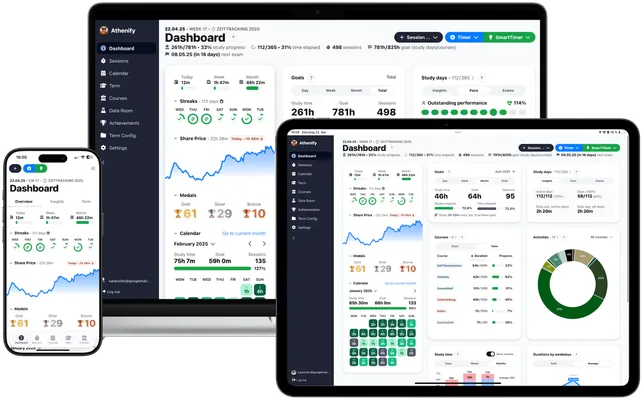
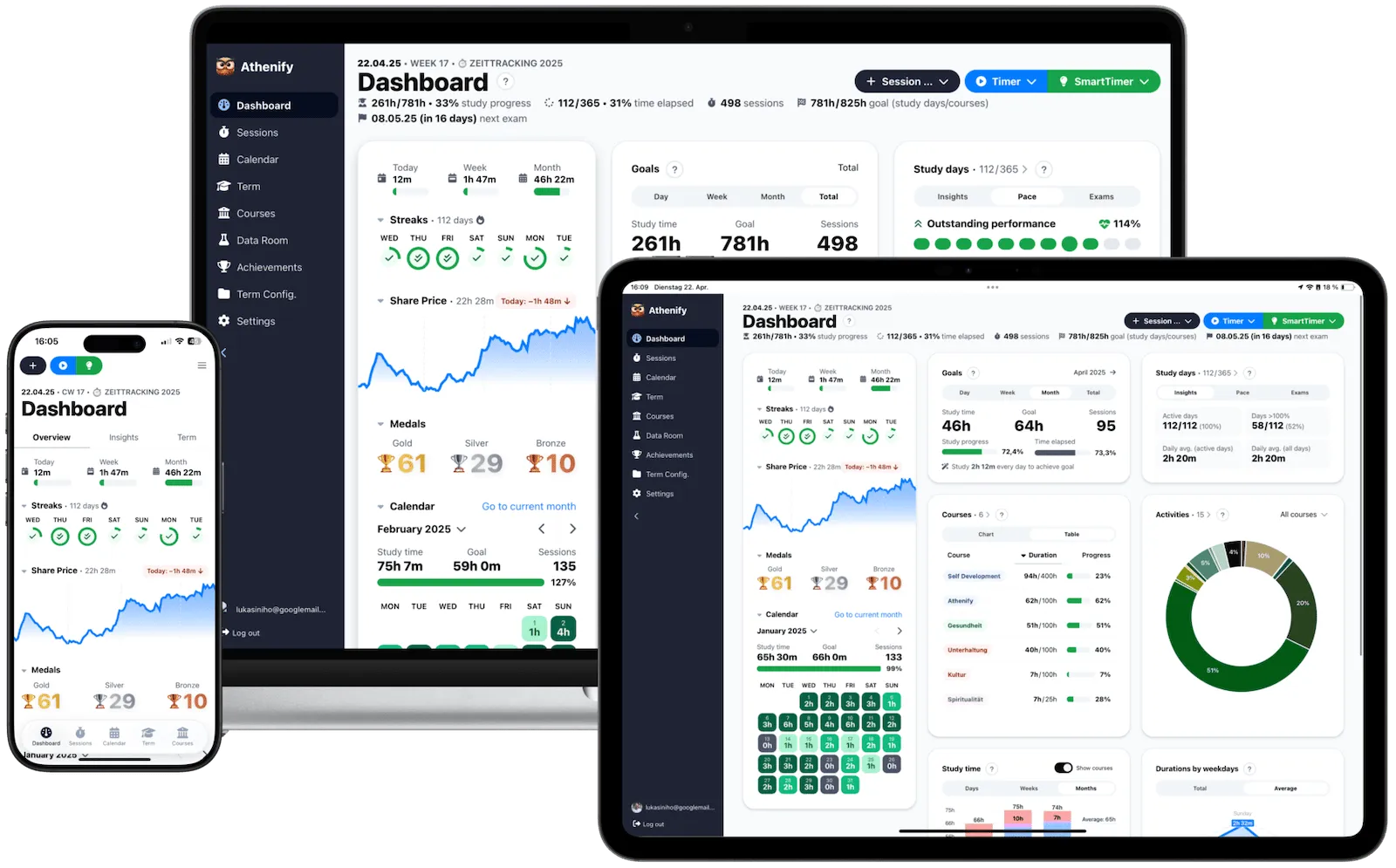
Create a category for each final exam. As you study, log your time. At the end of each day, you can see exactly how many hours went to organic chemistry versus statistics. More importantly, you can see whether your actual time distribution matches your intended allocation.
If organic chemistry was supposed to get 40% of your time but is only getting 25%, you see that gap immediately – while there's still time to correct it.
Daily Goals and Accountability
Set a concrete study hour target for each day. The goal tracker holds you accountable: at the end of the day, you see in black and white whether you delivered what you promised yourself.
During finals, when motivation wavers and Netflix beckons, this external accountability makes the difference between "I'll study more tomorrow" and actually putting in the hours today.
Streaks for Consistency
Even during intense finals prep, consistency matters. Studying 6 hours today, 0 tomorrow, 8 the day after is less effective than 5 hours each day. Streaks encourage the daily habit that makes finals week sustainable rather than a series of panic-fueled cramming sessions.
Try Athenify for free
Track each exam separately, set daily study goals, and see exactly where your time goes during finals – so you can adjust before it's too late.
No credit card required.
No credit card required.
Sleep, Nutrition, and Exercise During Finals
Your brain is a biological organ. Its performance depends on how you treat your body during the most demanding week of the semester.
Sleep: The Non-Negotiable
Sleep isn't optional during finals. It's when your brain consolidates memories, moving information from short-term to long-term storage. Skip sleep, and you interrupt this process – potentially losing much of what you studied.
One sleepless night reduces cognitive performance by approximately 25%. That's the equivalent of walking into your exam legally drunk in terms of mental impairment.
The 10pm rule: Stop studying by 10pm the night before an exam. Whatever you'd gain from two more hours of cramming, you'll lose – and more – from sleep deprivation.
Nutrition: Steady Energy
Your brain needs glucose, but blood sugar spikes and crashes sabotage focus. Eat regular meals with protein and complex carbohydrates. Avoid the candy-and-energy-drink diet that many students default to during finals.
| Do | Avoid |
|---|---|
| Regular meals at consistent times | Skipping meals then binging |
| Protein + complex carbs | Sugary snacks (energy crash) |
| Water throughout the day | Excessive caffeine after 2pm |
| Light healthy snacks (nuts, fruit) | Large heavy meals (food coma) |
Exercise: Brief but Essential
You don't need gym sessions during finals. But 15–20 minutes of movement daily – a walk, stretching, even climbing stairs – improves blood flow to your brain, regulates stress hormones, and clears the mental fog that builds during long study sessions.
The break itself is valuable. Your brain processes information during downtime, and stepping away from your desk often leads to insights that staring at notes never produces.
Dealing with Finals Anxiety and Stress
Some anxiety is normal – even helpful. The stress response focuses your attention and increases alertness. But too much anxiety impairs performance, disrupts sleep, and makes studying harder.
Recognize the Signs
Anxiety becomes problematic when it starts interfering with function: when you can't focus because you're worrying about outcomes instead of engaging with material, when you can't sleep because your mind races through worst-case scenarios, when you feel physically unwell with nausea, headaches, or a racing heartbeat, or when you're actively avoiding studying because opening your textbook triggers panic. Mild nervousness is normal and even helpful; these symptoms indicate something that needs addressing.
Practical Techniques
Most finals anxiety stems from feeling underprepared, which means the strategies in this guide – starting early, studying actively, tracking your progress – address the root cause rather than just the symptoms. When you can see 40 logged hours of preparation in Athenify, anxiety has less fuel to burn.
When anxiety makes it hard to start, try the 5-minute rule: commit to just 5 minutes of studying, after which you can stop if you want. Often, beginning is the hardest part, and momentum carries you once you've started. The barrier isn't the studying itself – it's the activation energy required to begin.
When anxiety spikes mid-session, try a physical reset. Do 2 minutes of deep breathing or take a quick walk around the building. Physical intervention interrupts the anxiety spiral faster than trying to think your way out, because anxiety lives in your body as much as your mind.
And maintain perspective: one exam, even one bad final, rarely ruins your life. It might feel catastrophic in the moment, but you'll recover, adapt, and move forward. This isn't permission to slack off – it's permission to stop catastrophising, which only makes performance worse.
For more on managing test anxiety, see how to overcome test anxiety. If you're dealing with more serious mental health challenges, our guide on studying with anxiety and depression offers additional support.
The Night Before and Day of Each Final
The final 24 hours before an exam require a specific strategy.
The Night Before
Stop learning new material. Anything new you try to cram in the final 24 hours is more likely to confuse you than help. Your brain needs time to consolidate what you've already learned – not more input.
Review only: Go through your notes, flashcards, and summaries. Reinforce what's already there. If you encounter a concept you don't know, accept that you won't know it. Trying to learn it now does more harm than good.
Prepare your materials: Lay out everything you need – ID, pencils, calculator, allowed notes. Reduce morning stress by handling logistics the night before.
Wind down by 10pm: Give yourself at least 8 hours before you need to wake up. Avoid screens for the last hour. Let your brain transition into sleep mode.
Exam Morning
Light review: Spend 20–30 minutes looking at key formulas, main concepts, and your summary notes. This primes your memory without overwhelming it.
Eat breakfast: Your brain needs fuel. Even if you're not hungry, eat something – toast, a banana, yogurt. Low blood sugar during an exam impairs thinking.
Arrive early: Get to the exam room 10–15 minutes before start time. Use this time to settle in, calm your nerves, and mentally prepare.
Stop studying 15 minutes before: Put away your notes. Last-minute cramming creates anxiety without adding knowledge. Trust your preparation.
During the Exam
Read instructions carefully: Don't lose points to careless errors on format or requirements.
Budget your time: Know how many questions there are and how much time you have. Don't spend 30 minutes on a 5-point question when 50-point questions await.
Answer what you know first: Build confidence and secure easy points before tackling harder questions.
If you blank: Move on and return later. The answer often surfaces while you're working on other problems.
What to Do After Finals
You made it. All exams complete. The semester is over. Now what?
Immediate Recovery
The first day after your last final, do nothing academic. Really nothing. Don't check grades obsessively – they won't be posted yet anyway, and refreshing the portal won't make them appear faster. Don't analyse what you might have gotten wrong on questions you can no longer change. Don't start reading ahead for next semester in a misguided burst of productivity.
Your brain has been running at maximum capacity for weeks. It needs genuine rest – not immediately pivoting to the next thing. Sleep without alarms for as many days as it takes to stop feeling exhausted. See friends and family you neglected during the study marathon. Exercise properly with actual workouts, not just 5-minute stress breaks between study sessions. Watch something mindless without guilt, letting your brain process passively instead of actively. Eat meals you actually enjoy rather than whatever was fastest to microwave between study blocks.
Reflection (After Recovery)
One to two weeks post-finals, when the stress has faded but the memory is fresh, reflect honestly on what happened. What study strategies actually worked – which techniques produced results you could feel during exams? Where did your schedule fall apart – was it a particular day, a particular subject, or a systematic underestimation? Which subjects took more time than expected, and could you have predicted that with better self-knowledge? Did you start early enough, or were the final days more frantic than they needed to be? What would you do differently if you could rewind and start your preparation over?
If you struggled with motivation, now is the time to develop systems that don't rely on willpower – willpower depletes, but systems persist. If you ran out of time, consider how to manage exam season more proactively next semester by starting earlier or allocating hours more strategically.
The patterns you identify now become genuine advantages for next finals week. Every exam period teaches you something about how you learn – but only if you take time to notice.
Finals week is a sprint within a marathon. Give it everything – then recover fully before the next one.
Conclusion: A System for Finals Success
Finals week doesn't have to be a scramble of all-nighters and panic. With the right system, it becomes a challenging but manageable test of skills you've been building all semester.
Start early: 2–3 weeks before your first exam gives you time for spaced repetition and stress-free preparation. Even one week is better than cramming.
Study smart: Active recall and spaced repetition beat passive rereading. Practice exams under test conditions reveal gaps and build confidence.
Prioritize ruthlessly: Not all finals are equal. Allocate more time to high-credit, high-difficulty exams where improvement is possible.
Rotate subjects: Maintain all exams in parallel rather than sequential focus. Interleaving improves retention and prevents neglecting later exams.
Protect your sleep: 7 hours minimum. No all-nighters. Sleep consolidates memory – without it, your studying is partially wasted.
Review, don't cram: The final 24 hours are for consolidation, not new learning. Trust your preparation and walk into each exam rested.
The students who ace finals aren't superhuman. They're the ones who started early, studied efficiently, and executed a plan. You now have that plan. The next step is yours.