Four exams in twelve days. You're staring at the calendar, doing math you don't like. Twenty chapters across four subjects. Maybe 80 hours of available study time if you're optimistic. Your brain is already trying to shut down from the overwhelm.

The student who studies less with better strategy often outperforms the one who studies more without a plan.
Here's the uncomfortable truth: when facing multiple exams, you cannot study everything. The sheer volume of material exceeds your available time – this is true for almost everyone. The question isn't whether you'll make trade-offs, but whether you'll make them strategically or by default. A solid approach to exam preparation makes all the difference.
Step 1: Prioritize Your Exams
Not all exams deserve equal attention. This sounds harsh, but it's mathematical reality. Your goal is to maximize your overall academic outcome, not to treat each exam "fairly."
The Priority Formula
For each exam, calculate a simple priority score: credits × difficulty. Difficulty is your subjective assessment on a 1–5 scale, where 1 means you could pass tomorrow and 5 means you're genuinely worried.
| Exam | Credits | Difficulty (1–5) | Priority Score |
|---|---|---|---|
| Organic Chemistry | 4 | 5 | 20 |
| Statistics | 3 | 4 | 12 |
| History | 3 | 2 | 6 |
| Psychology | 2 | 3 | 6 |
The organic chemistry exam demands your best hours and most attention. History and psychology, despite being different courses, have the same priority – so date proximity becomes the tiebreaker.
Factor in Exam Dates
Priority score establishes importance, but scheduling adds urgency. An exam in three days needs immediate attention regardless of its raw priority score. When building your schedule, weight both factors: high priority exams get more total hours, but imminent exams get concentrated attention in the days before.
Know Your Grade Targets
Be realistic about what you're aiming for in each course. If you need an A in statistics for your major GPA but history is a general requirement where a B is fine, factor that into your calculations. Sometimes "passing comfortably" is the strategic goal, freeing up hours for courses where you need excellence.
Treating all exams equally isn't fair – it's wasteful. Allocate time where it matters most.
Step 2: Build a Multi-Exam Study Calendar
Once priorities are clear, you need a master schedule that coordinates preparation for all exams simultaneously. This prevents the common failure mode: focusing entirely on the first exam, then panicking about the second.
Work Backward from Each Exam
Start with each exam date and work backward. The final three days before any exam should be review only – no new material. Before that, you need time for initial learning, practice problems, and consolidation. Map these phases onto your calendar.
For example, if your statistics exam is on February 15th, your timeline flows backward in phases. The final three days – February 12th through 14th – belong to review only: practice exams, flashcard review, and consolidation. Before that, February 8th through 11th is for deep practice: problem sets and past exams under timed conditions. The preceding four days tackle core learning, where you work through difficult concepts and fill knowledge gaps. Everything before February 4th is initial exposure and overview – getting the lay of the land before the real work begins.
Create Overlapping Study Phases
When multiple exams overlap, their phases interleave. You might be in "review mode" for one exam while in "deep learning mode" for another. Your calendar should reflect this complexity.
A weekly view helps you see the big picture:
| Day | Morning (2h) | Afternoon (2h) | Evening (2h) |
|---|---|---|---|
| Monday | Org Chem (learning) | Statistics (learning) | History (review) |
| Tuesday | Statistics (practice) | Org Chem (learning) | Psychology (learning) |
| Wednesday | Org Chem (practice) | History (learning) | Statistics (practice) |
This approach ensures no exam gets neglected while respecting the learning phases each one requires. For more detailed scheduling strategies, see our guide on how to create a study schedule.
Step 3: Interleaving vs. Blocking
How should you structure your actual study sessions? The intuitive answer – focus on one subject for hours or days before switching – is wrong.
The Case for Interleaving
Interleaving means mixing different subjects within a study day or week rather than blocking them into long, single-subject sessions. Research consistently shows that interleaving produces better long-term retention and transfer, even though it feels harder in the moment.
When you switch subjects, your brain must actively retrieve and apply different frameworks. This effort strengthens memory traces and improves your ability to discriminate between similar concepts. The spaced repetition method works on similar principles.
When Blocking Works
That said, blocking has its place. When you're learning fundamentally new material – encountering concepts for the first time – a longer focused session helps build the initial mental framework. Once you've grasped the basics, switch to interleaving for practice and consolidation.
A practical approach: use 90-minute blocks for initial learning of new topics, then switch to 60-minute interleaved sessions for review and practice.
Sample Daily Structure
Here's how interleaving might look in practice:
| Time | Activity | Mode |
|---|---|---|
| 8:00–9:30 | Organic Chemistry | Deep learning (new chapter) |
| 9:45–10:45 | Statistics | Practice problems |
| 11:00–12:00 | History | Review notes, make flashcards |
| – | Lunch break | – |
| 13:00–14:00 | Statistics | Continue practice |
| 14:15–15:15 | Organic Chemistry | Practice problems from morning |
| 15:30–16:30 | Psychology | Initial learning |
Notice how each subject appears twice, and how the mode shifts throughout the day. This maximizes both learning and retention.
Interleaving feels harder because it is harder – and that's exactly why it works.
Step 4: Preventing Subject Interference
When you're juggling multiple subjects, a real danger emerges: interference. Concepts from one course can blur into another, especially when subjects are similar or when you study them back-to-back.
Space Similar Subjects Apart
If you're taking both statistics and econometrics, don't study them in consecutive sessions. The formulas and methods are similar enough to create confusion. Instead, place dissimilar subjects between them: statistics in the morning, history or psychology midday, econometrics in the evening.
Use Contextual Cues
Your brain encodes memories with contextual information. Use this to your advantage by studying different subjects in different environments – or with different rituals. Study statistics at the library's quiet floor, history at the coffee shop, organic chemistry at your desk with a specific playlist. These environmental cues help your brain file information into the right mental compartments, reducing cross-subject interference. The physical context becomes a mental bookmark, making retrieval cleaner when you need to access that specific subject's knowledge.
Transition Rituals
Before starting a new subject, spend 2–3 minutes reviewing where you left off last time. Read your notes from the previous session. Look at the chapter headings. This "context restoration" helps your brain switch gears and access the relevant mental frameworks.
Step 5: The Triage Approach for Limited Time
Sometimes reality is brutal. You don't have enough time for adequate preparation in all subjects. When this happens, you need triage – the medical term for prioritizing patients based on the severity of their condition and likelihood of survival.
Assess the Situation Honestly
For each exam, answer two questions: What's the minimum score I need? What score can I realistically achieve with the time remaining?
If the answer to the second question is "lower than the first," you have a problem. The exam is in critical condition.
Triage isn't giving up – it's strategic reallocation of limited resources.
The Triage Categories
Sort your exams into three categories. Saveable exams are those where you can achieve your target score with reasonable effort – these get your primary attention. Improvable exams sit in the middle ground: you can pass or improve significantly, but excellence is unlikely given time constraints. Focus here shifts to high-yield material and damage control. Critical exams are the hardest to face – adequate preparation is mathematically impossible with the time remaining. For these, you need to make the hard call.
Making the Hard Call
For critical exams, you have options. You might defer to the retake period, accepting a later test date in exchange for saving your other exams. Alternatively, you can apply the Pareto principle ruthlessly: identify the 20% of material that accounts for 80% of exam points and focus there exclusively.
When to Cut Your Losses
This is the hardest decision: deliberately underpreparing for one exam to save the others. It feels like failure, but it's often the mathematically optimal choice.
If you have four exams and can realistically prepare well for three, those three solid performances will help your GPA more than four mediocre ones. Better to get an A, two Bs, and a C (with a planned retake) than four Cs.
Handling Back-to-Back Exam Days
The scheduling gods sometimes aren't kind. Two exams on the same day – or consecutive days – require special handling.
Same-Day Exams
When you have two exams on the same day, preparation must be parallel, not sequential. In the days before, alternate between both subjects rather than finishing one and moving to the other. You need both sets of knowledge fresh and accessible simultaneously.
On exam day itself, take at least a 30-minute break between exams. This isn't optional padding – it's essential recovery time. Use this break for light movement, food, and hydration, not cramming. Your brain needs to process what just happened and clear space for what's next. Most importantly, once the first exam ends, it's over. Do not ruminate on answers you might have gotten wrong. Do not discuss questions with classmates. Let it go completely. The mental energy you'd spend on post-mortem analysis is energy you need for exam two.
Consecutive-Day Exams
With exams on consecutive days, the challenge is avoiding the temptation to sacrifice the second exam for the first. When Tuesday's exam looms, it's psychologically hard to study for Wednesday's. But you must.
The day before the first exam, split your time: morning review for the imminent exam, afternoon touch-up for the next day's subject. After the first exam ends, you have limited evening hours for final review of the second – make them count by focusing on high-yield material only.
Mental Strategies for Staying Organized
Beyond schedules and tactics, your mental approach matters. Multiple exams create cognitive load that can overwhelm your working memory and decision-making capacity.
Externalize Your Plans
Don't try to keep the schedule in your head. Write everything down – physical planner, digital calendar, whiteboard in your room. When the plan is external, your brain can focus on execution rather than constantly recalculating what comes next.
Daily Reviews
Each morning, spend five minutes reviewing your plan for the day. Look at what's scheduled, mentally rehearse the transitions between subjects, and identify your top priority. Each evening, spend another five minutes assessing what you actually accomplished against what you intended. Did organic chemistry eat into your statistics time? Did that "quick" history review turn into two hours? Notice the drift – then adjust tomorrow's plan accordingly. This daily rhythm of intention-setting and reality-checking keeps you oriented when the weeks blur together.
Protect Your Sleep
The temptation to sacrifice sleep intensifies during finals. Resist it. One hour of lost sleep costs more in cognitive performance than one hour of studying gains. Seven hours is the minimum for full brain function; dip below six and you're actively sabotaging your exams.
For more on managing the stress of exam season, see our guide on how to overcome test anxiety.
Manage Your Energy, Not Just Your Time
Some hours are worth more than others. Your morning hours (for most people) are cognitively prime – use them for your hardest subjects. Save administrative tasks, light review, and organization for energy troughs. Fighting your circadian rhythm is a losing battle. For broader strategies on sustainable studying, see our time management guide for students.
Protect your peak hours fiercely. A distracted morning is worth less than a focused afternoon.
Using Tools to Stay on Track
When managing multiple exams, visibility matters. You need to see at a glance whether you're on track or falling behind.
Track Hours by Subject
Create categories for each exam and log your study time. At the end of each day, you should be able to see exactly how many hours went to organic chemistry versus statistics. This visibility matters more than you might think – without tracking, most students dramatically overestimate time spent on difficult subjects and underestimate time lost to distractions. Compare your actual allocation to your planned allocation regularly. Gaps reveal themselves before they become crises. If organic chemistry was supposed to get three hours but only got ninety minutes, you need to know that on Tuesday, not Friday.
Set Daily Goals
Define concrete targets each morning: "3 hours organic chemistry, 2 hours statistics, 1 hour history review." Be specific enough that success is measurable – vague intentions like "study a lot" accomplish nothing. At day's end, the gap between intention and reality tells you whether your system is working or whether adjustments are needed. If you're consistently missing targets in one subject, something is wrong: either the targets are unrealistic, or that subject is draining more energy than you budgeted for.
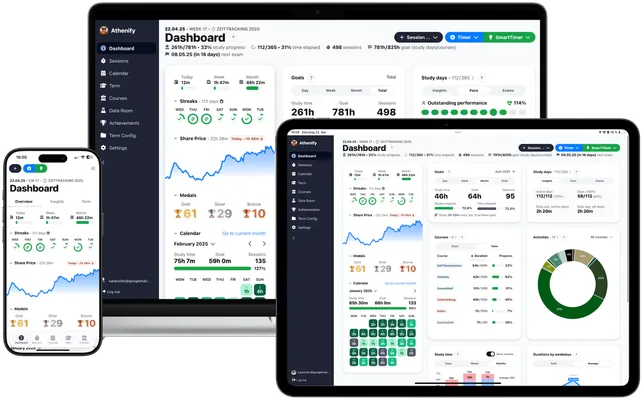
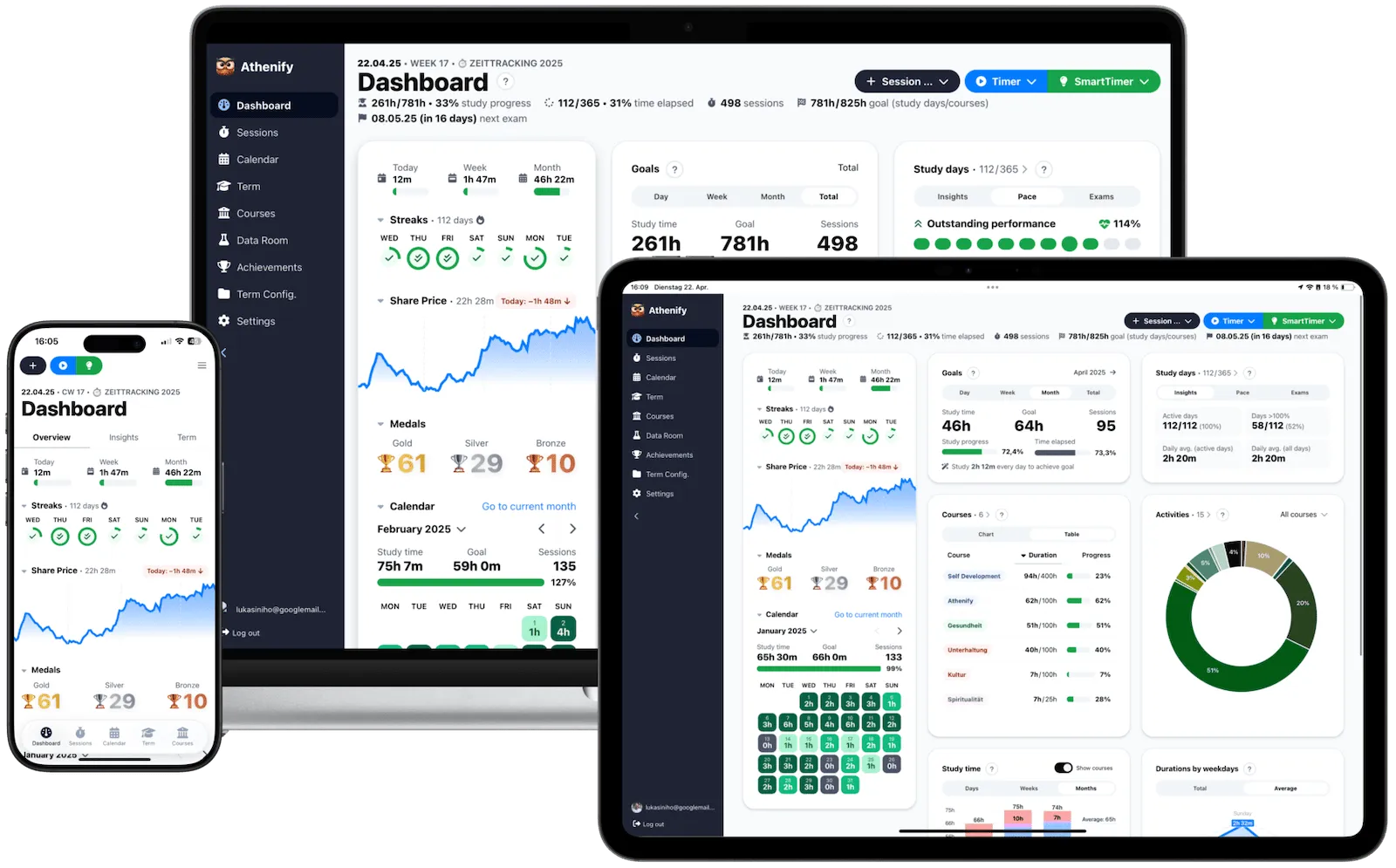
Tools like Athenify make this tracking automatic – start a timer, categorize your session, and build an accurate picture of where your time actually goes.
Try Athenify for free
Track each exam separately, compare planned vs. actual hours, and catch imbalances before they become problems – especially when juggling multiple tests.
No credit card required.
No credit card required.
The Final 48 Hours
As each exam approaches, your strategy shifts. The final 48 hours aren't for learning – they're for consolidation and confidence.
48 Hours Before
This is your last chance to address weak spots. If there's a concept you've been avoiding, face it now or accept you won't know it. Spend the morning on targeted gap-filling, the afternoon on practice problems.
24 Hours Before
No new material. Period. New content at this stage displaces what you've already learned. Review your notes, go through flashcards, look at your summaries. Reinforce what's already there.
Exam Morning
Light review only. Look at key formulas, main concepts, high-level structure. Then stop. Put away the materials. Your brain needs the final hours for rest and mental preparation, not last-minute cramming.
After It's Over
You wrote all four exams. The pressure lifts. Now what?
The first day should be about nothing – really nothing. Don't check results obsessively refreshing the portal. Don't analyze what you might have gotten wrong. Don't start next semester's reading out of some misguided sense of productivity. Your brain has been running at maximum capacity for weeks, and it needs genuine downtime to consolidate everything it just processed.
The first week continues this recovery. Catch up on everything you neglected: the sleep debt, the friends you haven't seen, the exercise that fell off your schedule. Sleep without an alarm. Let your mind wander without guilt. This isn't laziness – it's necessary neurological recovery after weeks of intensity. Trying to maintain exam-mode indefinitely leads to burnout, and burnout makes the next exam season worse, not better.
By the second week, you're ready for reflection. Look back honestly at what happened. Which strategies actually worked? Where did your schedule fall apart, and why? What would you do differently if you could restart? How can you begin earlier next semester so exam season doesn't devolve into panic season? The patterns you identify now become genuine advantages for your next round of finals. Every exam season teaches you something about your own learning – but only if you take time to notice.
Exam season is a sprint within a marathon. Give it everything – then recover fully before the next one.
Conclusion: Strategic Studying Beats More Studying
Facing multiple exams isn't about studying more – it's about studying smarter. The students who thrive during finals week aren't necessarily the ones who log the most hours in the library. They're the ones who allocate those hours strategically, who understand that time spent on the wrong subject at the wrong moment is time wasted.
The core principles fit on an index card. Prioritize ruthlessly based on credits and difficulty – not all exams deserve equal attention. Build a master calendar that maintains all subjects in parallel rather than sequential focus that leaves later exams stranded. Interleave your subjects to strengthen retention and prevent the comfortable illusion of mastery that comes from blocked practice. Space similar topics apart to prevent interference. And when time runs genuinely short, apply triage without guilt – sometimes saving three exams means strategically sacrificing one.
The principles are simple. Execution requires discipline. The gap between knowing these strategies and implementing them under pressure is where most students fail. But with the right system in place before the chaos begins, even the most daunting finals week becomes manageable. Not easy – manageable is not the same as easy. But manageable means you can do it. You can emerge on the other side with your grades intact and your sanity mostly preserved.
Your next exam season is coming. The calendar is already fixed. When it arrives, you'll face it with a plan – or you'll face it without one. That choice, at least, is entirely yours.