It's 2am. You're staring at chapter 7 of 12. Your first of 4 exams is in 6 days. Your coffee is cold. Your eyes are burning. And you're wondering why you didn't start earlier. The good news: you're not alone. The better news: with the right system, exam season isn't just survivable – it can be the moment you rise to the occasion.
Exam season isn't won by whoever studies the most – it's won by whoever prioritizes the smartest.
Exam season is the ultimate stress test of your academic career – multiple exams in a short timeframe, often with no real breaks in between. Going in without a system risks burnout or bad grades. But with a clear strategy, you can achieve excellent results even under pressure. A solid exam preparation approach can make all the difference.
Phase 0: Preparation (2 weeks before)
Exam season doesn't start on the first test day – it starts two weeks earlier, at your desk, with a blank sheet of paper. This preparation phase often determines your success more than the actual study time.
Why? Because without a plan, panic takes over. You jump from subject to subject, forget important topics, and realize three days before your hardest exam that you're barely prepared. With a plan, that doesn't happen.
Step 1: Create an overview
The first step is painful but necessary: write everything down. All exams, all dates, all material scope. No exceptions, no "I'll do that later."
| Exam | Date | Credits | Material Scope | My Assessment |
|---|---|---|---|---|
| Statistics II | Feb 5 | 3 | Medium | Difficult |
| Macroeconomics | Feb 8 | 4 | Large | Medium |
| Business Law | Feb 12 | 3 | Small | Easy |
| Marketing | Feb 15 | 3 | Medium | Medium |
Step 2: Assess your study materials
For each exam, you need to know exactly what you're dealing with. Which chapters and topics will actually be tested? Are there past exams or practice problems available? What's the minimum score to pass, and what do you need for the grade you're aiming for?
This assessment takes an afternoon, but it prevents the nightmare scenario of studying the wrong material. Too many students learn chapter 8 thoroughly only to discover it wasn't on the exam at all.
Step 3: Calculate your time budget
How many days do you have? How many hours per day are realistic? Calculate conservatively: with 14 days until your last exam and 6 hours of effective study time per day – with one rest day per week – you get 12 days times 6 hours, roughly 72 hours total. That sounds like a lot, but spread across 4 exams, it's only 18 hours per exam.
The Prioritization Matrix
Here lies the strategic core of exam season: not all exams are equally important. Treating them equally – giving each one the same study time – feels fair but wastes your limited energy on the wrong things.
Prioritization comes down to two factors you need to weigh against each other: how much the exam matters, and how hard it will be for you personally.
Factor 1: Credit hours
More credits means more impact on your GPA. A 4-credit exam weighs twice as much as a 2-credit one in your final grade calculation. This doesn't mean you should ignore the smaller exam entirely – but when time is tight and you have to choose where to invest your next hour, the priority is clear.
Factor 2: Difficulty for you
Subjects you're weak in need more preparation time. This sounds obvious, but many students intuitively do the opposite: they gravitate toward what comes easy because it feels more productive. You sit down, breeze through familiar material, and feel accomplished. Meanwhile, the hard exam looms, unstudied. In reality, you're just postponing the problem until it becomes a crisis.
The Matrix
| High Credits | Low Credits | |
|---|---|---|
| Difficult | Highest priority | Medium priority |
| Easy | Medium priority | Lowest priority |
Concrete time allocation (example)
For a 72-hour study budget and 4 exams:
| Exam | Priority | Share | Hours |
|---|---|---|---|
| Macro (4 credits, hard) | High | 35% | 25h |
| Statistics (3 credits, hard) | High | 30% | 22h |
| Marketing (3 credits, medium) | Medium | 20% | 14h |
| Law (3 credits, easy) | Low | 15% | 11h |
Allocate your time the way you'd allocate points: more for what matters most.
Daily Structure During Exam Season
The ideal day
The morning belongs to your hardest subject. After breakfast at 7am, start your first study block at 8am – two hours straight, full concentration on the subject that demands the most from you. Your brain is most capable in the morning; use that.
After a 30-minute break – ideally with some movement – comes the second block until 12:30pm. Then lunch and real recovery, no flashcards while eating. The afternoon brings two more blocks: first a different subject, then review of the previous day's material. At 6:30pm, you're done – really done. Your brain needs the evening hours for processing, not cramming.
Rotation between subjects
Don't study only one subject for days on end. Rotation leverages the spacing effect – distributed learning is demonstrably more effective than marathon sessions on a single topic. The spaced repetition method systematically fights forgetting. At the same time, variety keeps you alert and prevents the fatigue that sets in after hours in the same material. And it keeps all subjects fresh in parallel, rather than realizing three days before your second exam that you've forgotten everything from subject one.
Afternoon: Macro (secondary subject)
Evening: Review of yesterday's material (Marketing)
The last 3 days before an exam
Three days before the test, your strategy shifts. This is no longer the time for learning new material – it's the time for consolidation and confidence-building.
Day minus three is your last chance for weak topics. If there's a concept you've been avoiding, face it now or accept you won't know it. Day minus two belongs to past exams: solve them under realistic time pressure, simulating the actual test conditions as closely as possible. This reveals gaps you didn't know existed and builds the mental stamina you'll need.
Day minus one is review only – no new material, period. New content at this stage doesn't help; it only confuses and displaces what you've already learned. Go through your notes, your flashcards, your summaries. Reinforce what's already there.
On exam day itself, do a light review in the morning, then stop. Put away the books. Your brain needs the final hours for rest, not last-minute cramming.
All-Nighters: The Hard Truth
It's 3am, the exam is in 8 hours, and you still have two chapters to go. The temptation is strong to push through. Everyone does it. And you can sleep after the exam.
The truth is: this decision will cost you points. Not maybe – guaranteed.
What a sleepless night does to you
The research here is unambiguously clear. One night without sleep drops your cognitive performance by roughly 25% – you're essentially walking into the exam with a quarter of your brain tied behind your back. But it gets worse.
Memory consolidation – the process that transfers what you learned into long-term storage – happens during deep sleep. Skip the sleep, and you interrupt this process entirely. In the worst case, you spent the night studying material your brain will never properly store. Hours of work, vanished.
Your concentration suffers, your error rate climbs, and your emotional stability takes a hit too. That last one matters more than you'd think: when test anxiety kicks in during the exam, you need emotional reserves to push through. After an all-nighter, those reserves are empty.
Sleep and memory
This isn't pseudoscience – it's neurobiology. During deep sleep, your brain replays the day's learning, strengthening neural pathways and moving information from short-term to long-term storage. It's like your brain's nightly filing system: sorting, compressing, and archiving everything you studied.
There is no major system of the brain and no major organ of the body that is not affected by sleep deprivation.
– Matthew Walker, Why We Sleep
The math is brutal but simple: one hour less sleep costs you more than one hour of studying gains. You're not trading sleep for study time – you're trading effective retention for the illusion of productivity.
Sleep isn't the enemy of studying. It's the final step of studying.
Minimum sleep during exam season
Seven hours is ideal – your brain functions at full capacity with that amount. Six hours is acceptable for short periods if there's truly no other option. Anything under six hours is counterproductive: you study longer but retain less and make more errors on the exam.
Nutrition and Exercise
Your brain is an organ, and organs need fuel. During exam season, how you eat and move directly affects how you think. No nutrition science lecture needed – just practical principles.
Nutrition
Eat regular meals to keep your blood sugar stable. The alternative – skipping breakfast, then binging at lunch – creates energy rollercoasters that sabotage your focus. Stay hydrated; even mild dehydration measurably impairs concentration. And go easy on the coffee after 2pm, or you'll pay for it with poor sleep.
| Do | Don't |
|---|---|
| Regular meals (keeps blood sugar stable) | Too much coffee (avoid after 2pm) |
| Water (dehydrated = unfocused) | Sugary foods (energy crash) |
| Protein and complex carbs | Large meals (food coma) |
Avoid sugary snacks that give you a quick high followed by an energy crash. Large meals are equally problematic – they redirect blood flow to digestion, leaving your brain foggy for hours.
Exercise
Even 15 minutes makes a difference. Get outside during every break. Take the stairs instead of the elevator. Do five minutes of stretching between study blocks. This isn't about fitness gains – it's about blood flow to your brain and stress hormone regulation. Movement clears the mental fog that builds up after hours at your desk. Your body isn't just a transport vehicle for your head; it's part of the same system.
Multiple Exams on the Same Day
The worst-case scenario: two exams on the same day. It happens more often than it should, and it requires specific strategy.
Strategy
The temptation is strong to prioritize one exam over the other – to decide that Economics matters more than Marketing, so Marketing gets neglected. This backfires. You walk into the second exam underprepared, anxious, and regretful. Prepare for both exams equally in the days before.
On the day itself, plan at least a 30-minute buffer between exams. Use this time to breathe, eat something small, and mentally reset – not to cram. Your brain needs transition time, not more input.
Most importantly: don't think about the first exam once it's done. The moment you hand it in, it's over. You can't change a single answer. Every second spent ruminating – "Was question 3 right? Did I mess up the calculation?" – costs mental energy you need for exam two. Let it go. There will be time to analyze later.
Emergency Mode: When Time Runs Out
You started too late. Two days until the exam, 70% of the material still unknown. What now?
Triage strategy
In emergency mode, you need to think like an ER doctor. Not everything can be saved – you have to choose what gets your limited time.
Start by analyzing past exams. What topics appear every single year? What question types are guaranteed? These topics get absolute priority. Everything else is secondary.
Then apply the 80/20 rule ruthlessly. In most courses, roughly 20% of the material accounts for 80% of the exam points. Identify that 20% and learn it perfectly. It's better to know the core concepts cold than to have a shaky grasp of everything.
Finally, adjust your goals honestly. Sometimes passing is the realistic target. A C is infinitely better than a failed attempt that drags your GPA down and forces you to retake the course anyway. There's no shame in strategic pragmatism.
The honest decision
If you have four exams and don't have time for all four, prepare well for three and postpone the fourth to the retake date. This feels like defeat, but it's strategically smart.
Better to consciously postpone one exam than to do poorly on all four.
How Athenify Helps During Exam Season
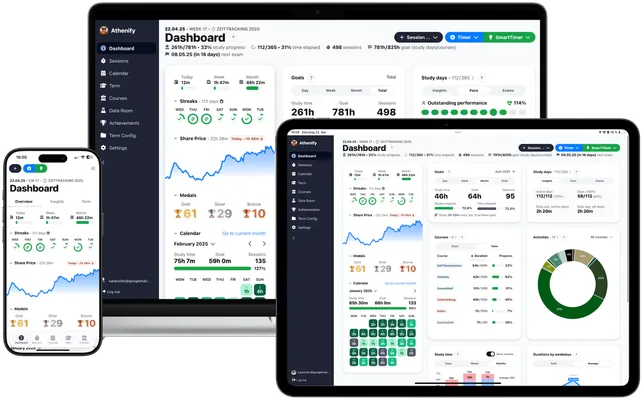
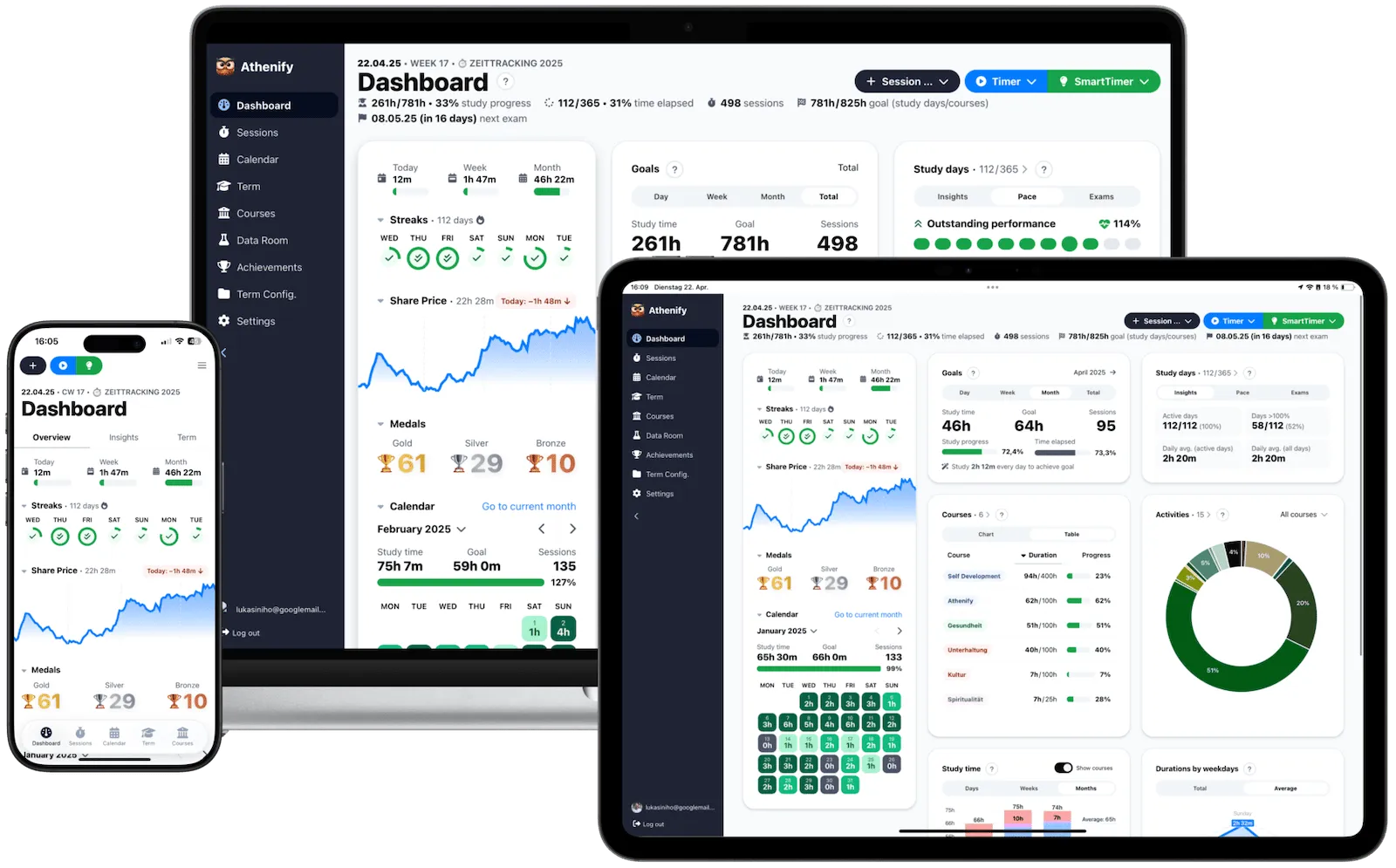
Athenify becomes especially valuable during exam season because every hour counts – and you can't afford to lose track of where your time is actually going.
The Share Price as progress indicator
The Share Price gives you instant feedback on whether you're keeping up. When it rises, you're on track. When it falls, you know immediately that you need to catch up. In a period where days blur together and it's easy to lose perspective, this simple visual indicator cuts through the noise and tells you the truth.
Subject tracking
Create a separate category for each exam, and the dashboard shows you exactly how many hours you've invested per subject. More importantly, it shows whether your actual time distribution matches your plan. If Statistics was supposed to get 30% of your time but is only getting 15%, you see that gap immediately – while there's still time to correct it.
Daily goals and streaks
Set a concrete hourly goal for each day. The goal achievement display holds you accountable: at the end of the day, you see in black and white whether you delivered what you promised yourself. And even during the intensity of exam season, Streaks help maintain consistency. Studying every day – even if only for 30 minutes – beats marathon sessions with empty days in between.
Try Athenify for free
Track each exam separately, see your time distribution at a glance, and stay on top of things with the Share Price – even when stress is high.
No credit card required.
No credit card required.
The Week After Your Last Exam
You made it. All exams written. The pressure lifts. What now?
Plan your recovery
The first day after your last exam: do nothing. Really nothing. No "just quickly check results," no ruminating over whether you got question 7 right. Your brain has been running at full capacity for weeks – it needs downtime, not analysis.
In the first week, catch up on everything you neglected. See your friends. Exercise properly, not just the five-minute breaks between study blocks. Sleep without an alarm. Watch something mindless. This isn't laziness or wasted time; it's necessary recovery after 2–4 weeks of intensive strain. Athletes don't train at maximum intensity every single day, and neither should you.
Reflection (after recovery)
Only after one to two weeks is it worth looking back. What worked this exam season? What would you do differently? And most importantly: how can you start earlier next semester so exam season doesn't become panic season again?
If test anxiety was an issue, now – while the memory is fresh but the pressure is off – is the right time to develop strategies against it. Don't wait until you're stressed again to think about stress management.
Conclusion: Survive and Thrive
Exam season is intense, but it's manageable – with the right strategy.
Start planning two weeks before your first exam. Get an overview of everything coming: dates, credits, material scope. Set priorities based on credits multiplied by difficulty, not based on what you enjoy studying. Calculate your realistic time budget and allocate it accordingly.
During the grind, stick to 6–8 hours of effective study time per day. More is counterproductive – you're not a machine, and pretending otherwise only leads to burnout and diminishing returns. Rotate between subjects to leverage the spacing effect and keep all your exams fresh in parallel.
Sleep comes before studying. Always. One all-nighter can undo days of preparation. Eat properly. Move your body. These aren't luxuries; they're part of the system.
And have an emergency plan for when time runs short. Sometimes strategic retreat – postponing one exam to nail the other three – is the smart play. The principles from our study schedule guide apply here too.
Exam season is a sprint within a marathon. Give it everything – but don't burn yourself out.
The next exam season will come. But with the right system, you won't face it with fear anymore. You'll face it with a plan.