Your palms are sweating. Your heart is racing. The exam paper sits in front of you, but the words blur together. You studied for this – you know the material – but right now your mind is completely blank.
This is test anxiety, and you're far from alone.
Test anxiety doesn't mean you're weak, unprepared, or incapable. It means your brain is treating an exam like a genuine threat to your survival. Understanding why this happens – and how to override it – can transform your exam performance.

What is test anxiety?
Test anxiety is more than just feeling nervous before an exam. It's a specific psychological pattern where the anticipation or experience of being evaluated triggers a stress response disproportionate to the actual situation.
Test anxiety isn't about being unprepared. Many anxious students know the material cold – until the exam starts.
Test anxiety manifests in three distinct ways. The physical symptoms are the most immediately obvious: racing heart, sweating, nausea, muscle tension, trembling hands, shallow breathing, headaches. Your body genuinely believes it's in danger and responds accordingly.
Then there are the cognitive symptoms – mental blanks, racing thoughts, difficulty concentrating, negative self-talk, catastrophic thinking that spirals from "I might not do well" to "I'm going to fail and ruin my entire life" in seconds. This is where test anxiety does its real damage: it hijacks your thinking precisely when you need it most.
Finally, the behavioral symptoms often begin long before exam day: avoiding studying because it triggers anxiety about the upcoming test, procrastinating, sleeping poorly in the days before exams, or – in severe cases – skipping tests entirely.
You might experience all three types or primarily one. The severity ranges widely – from mild nervousness that actually improves focus (useful) to debilitating panic that makes taking exams nearly impossible (needs intervention).
The science behind exam panic
Understanding why your body reacts this way helps you respond to it more effectively.
Your brain thinks it's protecting you
Deep in your brain, the amygdala constantly scans for threats. When it detects danger – real or perceived – it triggers the stress response: cortisol and adrenaline flood your system, blood flow shifts to your muscles, and your prefrontal cortex (responsible for complex thinking and memory retrieval) goes partially offline.
This is why you can study all night, know the material perfectly, and then freeze the moment the exam begins. Your brain is literally restricting access to your memories because it thinks you need to run or fight, not think.
The Yerkes-Dodson Law
Here's the counterintuitive truth: some anxiety actually helps performance.
The Yerkes-Dodson law describes an inverted-U relationship between arousal (stress/anxiety) and performance. Too little arousal leads to poor focus and careless mistakes. Too much arousal triggers the freeze response. But moderate arousal – that slightly nervous, alert feeling – actually optimizes cognitive performance.
The goal isn't to eliminate anxiety. It's to keep it in the productive zone.
Reframe anxiety as excitement
Harvard research by Alison Wood Brooks revealed a remarkably simple intervention: telling yourself "I am excited" instead of "I am calm."
Why does this work? Anxiety and excitement are physiologically almost identical – racing heart, heightened alertness, elevated arousal. The only difference is the label your brain applies.
Trying to calm down when you're anxious requires suppressing a powerful physiological response. But reframing anxiety as excitement requires only a cognitive shift – you're working with your body's arousal rather than against it.
"I'm nervous" and "I'm excited" feel nearly identical in your body. Choose the interpretation that serves you.
Try this before your next exam: When you feel anxiety rising, say to yourself (or even out loud): "I am excited. This energy will help me perform." Don't try to relax. Let your body stay activated – just redirect the narrative.
5 strategies to beat test anxiety
1. 4-7-8 breathing technique
This is your emergency brake for anxiety. The 4-7-8 breathing pattern activates your parasympathetic nervous system, physically forcing your body out of fight-or-flight mode.
The technique is simple: breathe in through your nose for 4 seconds, hold for 7 seconds, then exhale slowly through your mouth for 8 seconds. Repeat this cycle three or four times.
The extended exhale is the key. It triggers your vagus nerve and sends a direct signal to your brain that the threat has passed – even if your conscious mind still feels panicked. Your physiology doesn't care whether the "all clear" is real; it responds to the breathing pattern regardless.
The catch: this only works if you've practiced. In the moment of panic, you won't remember a technique you've only read about. Practice 4-7-8 breathing when you're not anxious – ideally every night before bed for two weeks – so the calming response becomes automatic. By exam day, your body will know what to do.
2. Cognitive restructuring
Test anxiety feeds on catastrophic thinking. One anxious thought spawns another, each more extreme: "If I fail this exam, I'll fail the class. If I fail the class, I won't graduate on time. If I don't graduate on time, I'll never get a good job. My life will be ruined." Within seconds, a single exam becomes an existential threat.
Cognitive restructuring interrupts this spiral by examining whether your thoughts are actually true – not whether they feel true, but whether evidence supports them.
When an anxious thought appears, challenge it with four questions. First, examine the evidence: what actually supports this thought, and what contradicts it? You've felt this way before tests and still passed most of them. That's evidence. Second, consider proportion: is your reaction proportional to the actual stakes? Failing one exam rarely ruins a life; it usually means retaking a test or adjusting your GPA by a fraction of a point.
Third, reflect on past experience: have you handled similar situations before? What actually happened – not what you feared would happen, but what actually occurred? Finally, apply the friend test: if a friend came to you with this exact thought, what would you tell them? You'd probably be compassionate and realistic. Offer yourself the same.
| Catastrophic thought | Realistic reframe |
|---|---|
| "I'm going to fail" | "I might not do perfectly, but I've prepared and will do my best" |
| "Everyone else is smarter" | "I can only control my own performance" |
| "This determines my future" | "This is one exam among many opportunities" |
| "I'll blank out completely" | "If I blank, I'll use my breathing technique and the answers will return" |
The goal isn't toxic positivity – pretending everything is fine when you're genuinely struggling. It's accurate thinking. Most anxious thoughts are predictions about the future that assume the worst. Cognitive restructuring asks: is that actually likely?
3. Exam simulation practice
Your brain learns that exams are threatening partly because they're unfamiliar, high-stakes environments. The exam room, the silence, the ticking clock, the proctor watching – all of these cues become associated with stress. Counter this by making exam conditions familiar before the real thing. A solid exam preparation routine that includes practice tests can significantly reduce anxiety.
To simulate real conditions, set a timer for the actual exam length and sit at a desk – not your couch. Put away your phone, skip the music, and don't take breaks. Use actual past exams or practice tests whenever possible. Some students even wear the same clothes they plan to wear on test day, making the simulation feel more authentic. It sounds excessive, but your amygdala doesn't know the difference between "real" and "practice" – it just learns that this environment is safe.
Each simulated exam teaches your amygdala that the "exam environment" isn't dangerous. The first practice test might still trigger anxiety. The second will be easier. By the fourth or fifth, the setting itself stops being a threat – it's just where you go to demonstrate what you know.
4. Track your study time
One of the biggest anxiety amplifiers is uncertainty. "Did I study enough? Am I actually prepared?" When you don't have concrete answers to these questions, your anxious brain will always assume the worst.
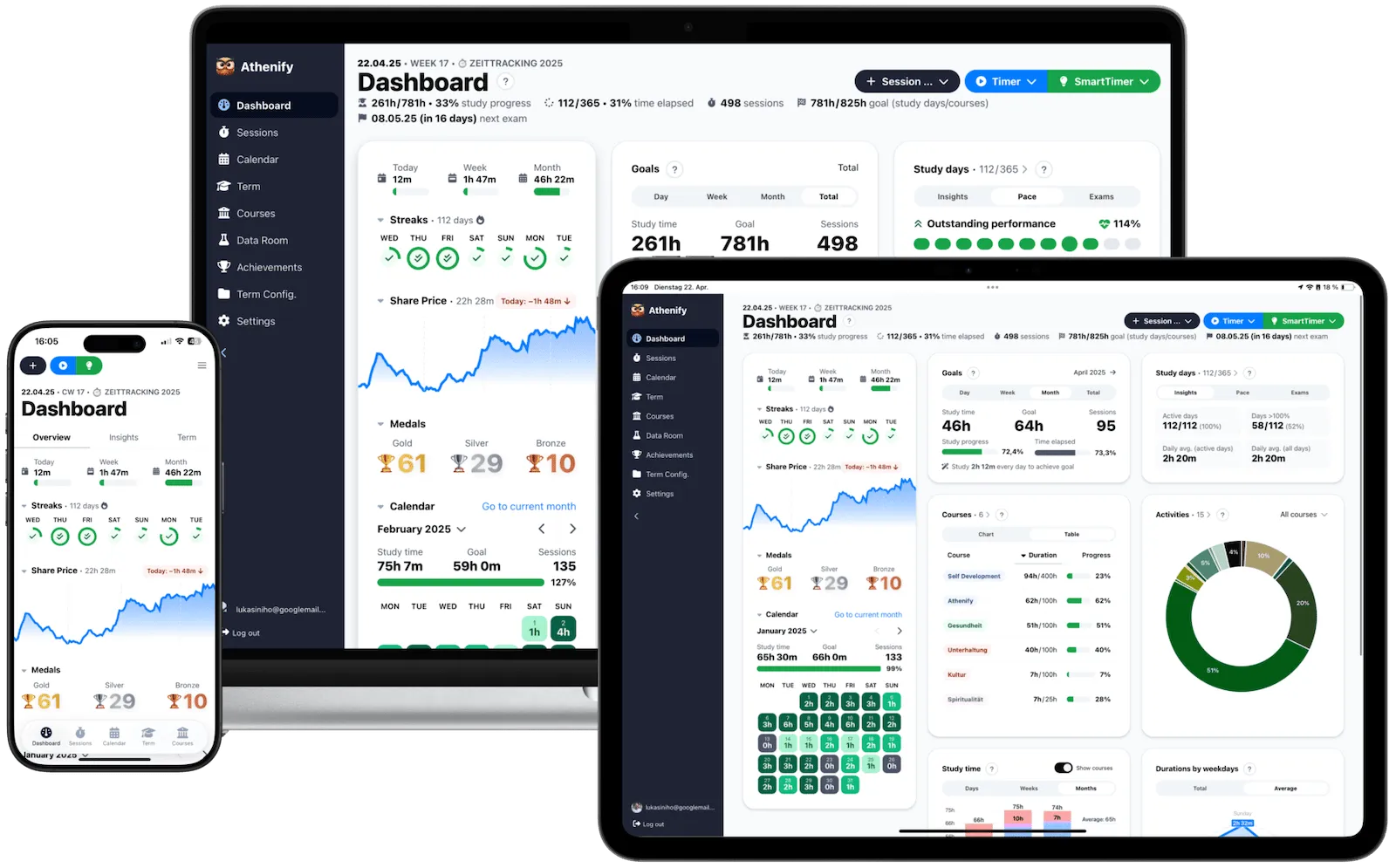
Tracking your study time replaces vague worry with concrete data. The anxious voice saying "you didn't do enough" can be answered with facts.
When you've logged 50 hours preparing for an exam, you have evidence that you're prepared. Not a feeling, not a hope – evidence. The anxious thought "I didn't study enough" runs into a wall of data: "Actually, I studied 50 hours. That's more than I've ever studied for an exam."
Time tracking also prevents a common anxiety trap: feeling like you've studied "all day" when you actually did 2 hours of focused work scattered between 6 hours of distracted pseudo-studying. Without tracking, you don't know. With tracking, you know exactly where you stand – and that certainty is calming.
Try Athenify for free
Track your study hours, build evidence of your preparation, and walk into exams knowing – not hoping – that you've done the work.
No credit card required.
No credit card required.
5. Worst-case analysis
Paradoxically, facing your worst fears often reduces anxiety. Your brain generates more stress from vague, undefined threats than from specific ones you've examined directly. "Something terrible might happen" is scarier than "I might have to retake this class."
Try this exercise: Write down your worst-case outcome. "I fail this exam." Now ask yourself: then what? Maybe you fail the class. Then what? You'd have to retake it next semester. Then what? You graduate a semester later. Keep going until you reach the ultimate consequence – the rock-bottom worst thing that could realistically happen.
Now assess honestly: is this survivable? Almost always, the answer is yes. Uncomfortable, disappointing, inconvenient – but survivable. Once you've examined the worst possible outcome and recognized you could handle it, the exam loses much of its terrorizing power. You're not pretending the stakes don't exist; you're putting them in realistic proportion. The vague monster under the bed becomes a specific, manageable problem.
During the exam: the blackout protocol
Despite your best preparation, you might still experience a mental blank during an exam. The page swims, the answer you knew perfectly yesterday has vanished, and panic starts to rise. Here's exactly what to do.
First, recognize what's happening. Name it silently: "I'm having a stress response. This is temporary." This simple act of labeling engages your prefrontal cortex and begins to calm the amygdala. You're not failing – you're experiencing a well-understood physiological response that will pass.
Next, activate physical calm. Do one round of 4-7-8 breathing – it takes 30 seconds. Close your eyes if you need to. Let your shoulders drop away from your ears. Your body doesn't know the threat isn't real, so you have to manually override the alarm.
Then ground yourself in the present. Notice five things you can see, four things you can hear, three things you can touch. This sounds like a wellness cliché, but it works: it pulls your attention out of the anxious spiral in your head and anchors it in the physical room where you're actually safe.
Now – and this is crucial – skip the question causing the blank. Find any question you can answer confidently and do that one. It doesn't matter if it's the easiest question on the test. Answering even one question proves to your brain that your knowledge is still there, that you haven't lost everything. That small success creates a foothold.
After answering a few accessible questions, your confidence and memory access will typically return. Go back to the challenging question with fresh eyes. Often, the answer that felt impossibly distant will now be obvious.
The information isn't gone – it's just temporarily inaccessible. Give it 2 minutes. The answers will come back.
When to seek professional help
Self-help strategies work for most students, but some situations require professional support. There's no shame in this – test anxiety is highly treatable, and getting help is a strategic decision, not an admission of weakness.
Consider seeing a counselor, therapist, or doctor if anxiety prevents you from attending exams at all. If you're physically unable to walk into the exam room, that's beyond what breathing techniques can fix. The same applies if you experience panic attacks with physical symptoms like vomiting, hyperventilation, or chest pain – your body is sending distress signals that need medical attention.
Professional support is also warranted when your grades suffer significantly despite adequate preparation. If you know the material but consistently underperform due to anxiety, something is blocking the connection between your knowledge and your performance. Similarly, if anxiety interferes with daily functioning beyond just exam periods – affecting your sleep, relationships, or general wellbeing – it's time to get support.
Finally, if you've tried self-help strategies consistently for 4–6 weeks without improvement, that's useful information. It doesn't mean you've failed; it means you need a different approach.
Professional options include cognitive-behavioral therapy (CBT), which has the strongest evidence base for anxiety disorders; counseling for developing personalized coping strategies; and in severe cases, medication that can help manage symptoms while you build longer-term skills.
Build lasting confidence
Test anxiety diminishes as you accumulate evidence that exams are manageable. Each exam you complete – regardless of the score – teaches your amygdala that you survived. Each technique that works when panic rises builds trust in your ability to self-regulate. Over time, this evidence compounds into genuine confidence.
Building this resilience is closely tied to study motivation – confidence and drive reinforce each other. When you trust your preparation and your ability to handle stress, studying feels less like dread and more like investment.
The goal isn't to never feel anxious. Some pre-exam butterflies are normal and even helpful – remember the Yerkes-Dodson curve. The goal is to have tools that keep anxiety in the productive zone, where it sharpens your focus rather than destroying it.
Start with one technique. Maybe it's 4-7-8 breathing. Practice it until it's automatic – until your body knows what to do before your conscious mind has to think about it. Then add another technique. Within a few weeks, you'll have a toolkit that transforms test anxiety from a paralyzing force into manageable background noise.
You've studied. You've prepared. Now trust the work – and trust yourself.
Related reading:
- How to Stop Procrastinating – Beat the avoidance that often accompanies test anxiety
- The Pomodoro Technique Complete Guide – Structure your study sessions for maximum focus
- The Streak: Building Consistency – How tracking streaks creates lasting study habits
- MCAT Anxiety: How to Stay Calm on Test Day – Specific strategies for high-stakes standardized tests