Your textbook is open. The words are right there. But you've read the same paragraph four times and nothing is sticking. Your mind keeps drifting to worst-case scenarios, or it feels wrapped in fog so thick that even simple concepts won't penetrate.
This is what studying with anxiety and depression feels like. And if this describes your experience, you need to know something important: the problem isn't that you're lazy or stupid. The problem is that your brain is working against you.
Anxiety and depression are among the most common challenges students face. They don't make you less capable of learning – but they do require different strategies than what works for neurotypical students. This guide offers evidence-based approaches to studying when your mind is struggling. For a broader look at the connection between academics and wellbeing, see our mental health and studying hub.

Why anxiety and depression make studying hard
To adapt your study methods, you first need to understand what's happening in your brain. Anxiety and depression aren't just "feeling bad" – they create measurable changes in brain chemistry and function that directly impair learning.
The anxious brain
Anxiety triggers your amygdala – the brain's threat detection center – into constant alert mode. When the amygdala perceives danger (real or imagined), it floods your system with cortisol and adrenaline. These stress hormones are useful if you're fleeing a predator. They're devastating if you're trying to memorize chemistry formulas.
Anxiety doesn't mean you're weak. It means your brain's alarm system is miscalibrated – seeing threats where none exist.
Under chronic stress, the prefrontal cortex – responsible for concentration, working memory, and complex reasoning – becomes impaired. Blood flow shifts away from "thinking" regions toward "survival" regions. The result: you can't focus, you can't remember, and your mind races with catastrophic thoughts instead of course material.
Anxiety also creates a vicious cycle with studying. You worry about an exam, so studying triggers anxiety. The anxiety makes studying unpleasant and ineffective, so you avoid it. Avoiding studying increases your worry about the exam. Each loop tightens the spiral. If exams are a major trigger, our guide on managing test anxiety offers targeted techniques for breaking this cycle.
The depressed brain
Depression involves deficits in dopamine and serotonin – neurotransmitters essential for motivation, pleasure, and cognitive function. Without adequate dopamine, your brain struggles to generate the motivation needed to start tasks. Without serotonin, even accomplishments feel hollow.
The hippocampus, crucial for forming new memories, can actually shrink during prolonged depression. This isn't permanent – it recovers with treatment – but it explains why learning feels impossible during depressive episodes. Your brain is literally less capable of encoding new information.
Depression adds another cruel twist: anhedonia, the inability to feel pleasure. Even when you accomplish something, you feel nothing. The normal reward feedback that reinforces study habits – the small satisfaction of understanding a concept – is muted or absent. Without that feedback, sustaining effort becomes extraordinarily difficult, and the risk of study burnout increases significantly.
When anxiety and depression coexist
Roughly half of people with depression also experience significant anxiety, and the combination creates unique challenges. Anxiety wants you to do everything perfectly and immediately. Depression tells you nothing matters and nothing will work. The result is paralysis – frozen between urgency and hopelessness.
Anxiety says "do it perfectly." Depression says "why bother." Both are lying to you.
Understanding these brain mechanisms matters because it shifts your approach. You're not fighting laziness or lack of intelligence. You're working with a brain whose chemistry is temporarily altered. That requires accommodation, not self-criticism.
Adapting your study methods
Standard study advice assumes a baseline of cognitive function that anxiety and depression compromise. Here's how to modify common techniques for struggling brains.
Make everything smaller
The number one adaptation: shrink everything. Tasks that seem manageable to neurotypical students can feel insurmountable when you're struggling. The solution isn't to push harder – it's to make the ask so small that your brain can't refuse.
Instead of "study Chapter 5," try "read pages 98–100." Instead of "review notes for an hour," try "review notes for 10 minutes." Instead of "write essay," try "write one paragraph."
This isn't about lowering standards – it's about making starts possible. Starting is the hardest part when motivation systems are impaired. Once you've begun, continuing is often easier than you expected. And if you stop after 10 minutes? You've still done something, which is infinitely better than the zero that paralysis produces.
Use active over passive methods
Passive studying – reading, highlighting, watching lectures – requires sustained concentration that anxious and depressed brains struggle to maintain. Your mind wanders, and 30 minutes of "reading" becomes 30 minutes of ruminating while your eyes pass over words.
Active methods demand engagement that crowds out intrusive thoughts. Flashcard creation works because the process of condensing information into questions and answers forces active processing – you can't ruminate while you're deciding how to phrase a flashcard. Practice problems keep your hands and mind occupied with the mechanics of working through examples. Teaching the material, even explaining concepts out loud to an empty room or a pet, requires the kind of sustained attention that leaves no room for anxious spirals. Writing summaries – closing your book after reading a section and writing what you remember – forces retrieval rather than passive recognition. The Feynman Technique, explaining a concept in simple terms as if teaching a child, demands you genuinely understand rather than fool yourself with familiarity.
These methods also produce concrete evidence of work done. When depression tells you "you accomplished nothing today," you can point to the stack of flashcards or the practice problems solved.
Study environment matters more
Environmental factors that mildly affect neurotypical students can make or break study sessions when you're struggling. Pay close attention to:
Noise and distraction: Some students with anxiety focus better with complete silence; others find it amplifies anxious thoughts and prefer background noise or music. Experiment to find what works for you. Our guide on how to focus when studying offers specific strategies for managing distractions.
Physical comfort: Depression often comes with physical symptoms – fatigue, body aches, restlessness. A comfortable chair, good lighting, and the right temperature remove physical barriers to studying.
Social presence: Some people study better alone; others benefit from the gentle accountability of studying with others or in a library. Isolation worsens depression for most people, so consider whether solo study is serving you or enabling withdrawal.
Visual clutter: A messy study space can increase anxiety. You don't need a spotless desk, but having your immediate workspace clear reduces cognitive load.
Building sustainable routines
Routines are especially powerful for anxiety and depression because they remove the need for moment-to-moment decisions. When you're struggling, every decision depletes limited mental resources. A routine lets you operate on autopilot.
Anchor to existing habits
New habits are easiest to build when attached to existing ones. Identify something you already do consistently, then add a small study session before or after.
Consider these pairings: after your morning coffee, review flashcards for 10 minutes – the caffeine provides a small energy boost, and the routine becomes automatic. Before lunch, read one section of a textbook, knowing that food is waiting as a natural reward. After returning from class, spend 15 minutes on homework while the material is still fresh and your transition home becomes a cue rather than a decision point.
The existing habit serves as a trigger, and the study session eventually becomes automatic – requiring no willpower to initiate.
Work with your energy patterns
Anxiety and depression rarely produce consistent energy. You might have better hours and worse hours, better days and worse days. Pay attention to these patterns and schedule demanding tasks for your higher-energy windows.
Don't fight your energy patterns. Work with them. Schedule hard tasks for good hours, easier tasks for bad hours.
For many people with depression, mornings are worst (morning depression is common) and energy improves through the day. For others, anxiety escalates as the day progresses. Tracking your energy for a week can reveal patterns you hadn't noticed.
Build in recovery
Sustainable routines include rest. Pushing through exhaustion might produce short-term output but accelerates burnout and worsens symptoms – learn to recognize the signs of study burnout and how to recover before it derails your semester. Plan recovery time deliberately:
- Study for 25 minutes, then take a genuine 5-minute break (not scrolling social media, which often increases anxiety)
- After intense sessions, do something genuinely restorative: walk outside, stretch, listen to music
- Schedule at least one full day per week without academic obligations
The Pomodoro Technique provides built-in recovery: focused intervals followed by mandatory breaks. This structure prevents the burnout that comes from marathon study sessions.
Self-compassion is not optional
This might be the most important section in this article. Students with anxiety and depression typically have brutal inner critics – voices that demand perfection, catastrophize failures, and interpret every setback as evidence of fundamental inadequacy.
This self-criticism isn't motivating. It's corrosive. Research consistently shows that self-compassion improves performance, while self-criticism worsens both productivity and mental health.
What self-compassion actually means
Self-compassion isn't making excuses or lowering standards. It's treating yourself with the same kindness you'd offer a struggling friend. When a friend says "I couldn't study today because my anxiety was too bad," you don't respond "You're pathetic and will fail at everything." You offer understanding and encouragement.
Self-compassion isn't weakness. It's recognizing that you're fighting a harder battle than healthy students – and that deserves acknowledgment, not criticism.
Three components of self-compassion:
- Self-kindness: Responding to failures with understanding rather than judgment. "I'm struggling right now, and that's okay" instead of "I'm worthless."
- Common humanity: Recognizing that suffering and imperfection are shared human experiences. You're not uniquely flawed – millions of students struggle with the same challenges.
- Mindfulness: Acknowledging painful thoughts and feelings without over-identifying with them. "I'm having the thought that I'll fail" rather than "I'm going to fail."
Practical self-compassion practices
When the inner critic attacks, have responses ready. Name what's happening: "That's my anxiety talking, not reality." This simple act of labeling creates distance between you and the thought. Reframe harsh self-judgments: replace "I should have studied more" with "I studied what I could given my circumstances" – same facts, different narrative. Externalize the criticism by asking: would you say this to a friend struggling the same way? If not, don't say it to yourself. And acknowledge the genuine difficulty of what you're doing: "Studying with depression is genuinely hard. The fact that I'm trying at all is worth recognizing." This isn't making excuses – it's being accurate about the challenge you're facing.
Redefine productivity
Productivity metrics designed for healthy brains don't apply when you're struggling. Studying for two hours while managing severe anxiety represents more effort than studying for four hours while feeling fine. The raw output might be lower, but the input – the willpower, the struggle – is much higher.
Measure yourself against what's possible for you today, not what would be possible if you were healthy. For more on protecting your wellbeing while keeping up academically, see our mental health and studying hub.
Avoiding the comparison trap
Social media and university culture create endless opportunities for toxic comparison. You see classmates posting about their achievements, study schedules, and internships while you're struggling to get out of bed.
This comparison is poisonous because it compares your internal experience (which includes every struggle, every failed attempt, every moment of despair) against others' curated external presentation (which shows only successes and hides struggles).
Everyone is fighting hidden battles
The truth is that many high-achieving students also struggle with mental health. They've simply learned to hide it. The classmate who seems effortlessly successful might be white-knuckling through panic attacks. You're not seeing the full picture.
Compare to your own past
The only valid comparison is to your own circumstances. Are you doing better than last week? Are you managing your symptoms more effectively than last month? These are meaningful metrics. How you compare to someone with different brain chemistry, different life circumstances, and different challenges is not.
Comparing your productivity to a healthy student's is like comparing your marathon time to someone who didn't have to run the first 10 miles through mud.
Curate your inputs
If certain social media accounts, study spaces, or conversations consistently trigger comparison spirals, limit your exposure. This isn't weakness – it's intelligent management of your mental environment. You wouldn't pour gasoline on a fire; don't pour triggering content on an anxious brain.
When to seek professional help
Self-help strategies have limits. They can manage mild to moderate symptoms, but they cannot replace professional treatment for serious conditions. Know when to escalate.
Signs you need more than self-help
Seek professional support if you experience any of the following:
- Persistent symptoms: Anxiety or depression lasting more than two weeks with no improvement
- Functional impairment: Unable to attend classes, complete assignments, or maintain basic self-care
- Severe physical symptoms: Panic attacks, inability to eat or sleep, constant physical agitation
- Suicidal thoughts: Any thoughts of self-harm or ending your life
- Substance use: Using alcohol or drugs to manage symptoms
- Academic crisis: At risk of failing or being placed on academic probation due to symptoms
What professional help looks like
Several evidence-based treatments exist for anxiety and depression:
Cognitive-Behavioral Therapy (CBT): Identifies and changes negative thought patterns. Particularly effective for anxiety. Most students see improvement within 8–12 sessions.
Medication: SSRIs and other antidepressants can restore neurochemical balance. Not a quick fix – they typically take 4–6 weeks to reach full effect – but highly effective for many people.
Counseling: Regular support from a trained professional provides coping strategies, accountability, and a space to process difficult experiences.
Academic accommodations: Many universities offer formal accommodations for mental health conditions: extended deadlines, testing in separate rooms, reduced course loads. Disability services can formalize these arrangements.
How to access help
Your first stop should be your university's counseling center. Most offer free short-term therapy and can refer you to longer-term resources. If you have insurance, psychology today's therapist finder can help locate covered providers.
If cost is a barrier, many therapists offer sliding-scale fees based on income. University training clinics provide low-cost therapy from supervised graduate students. Apps like BetterHelp offer more affordable online options, though quality varies.
Test anxiety with underlying conditions
If you experience test anxiety, understand that anxiety disorders can amplify normal pre-exam nerves into debilitating panic. All the strategies in our test anxiety guide apply, but you may need to work harder and longer to achieve the same results. Our guide on managing test anxiety offers additional techniques tailored for students dealing with persistent exam-related stress.
Several additional considerations apply specifically to anxious test-takers. Request formal testing accommodations if available – a separate room, extended time, or scheduled breaks can make an enormous difference when anxiety is a clinical condition, not just nervousness. Arrive early to avoid the pre-test rushing that sends anxiety spiraling before you even open the exam. During the exam, use grounding techniques when you feel panic rising: feel your feet solid on the floor, notice the weight of the pen in your hand, take three slow breaths. And have a plan for when you blank out, because you will: skip the question without judgment, breathe, move to something you can answer, and return later when your brain has had time to recover.
Depression can also affect test performance through reduced motivation to prepare and cognitive slowing during the exam itself. Track your study time to build concrete evidence of preparation – this counters depression's lie that you "didn't really study."
Building a support system
Studying with anxiety and depression shouldn't be a solo endeavor. Connection with others provides accountability, perspective, and the basic human need for belonging that isolation denies.
Study groups
Joining a study group creates gentle external structure: agreed-upon meeting times, shared goals, mutual accountability. The social component can also lift mood – even brief positive interactions reduce depressive symptoms.
If social anxiety makes study groups intimidating, start with just one trusted classmate. Two-person study partnerships provide many of the same benefits with less social overwhelm.
Tell someone
At least one person in your life should know you're struggling – a friend, family member, partner, or mentor. This person can check in on you, remind you that hard days end, and notice if you're spiraling.
You don't have to tell everyone. You don't have to share details. A simple "I've been dealing with anxiety and it's affecting my studies" is enough.
Isolation is depression's favorite environment. Connection – even small amounts – disrupts its grip.
Professional support network
Beyond friends and family, consider building a professional support team: a therapist, a psychiatrist (if medication is involved), your academic advisor, and your university's disability services coordinator. These people are in your corner and can intervene when symptoms escalate.
Daily practices for mental health
Small daily actions compound into significant mental health benefits. None of these replace treatment, but all support it.
Movement: Exercise is one of the most effective antidepressant interventions known. Even a 10-minute walk improves mood. On days when you can't face the gym, just move – pace while reviewing notes, stretch between study sessions, take stairs instead of elevators.
Sleep: Protect your sleep ruthlessly. Sleep deprivation worsens both anxiety and depression and impairs memory consolidation. Aim for 7–9 hours. Maintain consistent sleep and wake times even on weekends.
Nutrition: Blood sugar swings affect mood. Eat regular meals with protein and complex carbohydrates. Limit caffeine if it triggers anxiety. Stay hydrated.
Sunlight: Light exposure regulates circadian rhythms and supports serotonin production. Study near windows. Go outside between classes. Consider a light therapy lamp during dark winter months.
Mindfulness: Even five minutes of meditation can reduce anxiety symptoms. Apps like Headspace or Calm provide guided sessions. If meditation feels impossible, try mindful breathing: simply notice your breath for one minute.
You are more than your productivity
One final thought: your worth as a person is not determined by your academic output. You are not your GPA. You are not your career prospects. You are a human being navigating a difficult period, and you deserve care and compassion regardless of how many chapters you read today.
Anxiety and depression lie. They tell you that you're falling behind, that everyone else has it figured out, that you'll never catch up. These are symptoms, not truths.
On your hardest days, remember: you are not your productivity. You are a person deserving of care, struggling with something genuinely difficult. That struggle itself is worthy of respect.
The fact that you're reading this article – seeking strategies, trying to improve, not giving up – demonstrates more resilience than you're probably giving yourself credit for. That resilience will carry you through.
Study when you can. Rest when you must. Seek help when you need it. And keep going.
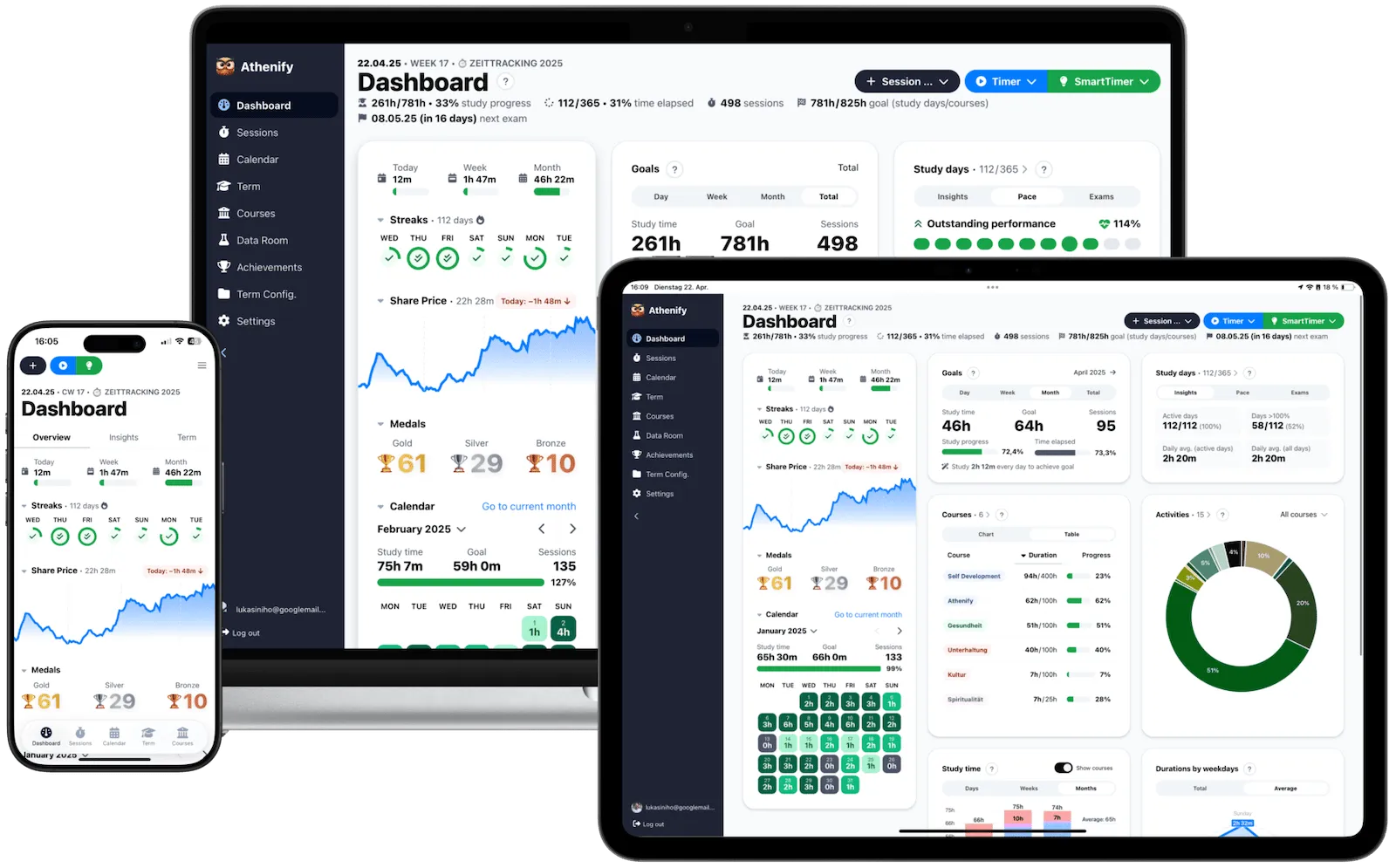
Try Athenify for free
Track your study time, celebrate small wins, and build sustainable habits that work with your brain – not against it.
No credit card required.
No credit card required.
Related reading:
- How to Overcome Test Anxiety – Science-based strategies for exam stress
- How to Focus When Studying – Techniques for concentration and avoiding distractions
- How to Stop Procrastinating – Break the avoidance cycle that anxiety fuels
- The Streak: Building Consistency – How small daily wins compound into lasting habits