The LSATLaw School Admission Test is the single most important factor in your law school application. Unlike your GPAGrade Point Average, which reflects years of accumulated work, or your personal statement, which can be subjective, the LSAT is a pure, objective measure of your analytical reasoning ability.
Here's what makes the LSAT unique: It's entirely learnable. The LSAT doesn't test legal knowledge, current events, or vocabulary. It tests logic, reasoning, and reading comprehension – skills that can be systematically developed through practice.
Students who invest 250–400 hours of focused preparation typically improve their scores by 10–15+ points.
Some improve by 20+ points.
But there's a catch: LSAT improvement is not linear. You might study for 50 hours and improve 5 points, then study another 50 hours and improve only 1 point. Then suddenly, after 150 hours, everything clicks and you jump 8 points. This pattern – slow grind followed by breakthrough – frustrates many students. The solution? Track every hour, trust the process, and stay consistent even when progress seems slow.
This guide will show you exactly how to prepare for the LSAT using evidence-based study strategies, optimal time allocation, and systematic progress tracking. For a broader overview of exam preparation timelines, see our guide on How Long Should You Study for an Exam? Our comprehensive exam preparation guide also covers foundational strategies that apply across all high-stakes tests.

Understanding the LSAT: format and scoring
The test structure
The LSAT has evolved. As of August 2024, it consists of:
| Section | Questions | Time | Scored |
|---|---|---|---|
| Logical Reasoning (LR) | ~25 | 35 min | Yes (2 sections) |
| Reading Comprehension (RC) | 27 (4 passages) | 35 min | Yes (1 section) |
| Analytical Reasoning / Logic Games (AR/LG) | 23 (4 games) | 35 min | Yes (1 section) |
| Variable Section | 22–28 | 35 min | No (experimental) |
| LSAT Writing | 1 essay | 35 min | Unscored (but sent to schools) |
Total scored sections: 4
Total questions: ~101
Test time: ~2.5 hours + breaks
LSAT Score Distribution:
- 120–147: Bottom 25%
- 150–152: 50th percentile (median)
- 160: 80th percentile (competitive for ranked schools)
- 165: 90th percentile (competitive for T-20)
- 170: 97th percentile (competitive for T-14)
- 175+: 99th+ percentile (elite scores)
What each score range means
| Score | Percentile | Law School Prospects |
|---|---|---|
| 120–145 | <25% | Limited options; consider retaking |
| 146–153 | 25–60% | Regional schools, lower-ranked programs |
| 154–159 | 60–80% | Solid regional schools, some ranked programs |
| 160–164 | 80–90% | Top-50 schools, competitive scholarships |
| 165–169 | 90–97% | Top-20 schools, significant scholarships |
| 170–174 | 97–99% | Top-14 schools, full scholarships at most schools |
| 175–180 | 99+% | Harvard/Yale/Stanford competitive, full rides everywhere else |
How many hours should you study for the LSAT?
The research is clear: LSAT improvement correlates strongly with practice hours.
Hour requirements by score improvement goal
Data from thousands of LSAT students reveals a clear correlation between study hours and score improvement:
- 5-point gain: 100–150 hours
- 10-point improvement: 200–300 hours
- 15-point jump: 300–400 hours
- 20+ point transformation: 400–500+ hours
These benchmarks assume focused, tracked study time with proper methods – not passive reading or distracted "studying."
Factors that affect your study time
Your starting point matters enormously. Students beginning below 145 need more foundational work – plan for 350–400 hours to reach 160 or higher. Those in the 145–155 range represent the average starting point and typically need 250–350 hours to hit 165+. If you're already scoring 155+ on your diagnostic, your strong fundamentals mean 200–300 hours could push you to 170+.
Your target score also shapes your timeline. Aiming for the 155–159 range requires 150–250 hours, while 160–164 demands 250–350 hours. The competitive 165–169 range needs 300–400 hours, and elite 170+ scores typically require 350–500 hours or more.
One hour of timed, focused practice under test conditions is worth 3–4 hours of casual "studying" with distractions.
Natural aptitude plays a role too, though not as much as most students assume. Those with strong math or philosophy backgrounds often grasp formal logic more quickly. Strong readers find RC comes easier, freeing more time for Logic Games. Students from humanities or social sciences backgrounds may need additional time to master conditional logic and diagramming.
Study efficiency is the great multiplier. Self-study with proper tracking uses the base hours listed above, but self-study without tracking typically requires 25–50% more time – students consistently overestimate their actual focused hours. Prep courses vary wildly in quality, while private tutoring can reduce total hours needed by providing targeted feedback. This is why time tracking with Athenify is crucial – it enforces honest accounting of actual focused work.
Creating your LSAT study timeline
Study timeline options
The intensive 3-month plan packs 250–300 hours into 20–25 weekly hours. This timeline suits summer study, gap-year students, or those who can study full-time, but carries significant burnout risk due to sustained intensity.
Most students thrive with a balanced 4-month plan, accumulating 300–350 hours at 18–22 hours per week. This represents the sweet spot for 10–15 point improvement – intense enough to build momentum, sustainable enough to maintain quality.
The extended 6-month plan spreads 350–400 hours across 15–18 weekly hours. This approach works best for students balancing full-time work or school, and those aiming for elite 170+ scores who want time for deeper mastery.
The LSAT rewards consistency over intensity. Three focused hours daily for 6 months beats six frantic hours daily for 3 months.
If you're working or taking a full course load, opt for 5–6 months without hesitation. The research consistently shows that consistent moderate effort outperforms sporadic cramming. Consider using the Pomodoro Technique to maintain focus during long study sessions, and explore our guide to building an effective study schedule for strategies on balancing LSAT prep with other commitments.
The proven LSAT study plan: 4-month timeline
Let's detail a 4-month (16-week) study plan targeting 320 hours for a strong 10–15 point improvement.
Phase 1: Fundamentals and diagnostic (Weeks 1–4)
Goal: Learn question types, establish baseline, identify strengths/weaknesses
Hours per week: 15–18
Total phase hours: 60–72
| Week | Focus | Hours | Activities |
|---|---|---|---|
| 1 | Take diagnostic, learn LR basics | 15–18 | Full PT (untimed), study LR question types |
| 2 | Logic Games introduction | 15–18 | Game types, basic diagramming, easy games |
| 3 | Reading Comp strategies | 15–18 | RC approaches, practice passages |
| 4 | Mixed practice, first timed PT | 15–18 | Timed sections, full PT under time |
Daily breakdown (for 16 hours/week):
- 5 weekdays: 2 hours/day = 10 hours
- Weekend: 3 hours/day = 6 hours
- Total: 16 hours
Phase 2: Skill building (Weeks 5–10)
Goal: Develop mastery in each section type, build speed
Hours per week: 20–22
Total phase hours: 120–132
| Week | Focus | Hours | Activities |
|---|---|---|---|
| 5 | Logic Games mastery | 20–22 | Game types, diagramming speed, 4 games daily |
| 6 | Logical Reasoning deep dive | 20–22 | Question type drills, timing practice |
| 7 | Reading Comp intensive | 20–22 | Passage annotation, comparative passages |
| 8 | Timed section practice | 20–22 | Full timed sections, PT #2 |
| 9 | Weakness targeting | 20–22 | Extra work on weakest section |
| 10 | Mixed practice, PT #3 | 20–22 | All section types, full PT |
The optimal study emphasis during this phase allocates 40% of your time to Logic Games (the most improvable section), 35% to Logical Reasoning (which accounts for half your score), and 25% to Reading Comprehension (the hardest to improve quickly).
Logic Games feel intimidating at first but improve the fastest with practice. Many students go from -10 per section to -0 to -2 (near perfect) with 80–120 hours of focused practice. This single section can boost your overall score by 5+ points, making it the highest-ROI investment of your study time.
Phase 3: Practice test intensive (Weeks 11–14)
Goal: Build test-taking stamina, refine timing, reach target score
Hours per week: 22–25
Total phase hours: 88–100
| Week | Focus | Hours | Activities |
|---|---|---|---|
| 11 | PT #4, thorough review | 22–25 | Full PT, 6–8 hour review |
| 12 | Targeted drills, PT #5 | 22–25 | Weakness drills, full PT |
| 13 | PT #6, advanced strategies | 22–25 | Full PT, timing optimization |
| 14 | PT #7, confidence building | 22–25 | Full PT, review difficult question types |
Your practice test schedule should follow a deliberate progression: diagnostic in Week 1 (untimed, then analyze timing), your first timed PT in Week 4, PT #2 in Week 8, PT #3 in Week 10, then PT #4–7 across Weeks 11–14, culminating with your final PT #8 in Week 15.
The review ratio is where most students fall short. For every hour spent taking a practice test, spend 2–3 hours reviewing it. This means a 2.5-hour test requires 5–7 hours of review, totaling 7.5–9.5 hours per practice test. Factor this into your weekly schedule – it's not optional overhead, it's where the learning actually happens.
Phase 4: Final preparation (Weeks 15–16)
Goal: Peak performance, light review, confidence
Hours per week: Week 15: 20–25 hours, Week 16: 8–12 hours
Total phase hours: 28–37
| Week | Focus | Hours | Activities |
|---|---|---|---|
| 15 | Final PT (#8), comprehensive review | 20–25 | Last full PT, polish remaining weaknesses |
| 16 | Light review, taper, rest | 8–12 | Quick review, confidence building, rest |
Section-specific strategies
Mastering logical reasoning (LR)
The Challenge: 50% of your score depends on this section
Time per question: 1 minute 20 seconds average (25 questions in 35 minutes)
The 15 Question Types (approximate frequency):
| Type | Frequency | Difficulty |
|---|---|---|
| Necessary Assumption | 15–20% | Medium-Hard |
| Strengthen/Weaken | 15–20% | Medium |
| Inference/Must Be True | 10–15% | Medium |
| Flaw | 10–15% | Medium |
| Sufficient Assumption | 5–10% | Hard |
| Method of Reasoning | 5–10% | Medium |
| Principle | 5–10% | Medium |
| Parallel Reasoning | 3–5% | Time-consuming |
| Paradox/Resolve | 3–5% | Easy-Medium |
Study strategy for LR:
Your LR development proceeds through three phases:
- Learn question type identification: Identify all 15 types by their stems alone – this lets you approach each question with the right mental framework before reading the stimulus
- Master common reasoning patterns: Causal reasoning (30%+ of questions), conditional logic (if/then structures), argument structure recognition, and common flaws (correlation/causation, sampling issues)
- Develop timing efficiency: Create "skip triggers" (parallel reasoning on first pass? Mark and return), build 80%+ accuracy on easy/medium questions, improve speed through pattern recognition
Read the question stem FIRST. This tells you what to look for in the stimulus, saving 10–15 seconds per question while improving accuracy.
The highest-yield LR skills cluster around five core competencies:
- Identifying conclusions (which aren't always at the end)
- Spotting unstated assumptions
- Mastering conditional logic including contrapositives
- Distinguishing correlation from causation in causal reasoning
- Understanding quantifier distinctions (some/most/all differences matter enormously)
Watch for common mistakes that trap even prepared students: choosing "could be true" instead of "must be true," selecting strengthening answers when you need to weaken, falling for "out of scope" attractive wrong answers, and selecting before systematically eliminating.
Track your LR accuracy by question type in your Athenify notes. If you're missing 70% of Sufficient Assumption questions but only 20% of Strengthen questions, you know where to drill.
Conquering analytical reasoning / Logic Games (LG)
The Challenge: Most learnable section, but requires the most practice
Time per game: 8 minutes 45 seconds (4 games in 35 minutes)
The Game Types:
- Sequencing Games (40–50% of games)
- Linear (most common): Order elements in a sequence
- Advanced: Multiple sequences, circular ordering
- Grouping Games (30–40%)
- In/Out: Elements divided into two groups
- Distribution: Elements sorted into 3+ groups
- Matching Games (10–20%)
- Assign multiple attributes to elements
- Hybrid Games (10–20%)
- Combination of two or more types
The 5-Step Logic Games Method:
- Read and visualize (45 sec): Understand the scenario
- Set up the game board (1 min): Create your diagram/framework
- Symbolize the rules (1 min): Translate all constraints
- Make inferences (2 min): Combine rules, spot deductions
- Attack the questions (4–5 min): Answer systematically
Logic Games improvement curve:
Most students experience a predictable progression through Logic Games. The first 0–30 hours feel disorienting – games take 15–20 minutes each with many errors. Between 30–60 hours, understanding begins crystallizing (typically -8 to -10 per section). Hours 60–100 bring competence (-4 to -6 per section). At 100–150 hours, most students become strong performers (-0 to -3 per section). Beyond 150 hours lies true mastery (-0 to -1 per section).
Track your LG hours separately in Athenify. This section is completely conquerable with adequate practice – the question is simply whether you'll invest the hours. For optimal long-term retention of game setups and patterns, combine your drilling with spaced repetition to revisit problem types at strategic intervals.
Game-specific strategies:
For sequencing games, draw a simple line with slots, use abbreviations consistently, look for "blocks" (elements that must stay together), and identify "splits" where rules create binary possibilities.
For grouping games, counting is essential – know exactly how many elements go in each group. Look for numerical distributions upfront and use "in-out" boards for binary grouping scenarios.
For matching games, create a grid mapping elements to attributes, check "either/or" rules with particular care, and trace conditional chains through to their logical conclusions.
Many students who go -10 on their diagnostic eventually score -0 to -2 consistently. This single improvement can raise your score by 5–8 points.
Dominating reading comprehension (RC)
The Challenge: Hardest section to improve quickly, but strategic gains are possible
Time per passage: 8 minutes 45 seconds (4 passages, 27 questions in 35 minutes)
Passage types (one of each per test):
- Law: Legal theory, court cases, jurisprudence
- Science: Biology, physics, astronomy (explained for laypeople)
- Humanities: Art, literature, philosophy
- Social Science: Economics, sociology, psychology
- Comparative: Two shorter passages on related topics
The Active Reading Method:
Step 1: Read for structure (3–4 min)
- Paragraph 1: What's the topic and author's purpose?
- Paragraphs 2–3: What's the development? (evidence, contrast, examples)
- Final paragraph: What's the conclusion/significance?
Step 2: Create a mental map
- Don't memorize details – know where to find them
- Note tone/attitude: Is the author neutral, critical, supportive?
- Identify the "main point" in one sentence
Step 3: Attack questions strategically (4–5 min)
- Do "specific" questions first (line references)
- Then "inference" questions (use your map)
- Save "main point" for last (easiest once you've engaged with the passage)
Some students swear by annotating (underlining, circling). Others read "pure" without marking. Experiment with both in your first 20–30 passages, then stick with what yields better accuracy. Track both methods separately in Athenify to compare.
Common RC mistakes:
The most frequent RC errors fall into predictable patterns. Many students read too slowly and run out of time, while others read too quickly and miss key information – finding your personal speed-accuracy balance requires experimentation. The "could be true" vs. "must be true" distinction trips up even strong readers. Confusing the author's perspective with views merely described in the passage causes unnecessary errors. And selecting extreme answers ("always," "never") when the passage is nuanced represents one of the test-maker's favorite traps.
RC improvement timeline:
- Foundation (ongoing): Read difficult material daily – 30 minutes with The Economist, Scientific American, or dense philosophy articles
- Weeks 1–4: Practice untimed, focusing on understanding; aim for 90%+ accuracy before adding time pressure
- Weeks 5–8: Introduce timing gradually – start with 10 minutes per passage, work down to 8:45
- Week 9+: Drill specific weaknesses (struggling with science passages? Do 10 extra; missing inference questions? Drill that type)
Track your RC accuracy by passage type and question type in Athenify. If you consistently miss science passages, you need more practice with scientific reasoning – the data will reveal patterns invisible to casual observation.
How Athenify optimizes your LSAT preparation
The LSAT requires 250–400 hours of focused practice, and without tracking, students consistently fail to reach their potential. They overestimate actual study time by 30–50%, don't allocate time optimally across sections, can't identify which methods are actually working, and lose motivation when progress feels invisible.
Athenify solves these problems.
1. Section-based time tracking
Create categories for each LSAT component: Logical Reasoning, Logic Games, Reading Comprehension, Practice Tests (full), Test Review, and Drilling (for specific weaknesses). After 3–4 weeks of tracking, you'll see your actual time distribution laid bare.
Most students spend too much time on their strongest section (because it feels good) and not enough on their weakest (because it's frustrating). Athenify makes this imbalance visible and undeniable. If you're spending 60% of time on LR because you enjoy it, but only 15% on LG even though you're -8 per section, the data shows exactly where you need to rebalance.
2. Hour goals and progress tracking
Set total hour goals by phase: 60–72 hours for Phase 1 (Fundamentals), 120–132 hours for Phase 2 (Skill Building), 88–100 hours for Phase 3 (Practice Tests), and 28–37 hours for Phase 4 (Final Prep) – totaling 296–341 hours across your preparation.
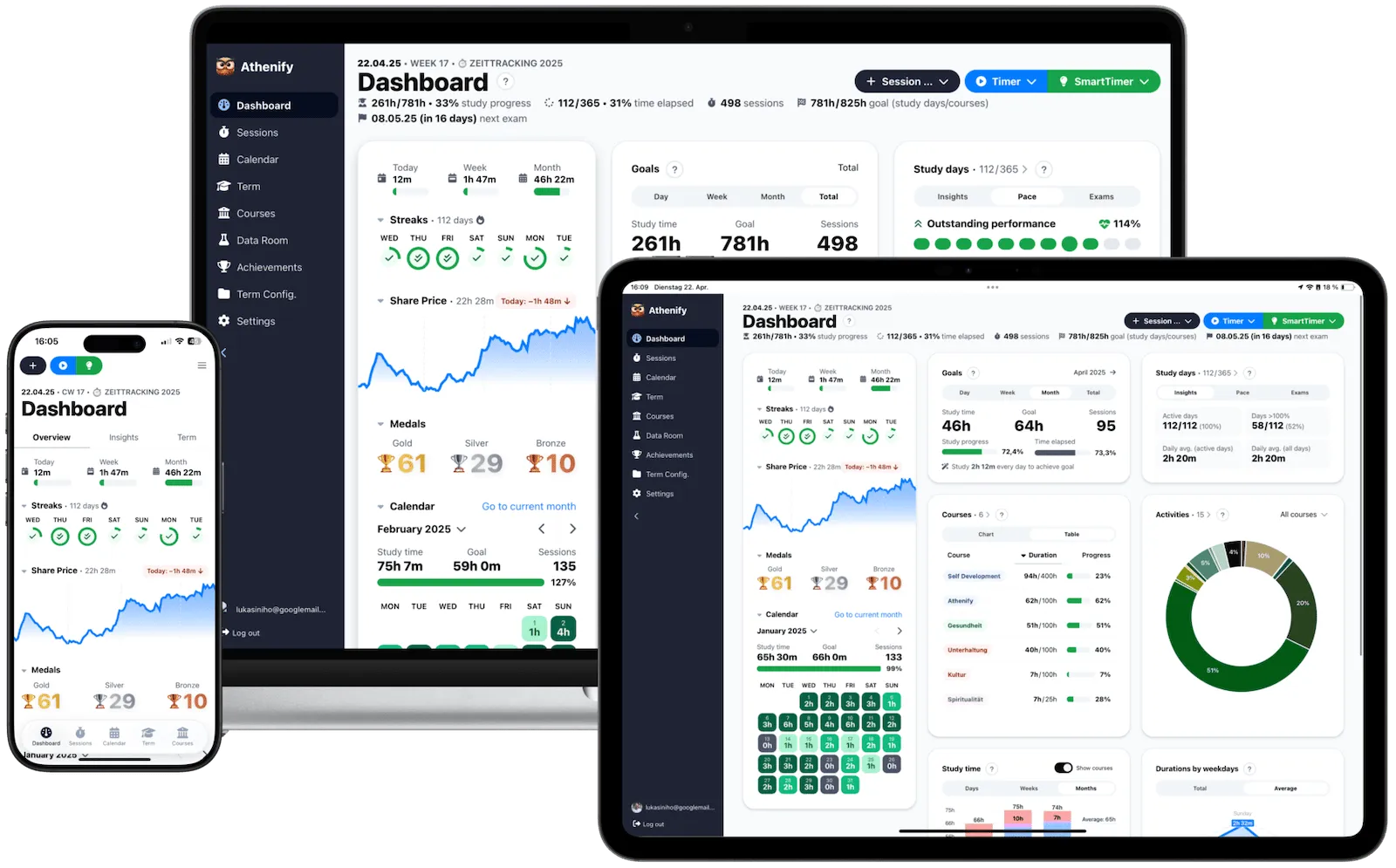
Athenify tracks your progress toward these milestones in real-time. Behind your pace in Week 6? You'll know immediately and can catch up in Week 7 before the gap becomes insurmountable.
Try Athenify for free
Track your 300+ hours of LSAT prep by section, monitor your practice test progression, and stay motivated over 4–6 months with streaks and milestones.
No credit card required.
No credit card required.
3. Practice test score tracking
Log every practice test with comprehensive data: test number, date taken, total score plus section scores, hours studied since last PT, key weaknesses identified, and review time invested. After 4–5 tests, clear trends emerge – overall score trajectory (improving, plateauing, or fluctuating), section-specific patterns (is LG improving while RC stagnates?), and score variance (high variance suggests timing issues or inconsistent fundamentals).
The ideal LSAT score progression over 4 months, starting from a 150 diagnostic, looks something like this: PT #1 in Week 4 at 151–153, PT #2 in Week 8 at 154–157, PT #3 in Week 10 at 157–160, PT #4–6 across Weeks 11–13 at 160–163, and PT #7–8 in Weeks 14–15 at 163–166. Each 3-point improvement represents roughly 40–60 hours of effective study – track this correlation in Athenify to understand your personal learning curve.
4. Identifying optimal study patterns
After 60–80 hours of tracked study, analyze your patterns to find your personal optimization formula. Do you focus better in 90-minute blocks or 3-hour sessions? Does your peak performance occur in the morning, afternoon, or evening? Is timed or untimed practice more effective for building your skills? Does the library, home, or coffee shop yield your best focus?
Use this data to optimize your remaining 200+ study hours. The answers differ for everyone, and only tracked data reveals your personal patterns.
5. Gamification for long-term consistency
4–6 months of LSAT study is a marathon. Athenify's gamification features maintain motivation:
Streaks: Study at least 2–3 hours daily. Build a 60-day streak leading into your test. Breaking a long streak hurts – which keeps you consistent.
Medals: Bronze (meet daily goal), Silver (exceed goal), Gold (double goal). Competitive students thrive on collecting these.
Share Price: Your cumulative effort visualized as a rising number. Watch it climb from 0 to 300+ hours.
Students who maintain consistent study streaks (even just 2 hours per day minimum) outperform those with sporadic study patterns – even when total hours are similar. Consistency beats intensity for LSAT improvement.
6. Honest accountability
The timer enforces honesty. When you start an Athenify session, you're committing to genuine focus – no counting "study time" spent scrolling social media, no logging dinner breaks as study hours, no claiming credit for watching videos while barely paying attention or flipping through books without active engagement. This kind of deep work is what separates high scorers from those who plateau.
Only real, focused study counts. This accountability is uncomfortable but transformative.
The students who improve most are those who can look at their logged hours and know every minute represents genuine effort.
Common LSAT preparation mistakes
Mistake #1: Starting too late
Every cycle, thousands of students start LSAT prep 6–8 weeks before their test. Result: Scores 5–10 points below potential, forcing expensive retakes and delayed law school applications.
Solution: Start 4–6 months before your target test date. Use Athenify from Day 1 to track toward your 300+ hour goal.
Mistake #2: Neglecting Logic Games
"I'm good at reading and logic, so I'll focus less on games.
Wrong. Logic Games is the highest-ROIReturn on Investment section for most students. It's completely learnable with practice.
Solution: Allocate 35–40% of total study time to Logic Games until you're consistently -2 or better. Track LG time separately in Athenify.
Mistake #3: Not reviewing practice tests thoroughly
Taking a PT without deep review is like going to the gym and not lifting weights – you showed up, but you didn't actually train.
For every wrong answer, you must understand why you got it wrong, identify the question type and optimal strategy, find the exact evidence supporting the right answer, and complete 3–5 similar questions to reinforce the concept. This takes 5–7 hours per PT – longer than the test itself. But this review time is where actual learning occurs – it's the essence of active recall, which research shows is far more effective than passive re-reading.
Mistake #4: Using only new practice tests
The LSAT recycles logic patterns. Older tests (PTs 1–40) are excellent practice, especially for fundamentals.
Solution: Use older tests for drilling and untimed practice. Save newer tests (PTs 70+) for your final 8–10 full practice tests.
Mistake #5: Studying inefficiently
Here's a hard truth: watching "LSAT tips" videos isn't studying. Reading explanations isn't studying. Thinking about studying definitely isn't studying. Only active practice – doing timed sections, working through games, attacking passages – counts as real preparation.
Follow the 80/20 rule: 80% of your study time should be active practice (solving problems, taking tests, drilling), while only 20% should be strategy learning (videos, reading guides). Track both categories separately in Athenify to maintain this ratio – it's easy to let passive learning creep up when active practice feels hard.
The final two weeks: peak and taper
Final week schedule
| Day | Activity | Time |
|---|---|---|
| 14 days out | Last full practice test (PT #8) | 2.5 hours |
| 13–12 days out | Thorough PT review | 6–8 hours |
| 11–10 days out | Light drilling (weak areas only) | 3–4 hours |
| 9 days out | One timed LG section | 35 min |
| 8 days out | One timed RC section | 35 min |
| 7 days out | One timed LR section | 35 min |
| 6–5 days out | Light review, formula review | 2 hours |
| 4 days out | Complete rest day | 0 hours |
| 3 days out | One untimed LG (for confidence) | 30 min |
| 2 days out | Skim notes, relax | 1 hour |
| 1 day out | Prepare materials, early bed | 0 hours |
Test day strategy
The night before
Prepare everything you'll need:
- LSAT admission ticket
- Government ID
- Five or six #2 pencils
- Eraser
- Analog watch (digital not allowed)
- Snacks and water
Get a full 8 hours of sleep – no exceptions. Do absolutely no LSAT work; your brain needs rest to consolidate everything you've learned. If anxiety strikes, review your score progression in Athenify to remind yourself of the evidence of your preparation.
The morning of
- Eat a high-protein breakfast (avoid mid-test sugar crashes)
- Arrive 30 minutes early to settle in without rushing
- Bring a light jacket (test centers vary wildly in temperature)
- Take a quick bathroom visit before check-in
- Take three deep breaths before entering the testing room
During the test
Time management:
- Budget 8:45 per game or passage, 1:20 per LR question
- Mark difficult questions and return to them – don't spiral on any single problem
- If you encounter two LR sections, treat both as scored (you won't know which is experimental)
Break time strategy:
- Walk around and stretch
- Breathe deeply
- Eat your snack and hydrate
Maintain the right mindset throughout. Everyone finds the LSAT hard – that's completely normal. One bad game or passage won't ruin your score. Focus on the question directly in front of you, not your running estimate of overall performance. Trust the 300+ hours of preparation you've logged.
The Cancellation Decision: You can cancel your score immediately after the test, but only do so if you got visibly sick during the exam, completely misunderstood multiple sections, or experienced a genuine emergency. Don't cancel just because it felt hard – it always feels hard. Many students cancel impulsively, then realize they would have scored fine. Cancellations only delay your application cycle.
Retake strategy
About 25–30% of LSAT takers retake the test. Should you?
When to retake
Consider retaking if:
- Your score is 5+ points below your recent practice test average
- You're below your target school's median
- You had unusual test-day circumstances (illness, distraction)
- Your score distribution shows obvious anomalies (e.g., -15 in one section but -2 in others, suggesting a timing issue)
The average LSAT retake improvement is just 2–4 points. However, students who study an additional 80–120 hours, focus specifically on their weakest section, and take 4–5 new practice tests improve an average of 5–8 points. The difference is preparation quality, not just showing up again.
Retake study plan (2–3 month timeline)
Month 1: Targeted drilling (spend 60% of time on weakest section)
Month 2: Full practice tests (4–5 tests) with thorough review
Month 3: Timed section work, final 2 practice tests, taper
Track all retake hours separately in Athenify to ensure you're putting in the necessary 80–120 additional hours.
Important: Law schools see all your LSAT scores. Most use your highest, but some average them. Research your target schools' policies. Generally, one retake with improvement is viewed positively. Multiple retakes suggest test anxiety issues.
Conclusion: from pre-law to law student
The LSAT is conquerable. It's not an IQ test. It's not a mystery. It's a standardized exam that rewards preparation, strategy, and consistency.
The formula is proven:
- Start early (4–6 months before test day)
- Set realistic hour goals (250–400 hours based on target improvement)
- Track every session using Athenify to log study time by section
- Practice actively (80% doing problems, 20% learning strategies)
- Take regular practice tests (8–10 full tests with thorough review)
- Analyze your data to identify patterns and optimize your approach
- Stay consistent because daily study beats sporadic cramming
Set up your Athenify categories today – LR, LG, RC. Set your total hour goal (250–400). Take your diagnostic test. Log your first study session. Watch your hours accumulate and your practice scores rise.
The students who succeed on the LSAT aren't necessarily the naturally brightest. They're the most prepared.
They put in adequate hours (300+). They track their time honestly. They stay consistent even through frustrating plateaus. They trust the process when improvement seems slow. And they show up on test day confident, fresh, and ready.
You can be one of them.