You've spent months preparing. Hundreds of hours of practice problems, flashcards, and full-length tests. But as the MCATMedical College Admission Test approaches, a familiar dread builds: What if I freeze? What if I blank on everything I studied?
MCAT anxiety is different from regular test anxiety. The stakes are objectively high – your score significantly influences which medical schools will consider you. The format is uniquely demanding – few other exams require 7.5 hours of sustained mental effort. And the preparation timeline is enormous – you've invested 300–500 hours into this single day. Understanding effective exam preparation strategies can help you feel more confident walking into test day.
Your anxiety isn't irrational. But it is manageable.
Why the MCAT triggers intense anxiety
The MCAT combines multiple anxiety triggers that rarely appear together:
The stakes are real. Unlike a classroom exam where you can recover with the next test, the MCAT is a gatekeeping exam. Low scores can close doors to your preferred schools or require a retake that delays your entire application cycle.
The length is brutal. Maintaining focus for 7.5 hours depletes mental resources in ways you rarely experience. Fatigue compounds anxiety – by the third section, even confident students feel doubt creeping in. Learning to enter deep work states during your preparation can help build the mental stamina needed for this marathon exam. Building the capacity for deep, focused work during your preparation helps you develop the mental stamina needed for test day.
The breadth is overwhelming. Four distinct sections spanning biology, chemistry, physics, psychology, sociology, and reading comprehension. Your brain can't help thinking about all the content you might have missed.
You've invested enormously. After months of preparation and significant opportunity costs, it feels like everything rides on this single performance. That pressure amplifies every moment of uncertainty during the test.
Your anxiety about the MCAT proves you understand the stakes. Now learn to channel that energy productively.
3 quick techniques for test day
These techniques are designed to work quickly, during the limited time between sections or when you feel panic rising mid-question.
1. The 60-second reset (4-7-8 breathing)
This is your most powerful tool. The 4-7-8 breathing pattern physically activates your parasympathetic nervous system, counteracting the stress response. If you use the Pomodoro technique during your study sessions, you can practice this breathing pattern during every break until it becomes automatic.
How to do it: Breathe in through your nose for four seconds, hold for seven seconds, then exhale slowly through your mouth for eight seconds. Repeat two to three times. The entire reset takes less than sixty seconds.
Use this before the exam starts, during every break, and any time you feel anxiety spiking during a section. The extended exhale is the key – it signals safety to your brain and interrupts the fight-or-flight cascade before it takes hold.
2. Reframe nerves as excitement
Your racing heart and heightened alertness aren't signs of impending failure – they're your body preparing for a challenge. Anxiety and excitement feel nearly identical physically.
Instead of thinking "I'm so nervous, I need to calm down," tell yourself: "I'm excited. This energy will help me focus."
Research shows this simple cognitive reframe improves performance by up to 17%. You're not suppressing your body's response – you're redirecting its meaning.
3. The 5-4-3-2-1 grounding technique
If anxiety spirals into near-panic, this sensory grounding exercise pulls you back to the present moment. Start by noticing five things you can see – the computer screen, your scratch paper, the desk. Then identify four things you can hear, like the AC hum or your own breathing. Notice three things you can physically touch: the keyboard, the chair, your clothing. Find two things you can smell and one thing you can taste.
Your brain can't simultaneously panic about the future and notice sensory details in the present.
This exercise takes about thirty seconds and interrupts the catastrophic thought loops that fuel anxiety. By forcing your attention onto concrete sensory input, you break the cycle of spiraling worry.
If you blank mid-exam
Mental blanks happen when stress hormones temporarily block memory retrieval. The information is still there – it's just inaccessible. Knowing this changes everything: you're not failing, your brain is simply in temporary lockdown.
When a blank hits, recognize it immediately. Tell yourself: "This is a stress response. It's temporary." Then mark the question for review and move on without hesitation – dwelling on a blank question only deepens the panic. Answer two or three easier questions to prove to your brain that you still know things. This reduces the perceived threat and allows retrieval pathways to reopen. When you return to the marked question with fresh eyes, the answer usually surfaces once the acute stress has passed.
Build confidence through tracking
Much of MCAT anxiety stems from uncertainty: Did I study enough? Am I actually prepared?
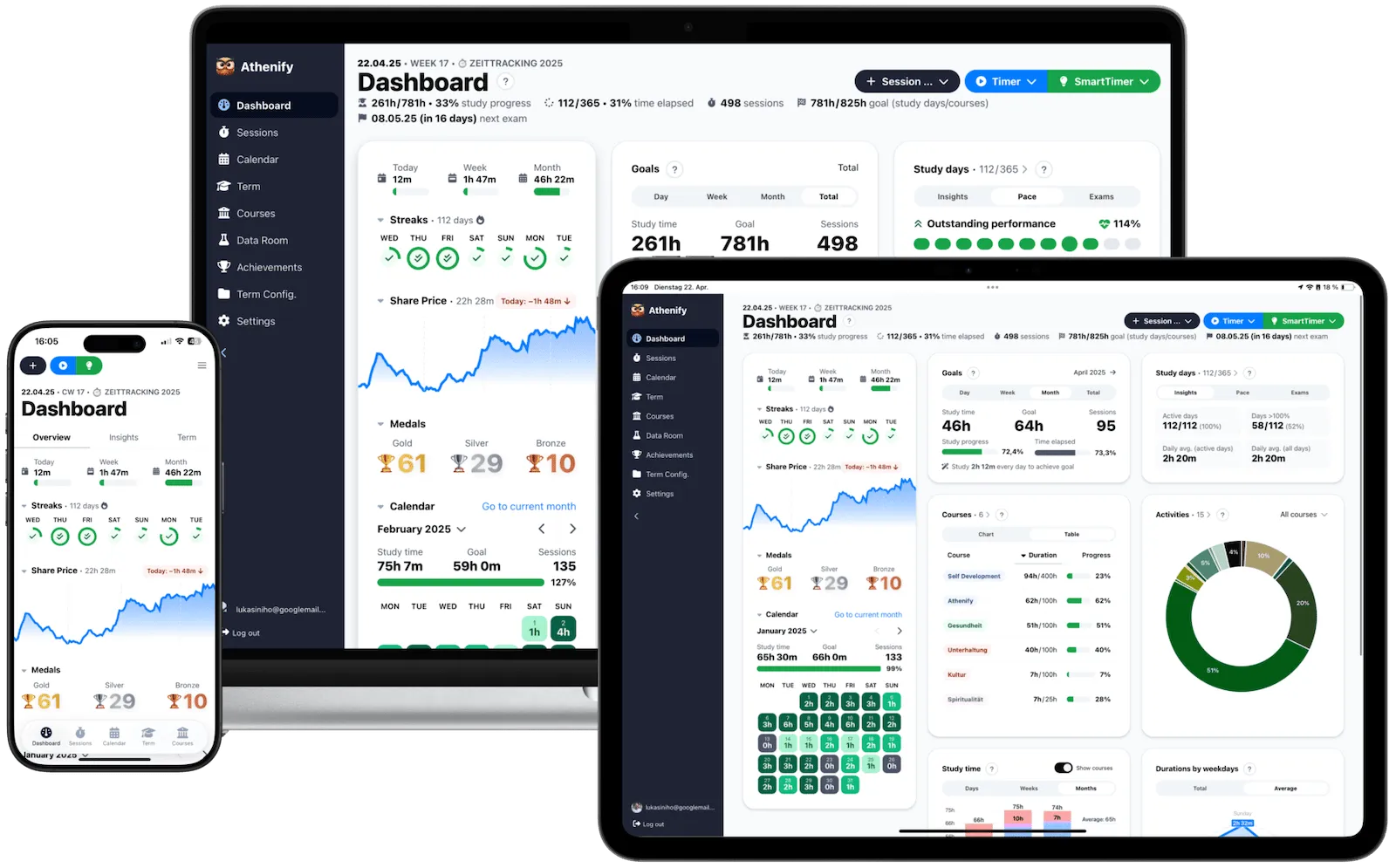
The antidote is data. When you've tracked 400+ hours of MCAT preparation – broken down by section, with practice test scores showing steady improvement – you have evidence that you're ready. Understanding the science of study time tracking reveals why this approach works: objective data overrides the subjective distortions anxiety creates.
Vague feelings of unpreparedness can't survive contact with a spreadsheet. When you can see your total hours logged, your time distribution across each section, and your practice test progression climbing from 502 to 506 to 510 to 514, the evidence speaks louder than anxiety ever could.
The night before the exam, look at your tracked hours. That number represents real work, real preparation, real competence. Let the evidence quiet the anxious voice. If you're struggling to maintain momentum through your prep, our guide on study motivation offers strategies to stay on track despite anxiety.
Try Athenify for free
Track your MCAT hours by section, log practice test scores, and walk into test day with data-backed confidence.
No credit card required.
No credit card required.
You're ready
MCAT anxiety is universal because the exam is genuinely challenging. But thousands of students manage that anxiety and perform at their ability level every year. You can too.
Your preparation is complete. Your techniques are practiced. Trust the 300–500 hours you invested – and trust yourself.
Related reading:
- How to Overcome Test Anxiety – Comprehensive strategies for all types of exam anxiety
- MCAT Preparation Study Plan – The complete guide to structuring your MCAT prep
- The Streak: Building Consistency – How tracking streaks creates lasting study habits