

Cal Newport's concept of "Deep Work" revolutionized how we think about productivity. In his influential book, Newport defines deep work as "professional activities performed in a state of distraction-free concentration that push your cognitive capabilities to their limit." This type of work creates new value, improves your skills, and is hard to replicate. For students preparing for exams or working through dense material, deep work is not optional—it is the difference between surface-level familiarity and genuine understanding.
The flow state is the psychological basis of deep focus. Psychologist Mihaly Csikszentmihalyi discovered that people are happiest and most productive when fully immersed in a challenging task. Flow requires clear goals, immediate feedback, and a balance between challenge and skill—conditions a good focus timer helps create. When you start a timed session with a defined task, you set the stage for flow by giving your brain a clear target and a finite window to reach it.
Longer sessions work better for complex tasks. While the Pomodoro Technique's 25-minute intervals are great for routine work, deep cognitive tasks often benefit from 50–90 minute sessions. It takes time to "load" complex problems into your working memory; frequent breaks can reset this progress. A dedicated study timer lets you choose the session length that matches the depth of your work, rather than forcing every task into the same mold.
Digital hygiene is essential for deep focus. Every notification, every visible browser tab, every potential distraction consumes cognitive resources—even if you don't act on it. A fullscreen timer physically removes these distractions by covering your entire screen, making it easier to enter and maintain a flow state. This simple environmental change can dramatically improve your concentration during study sessions.
Focus is a skill that improves with practice. Like a muscle, your ability to concentrate deeply strengthens with regular training. An aesthetic focus timer paired with a study tracker provides the structure you need to build this "attention muscle"—measuring progress, rewarding consistency, and making each session count. The key is not willpower but routine: the more you practice deliberate concentration, the more natural it becomes.
Choosing the right focus session length
There is no universal "best" session length—but there are evidence-based guidelines. Research on ultradian rhythms suggests that the brain naturally cycles through periods of high and low alertness in roughly 90-minute waves. This does not mean every session must last 90 minutes, but it does mean your timer should work with your biology rather than against it. The right session length depends on the task, your current focus capacity, and how deep you need to go.
25-minute sessions suit tasks that require quick execution or feel overwhelming. The Pomodoro timer technique breaks work into short, manageable intervals with 5-minute breaks between them. This works well for reviewing flashcards, answering practice questions, administrative study tasks, or any work where momentum matters more than depth. Shorter sessions also lower the barrier to starting—when the entire commitment is only 25 minutes, procrastination has less room to take hold.
50-minute sessions hit the sweet spot for most academic work. This length gives your brain enough time to fully engage with complex material—reading dense textbook chapters, writing essay drafts, or working through problem sets—without pushing into fatigue. A 50-minute block with a 10-minute break mirrors the traditional lecture format for good reason: it balances sustained concentration with necessary recovery. If you are new to using a focus timer online, 50 minutes is the most reliable starting point.
90-minute sessions are reserved for your deepest work. Thesis writing, long-form research, coding projects, and creative problem-solving often require this extended runway. The first 15–20 minutes are typically spent "loading" the problem into working memory; breaking too early means you never reach the productive phase that follows. However, 90-minute sessions demand more recovery—plan for a 20–30 minute break afterward, and limit yourself to two or three such blocks per day. To find your personal sweet spot, experiment across session lengths and use a study tracker to compare your output and energy levels over time.
Building a daily focus practice
Consistency matters more than intensity. A student who completes three focused 50-minute sessions every day will outperform someone who crams six hours on the weekend. The reason is neurological: spaced, repeated effort consolidates learning more effectively than marathon sessions. Treat your focus practice like exercise—regular, scheduled, and non-negotiable. Block specific times in your calendar and defend them the way you would a class or a meeting.
Your environment shapes your focus before you even sit down. Dedicated study spaces train your brain to associate a specific location with concentration. Keep your desk clear of unrelated items. Use noise-cancelling headphones or background sound if your space is noisy. And when it is time to work, launch a fullscreen timer to eliminate the last digital temptation—your own screen. The aesthetic quality of your timer matters here, too. A clean, beautiful interface signals to your brain that this is a deliberate, intentional activity, not just another browser tab competing for attention.
Tracking turns vague intentions into concrete data. Without measurement, "I studied a lot this week" is a feeling, not a fact. A study tracker that logs your sessions automatically gives you an honest record: how many hours you actually focused, which subjects received the most attention, and whether your consistency is improving or slipping. This data is motivating when things go well and diagnostic when they do not. Over weeks and months, your logged sessions become proof of effort—a visual record that builds confidence heading into exams.
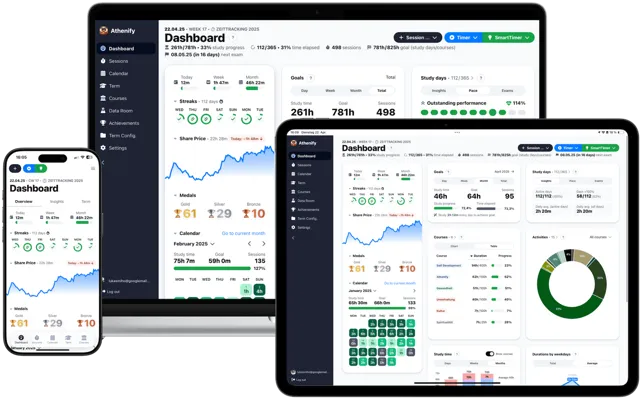
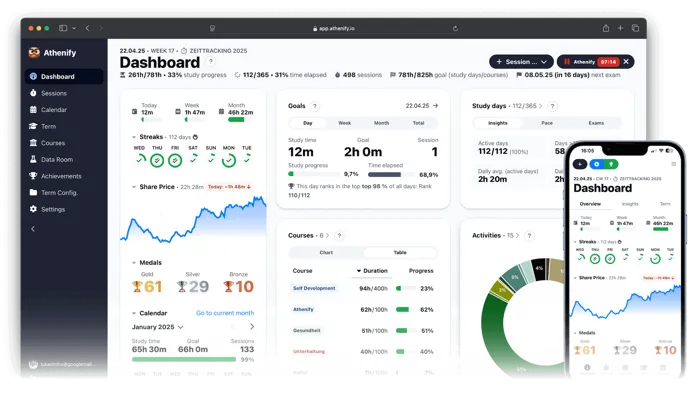
Athenify combines the timer and the tracker into a single workflow. Start a focus session, and the study timer counts down while your time is automatically logged to the right subject. When the session ends, your dashboard updates with new data. There is no separate step to record your hours, no spreadsheet to maintain, no friction between working and tracking. This seamless connection between concentration and measurement is what turns a simple online timer into a complete focus system—and what helps you build the daily practice that produces real results.