What if everything you believed about your study habits was wrong? That unsettling question hit me one fall afternoon in 2014, sitting in a university library with no idea whether I was actually productive or just fooling myself. So I did something that would change my entire academic career: I started tracking every single minute I spent studying. Over the next several years, I logged more than 2,000 hours of study time – and the insights I gained completely transformed how I approach learning.
1. The idea: why I built a Study Journal
Fall 2014. Finals were coming up in December, and I was sitting in the library with my MacBook, trying to study for my Finance 301 exam. Something felt off. I had no idea how much work I was actually putting in. No overview, no real plan – my entire study process was a complete black box.
So I opened the App Store, hoping to find something that would help me get my act together. I vaguely remembered reading about the Pomodoro technique somewhere online, and I figured I'd give it a shot.
I used a Pomodoro app for a few days, but it just didn't click. The app only let me do things its way – I couldn't track my study sessions the way I wanted to. But here's the thing: the idea of documenting every study session fascinated me. I couldn't shake it.
So I opened Numbers (Apple's version of Excel) and started building my own tracking system. My goal was simple: create a little "database" to log my study time. What did I need? Just three things: the subject, the start and end time, and a quick note about what I worked on. And just like that, the first version of my Study Journal was born.
Want to try the Pomodoro technique yourself? Check out our free Pomodoro Timer.

2. The concept: a tool to help me study more
What gets measured gets managed – tracking makes the invisible visible.
The core idea behind the Study Journal is deceptively simple: more time spent studying beats less time spent studying. My assumption was that the more time you put in, the better your chances of getting a good grade. Sure, there are diminishing returns at some point, but all else being equal, more studying is better than less.
I know this sounds almost too simple – it doesn't account for things like study efficiency. But that's kind of the point. The Study Journal isn't about how you study. It's not about flashcards vs. practice problems, or studying alone vs. in groups. It's purely about measuring how much you study.
That's exactly what my Study Journal does – it's a tracking system that helps me study more by making the invisible visible. Put simply: the Study Journal tracks every study session, creates transparency, and motivates me to keep going. This philosophy of accountability in studying – supported by the science of study time tracking – eventually became the foundation for Athenify.
3. How it works
Over the years, I kept refining the Study Journal semester after semester. At first, I just wanted a clear picture of what I was actually doing – I wanted to see if my gut feeling matched reality.

At its heart, the Study Journal is just a spreadsheet. Each row represents one study session with these columns:
- Date – When you studied
- Start and end times – The exact time window
- Breaks taken – To calculate net duration
- Net duration – Total time minus breaks
- Solo or group – Your study setting
- Type of work – Reading slides, solving problem sets, memorizing, etc.
- Subject – Which course or topic
- Notes – What you specifically covered
Over a semester, you end up with hundreds of these entries. And with basic spreadsheet formulas, you can pull out some really interesting insights.
4. The evolution: building something better
People always ask me: "Isn't tracking every study session super time-consuming?"
Here's how I think about it. There are two types of costs:
- Setup cost – Building the spreadsheet template (you do this once, takes an hour or two)
- Logging cost – Recording each session (takes seconds per entry)
Yes, setting up the template takes time upfront. But after that? You're good to go for the entire semester.
Logging each session feels weird at first, but it quickly becomes second nature. We're talking a few seconds – punch in the time, select the activity type, jot down what you did. Even if it took a full minute per session (it doesn't), that's less than 10 hours over an entire semester with 500 sessions. In exchange, you get complete visibility into your study habits. Pretty good trade-off. For more on why time tracking as a student is worth the effort, see our dedicated guide.
Today, Athenify's features make this whole process even faster.
5. What the Study Journal actually does
What started as simple documentation turned into something much more powerful. I discovered three main benefits:
- Transparency – Seeing exactly what you're doing through learning analytics. No more guessing.
- Control – Steering your studying in the right direction through motivational tools.
- Understanding – Learning about your own patterns through insights that compound over time.
The Study Journal brings order to chaos. Every session gets logged the same way, which means you can actually analyze what's happening.
Let's be honest – studying is often messy and emotional. The Study Journal brings order to that chaos. With everything tracked, you can see exactly what you did (and didn't do) each day. You can compare subjects, compare semesters, and spot patterns you'd never notice otherwise. And perhaps the biggest benefit: the built-in motivation. The Study Journal pushes you to hit your targets. Tools like the medal table and the share price add extra incentives that really work.
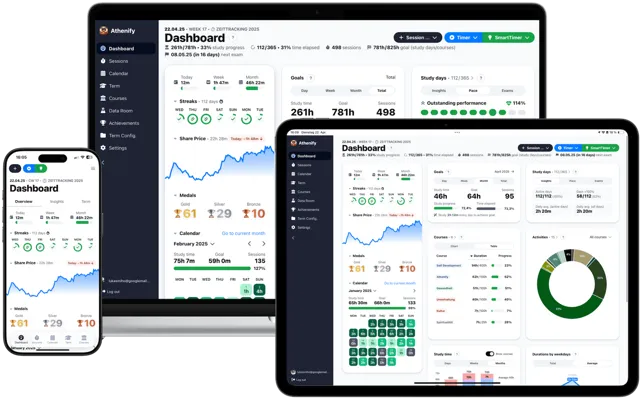
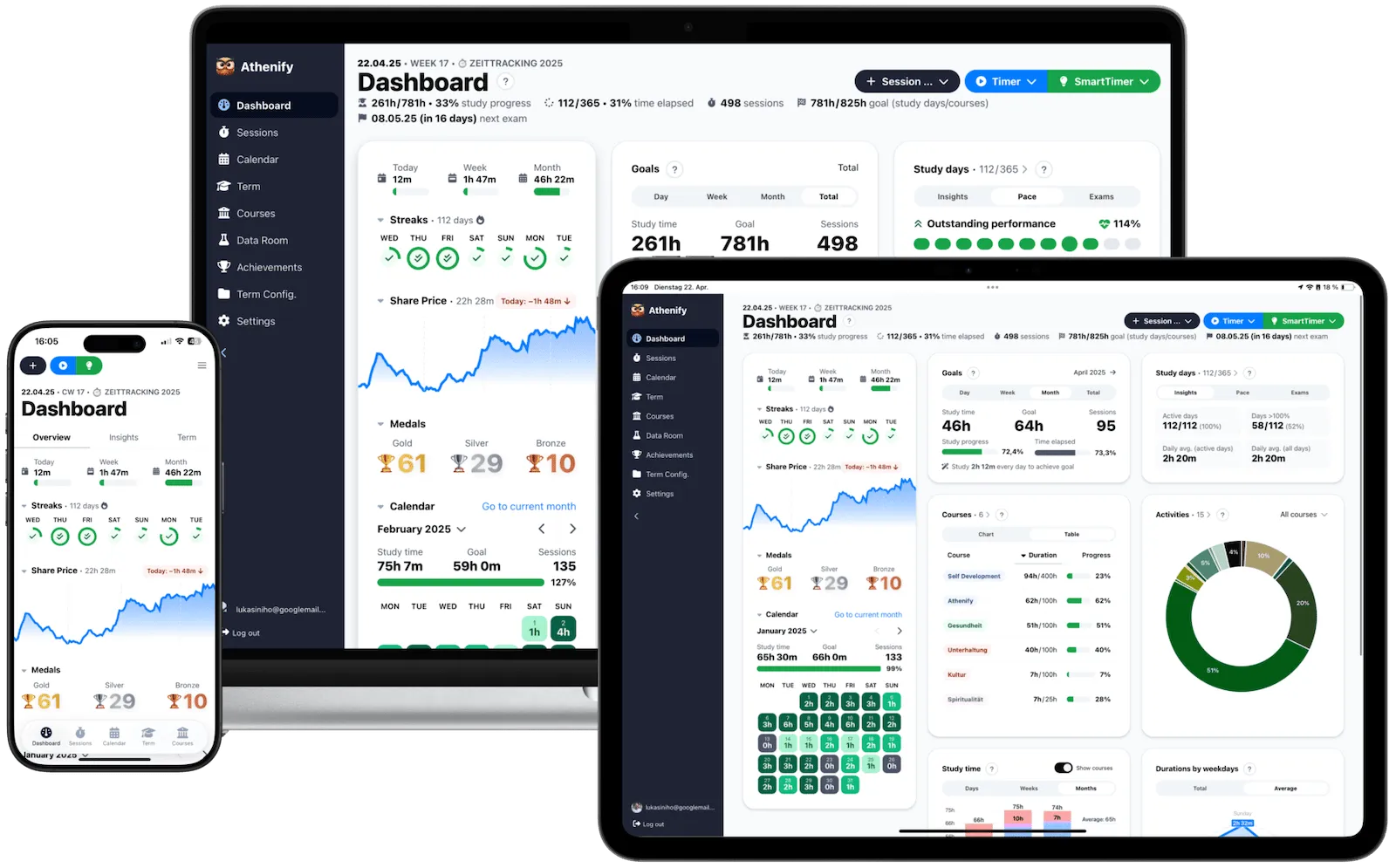
The dashboard

Eventually, I built a dashboard to see everything at a glance. Here's what I track:
Daily study time: This was huge for me early on. I wanted to know if my actual study time matched how much I felt like I'd studied. Spoiler: it often doesn't. Some days you grind for hours and it feels like nothing. Other days, three hours feels like five.

Time per subject: This shows me exactly how much attention each class is getting. I wanted to know: does study time correlate with credits? With difficulty? Turns out I tend to study less for subjects I actually enjoy. Go figure.

Time by activity type: I first used this when writing my bachelor's thesis. I wanted to see how my time broke down between research, reading papers, outlining, writing, and editing.

7-day average: This graph shows daily study hours with a rolling weekly average (the red line). You can watch it climb as the semester progresses, eventually plateauing around 5 hours per day during finals.

Cumulative time: This one's pretty self-explanatory – it shows your total study hours over time. The curve starts flat at the beginning of the semester, then gets steeper as finals approach.

Gamification: the secret sauce
Here's where things get fun. I built in some psychological tricks to keep myself motivated: the medal table and the share price.

The Medal System: I figured out that 5 hours of net study time is my sweet spot. So I started awarding myself medals based on daily performance – Platinum for 6+ hours, Gold for 5+ hours, Silver for 4+ hours, and Bronze for 3+ hours. The goal? Collect as many medals as possible. I also try to build streaks – like getting 5 gold medals in a row. It sounds silly, but it works. When you're at 4.5 hours, you really want to push through to gold.
When you're at 4.5 hours, you really want to push through to gold. Gamification turns studying into a game you want to win.
The Share Price: This one's a bit quirky, but bear with me. I set a daily study target, and my performance affects a fake "stock price." Hit the target exactly? Price stays flat. Miss it? Price drops. Beat it? Price goes up.

I even named it after myself (the "von-Hohnhorst stock"). Something about watching your personal stock price rise is weirdly motivating. Learn more about how the share price works.
6. What I learned about studying

After years of tracking, I understand my study habits way better. I can compare semesters, predict how many hours I'll need for certain grades, and see what actually works for me.
After years of tracking, these five insights changed how I think about studying:
- More studying = better grades – I ran a correlation analysis comparing "study time per credit hour" across semesters. The correlation with GPA was −0.95 (negative because in Germany, lower GPA numbers are better). Correlation isn't causation, but it's hard to argue that study time doesn't matter.
- 5 hours is the sweet spot – Through trial and error, I've found that 5 hours of net study time per day is optimal. I can push to 6+ hours if I start early and sleep well, but productivity drops off. At 5 hours, I stay balanced with energy for exercise, reading, and life outside of studying.
- Keep it simple (80/20 rule) – My Study Journal sits at the sweet spot between powerful and manageable. The Pareto principle applies: 20% of the features deliver 80% of the value. Don't over-engineer it. This simplicity is one of the best study habits I've developed.
- Your gut is often wrong – Some days feel super productive but the numbers tell a different story. Other times, you feel like you barely did anything, but you actually logged 5 solid hours. The data doesn't lie.
- Preparation doesn't guarantee results – Even with perfect preparation, exams can go sideways. Studying and test-taking are two different skills.
Some days feel super productive but the numbers tell a different story. The data doesn't lie – that's the whole point.
Try Athenify for free
Start your own study journal with automatic tracking, streaks, and analytics that reveal exactly where your time goes.
No credit card required.
No credit card required.
When preparation doesn't match results
Here's a tough truth: even with perfect preparation, exams can go sideways. Studying and test-taking are two different skills. You can prepare brilliantly and still have an off day, or get hit with weird questions.
When that happens, review what went wrong and move on. Every exam is a fresh start. The Study Journal helps you nail the preparation – the rest is up to you.