As a student, you probably feel like there's never enough time. Between lectures, assignments, social life, and everything else, your days seem to vanish. But here's the uncomfortable truth: Most students have no idea where their time actually goes.
You might think you studied for 4 hours yesterday, but if you tracked every distraction, scroll through social media, and mindless YouTube video, the real focused study time was probably closer to 90 minutes. This gap between perception and reality is costing you grades, sleep, and sanity.
Time tracking closes this gap. It transforms vague intentions ("I should study more") into concrete data ("I studied Math for 3 hours and 42 minutes this week"). For a complete overview of tracking methods and benefits, see our study time tracking guide.
Data, unlike motivation, doesn't lie – track your time and discover the truth about your study habits.
Why time tracking matters for students
Think about your last exam preparation. How many hours did you actually study? Can you say with certainty? Most students can't.
Without tracking, you're flying blind. You base your study schedule on feelings rather than facts. You assume you're working hard enough because you feel busy. But busy doesn't equal productive. Time tracking means recording exactly how long you spend on specific tasks – logging study sessions by subject, measuring focused work time, and analyzing patterns over days and weeks.
When you start tracking, three transformations happen almost immediately. First comes the reality check: you finally see undeniable evidence of where your time goes, with no more guessing or self-deception. Second, accountability kicks in – when you know the clock is running, you're far less likely to get distracted. Simply starting a timer creates a psychological commitment that changes your behavior. Learn more about building study accountability. For a complete breakdown of the most effective habits to build, see our study habits guide.
You can't improve what you don't measure. Time tracking gives you concrete metrics to optimize your study approach.
Third, and perhaps most surprisingly, you begin improving without even trying. Studies show that people who track their behavior change it automatically – just the act of measuring your study time can increase your focus by up to 25%.
Discovering where your time actually goes
Here's an exercise: Estimate how much time you spent on your phone yesterday. Got a number? Now check your screen time stats. For most people, the real number is 2-3x higher than their estimate.
The same principle applies to studying. Without tracking, you have no idea where your time actually goes.
The hidden time thieves
When you start tracking, you'll discover patterns you never noticed. Your brain tells you: "I'll just check Instagram for 5 minutes." Reality: 35 minutes vanished. This happens multiple times per day, and time tracking makes these micro-distractions visible and measurable.
The gap between perception and reality is staggering:
- "Quick" phone check – You thought 2 minutes. Reality: 15–30 minutes.
- Social media break – You planned 5 minutes. Actually 20–45 minutes.
- YouTube "to relax" – You estimated 10 minutes. Try 1–2 hours.
- Netflix as "background noise" – Zero productive work. You're watching TV while occasionally glancing at notes.
The context-switching tax
Every time you switch tasks, your brain needs time to refocus. Check your phone mid-study session? You just lost 10–15 minutes of cognitive performance – even if you only looked for 30 seconds.
It takes an average of 23 minutes and 15 seconds to get back to the task after an interruption.
– Gloria Mark, UC Irvine
If you check your phone 4 times during a 2-hour study session, you've destroyed your ability to achieve deep work.
Time tracking makes these costs visible. When you see that a 2-hour "study session" only included 47 minutes of actual focus, you'll start taking distractions seriously.
Want to maximize your focus? Read our guide on deep work for students to learn how to achieve distraction-free concentration. And for research-backed guidance on optimal daily study hours, see How Many Hours Should You Study Per Day?
Prioritizing tasks effectively
Here's the problem with most student schedules: They're based on wishful thinking, not reality.
You write a to-do list with 8 items that would take 12 hours to complete. You have 5 hours available. Then you feel like a failure when you don't finish everything.
Time tracking fixes this by showing you what's actually possible in a day.
Understanding your real capacity
After a week of tracking, you'll know your patterns with surprising precision. You'll discover your actual productive hours per day – usually 3–5 hours for most students, not the 8–10 hours you might have assumed. You'll identify your peak performance windows when you do your best work, and you'll recognize your energy cycles, including when you hit slumps and need breaks.
Are you a morning person or night owl? Time tracking reveals when you're most productive. Schedule your hardest subjects during your peak hours and save easy tasks for low-energy periods. This isn't about working more – it's about working smarter by aligning your schedule with your natural rhythms.
The priority matrix for students
Not all study time is equal. Use your tracked data to match tasks with energy levels. Critical work – exams tomorrow, major deadlines – belongs in your peak energy hours. Important long-term projects and difficult subjects need high-energy blocks. Useful tasks like review and practice problems fit medium-energy time, while nice-to-have activities like extra reading work well during low-energy periods.
20% of your study activities produce 80% of your results. Time tracking helps identify which activities actually move the needle.
This is the 80/20 Rule in action. Time tracking reveals which activities actually move the needle, allowing you to focus ruthlessly on high-impact work and let go of busy work that feels productive but isn't. For more strategies to maximize your efficiency, explore our student productivity guide.
Time blocking based on real data
Once you know your patterns, create a realistic schedule built on actual data. A typical data-driven day might look like this: tackle your hardest subject from 9–11 AM during peak energy, then shift to medium-difficulty reading from 11:30 AM–12:30 PM while energy is still good. Use the post-lunch slump from 2–4 PM for easier tasks like flashcards and organization. Then ride your second wind from 7–9 PM for problem sets and writing.
This isn't guesswork – it's based on your actual tracked performance data. And it works because you're swimming with the current of your energy, not against it.
Measuring goals and progress
"I want to study more" is not a goal. It's a vague intention that will never happen.
"I will study Math for 2 hours daily, tracked and verified" is a goal. It's specific, measurable, and achievable – but only if you track it.
Setting data-driven study goals
With time tracking, you can transform vague intentions into precise, realistic targets. Instead of "study more for finals," you commit to "study 20 hours this week across all subjects." Rather than "get better at Physics," you aim to "complete 3 hours of Physics problems by Friday." And "stop procrastinating" becomes "maintain 90-minute average session length."
Research shows that people with specific, measurable goals achieve them 90% more often than those with vague intentions. Time tracking makes your goals measurable by default – you can't lie to the data.
The power of weekly reviews
Every Sunday, review your tracked data:
| Metric | Target | Actual | Status |
|---|---|---|---|
| Total study hours | 25 hours | 23.5 hours | 94% ✅ |
| Math study time | 8 hours | 9.2 hours | 115% 🎯 |
| Average session length | 60 min | 54 min | 90% ⚠️ |
| Days studied | 6 days | 7 days | 117% 🔥 |
This data tells a story. You're hitting your hours but need to work on session length (fewer, longer sessions = better focus).
Motivation through progress tracking
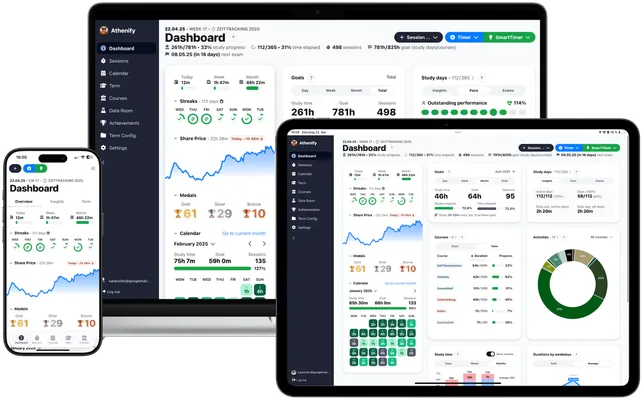
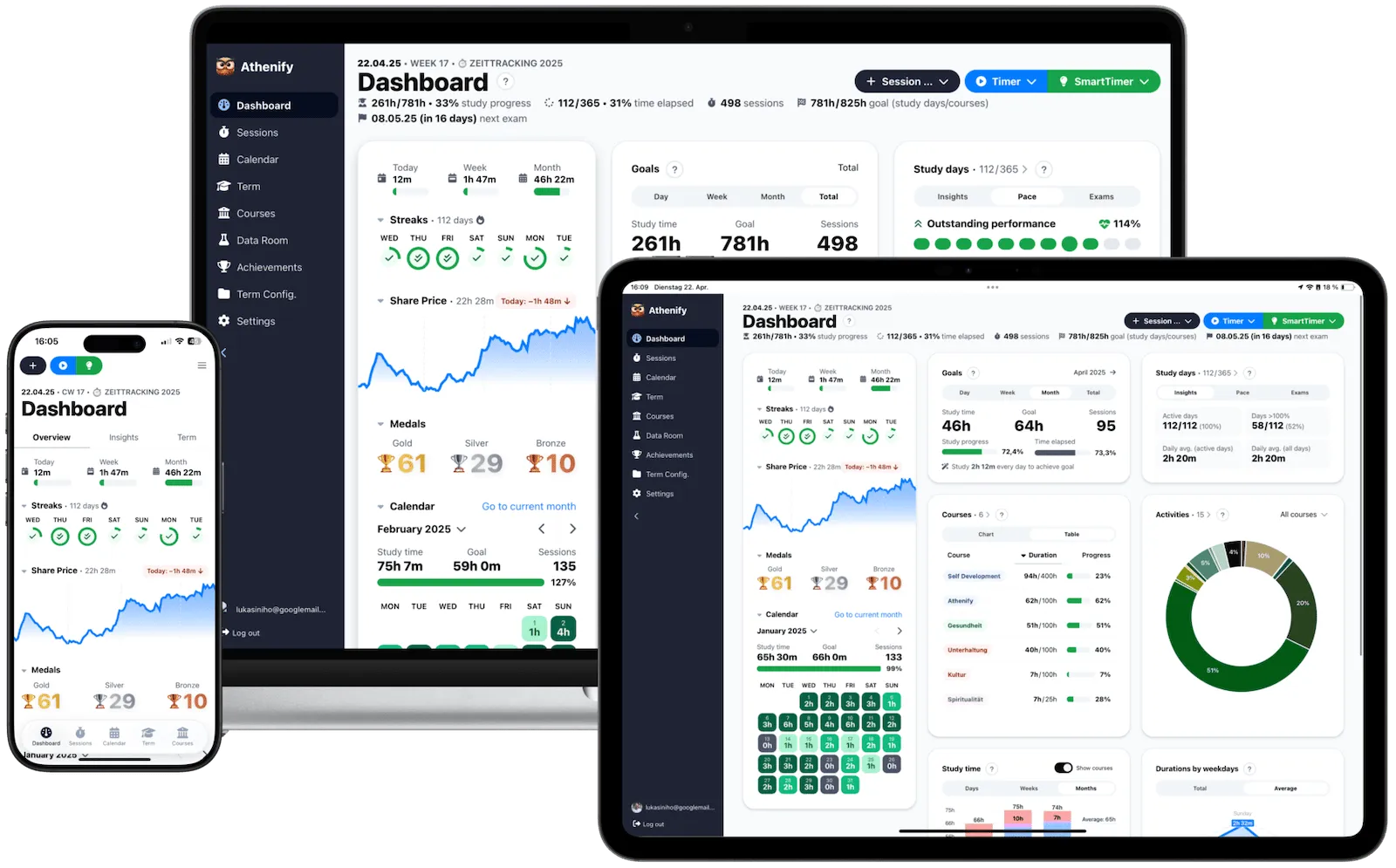
Here's what makes time tracking addictive in the best way: you see progress accumulating. Athenify's motivation features make this automatic. Streaks track consecutive days meeting your targets – miss a day and it resets, creating powerful daily accountability. The Medal System awards Bronze, Silver, or Gold medals based on daily performance, and collection becomes its own reward. Your Share Price translates cumulative effort into a "stock price" that rises and falls based on consistency – gamification that actually works.
Track your "personal records": longest study session, most productive week, highest streak. These milestones create motivation during tough periods. When you're struggling, looking at your progress history reminds you what you're capable of.
Course correction based on data
Not meeting your goals? Your tracking data reveals why:
- Total hours low? – You're not starting enough sessions. Fix: Set specific daily start times that trigger automatically.
- Session lengths short? – You're getting distracted mid-session. Fix: Phone separation and deep work techniques.
- Certain subjects neglected? – You're avoiding difficult material. Fix: Schedule hardest subjects during peak energy times.
Data removes guesswork from improvement. You stop wondering why you're struggling and start knowing exactly what to fix.
How to start tracking your time
You don't need fancy tools to start. But the right tools make tracking effortless – and effortless means you'll actually do it consistently.
Method 1: The basic approach (free)
All you need is a timer or stopwatch – your phone, watch, or a web-based tool will do. The process is simple: decide what you're studying (e.g., "Biology Chapter 3"), start the timer, study without interruption, stop the timer when done, and record the time in a notebook or spreadsheet.
This approach is free and has no learning curve, but manual tracking gets tedious, you get no analytics, and it's easy to forget. Try our free Pomodoro timer to begin building the time tracking habit – 25-minute focused sessions with 5-minute breaks is a proven technique that works.
Method 2: The smart approach (recommended)
A dedicated student time tracking app like Athenify takes the friction out of tracking entirely. Athenify automatically calculates and visualizes your total study time (daily, weekly, monthly), time per subject, average session lengths, most productive times of day, and productivity trends over time. No spreadsheets, no manual calculations – just pure insight.
Built-in goal setting lets you define daily targets like "Study 3 hours today" and weekly goals, with real-time progress tracking that creates accountability. The share price feature gamifies your overall performance, translating cumulative effort into a "stock price" you can track over time.
Unlike basic timers, Athenify includes psychology-backed motivation systems: Streaks for consecutive days meeting your targets, Medals for daily performance rewards (Bronze, Silver, Gold), and visual progress tracking that provides proof of your efforts. These features tap into behavioral psychology to make studying inherently rewarding.
Multi-platform sync means you can track on your phone, tablet, or computer – all data syncs automatically. Start a session on your laptop and continue on your phone; it just works. After a month of tracking, you'll have data revealing your optimal study schedule, which subjects need more attention, your actual productive capacity, and patterns you never noticed. This intelligence is impossible to get from basic timers.
Try Athenify for free
Track by subject, build streaks, and finally see in black and white where your study time actually goes.
No credit card required.
No credit card required.
Getting started: your first week
Your first two days are about establishing a baseline. Track everything without trying to improve – just observe where your time goes without judging yourself. During days three through five, awareness kicks in. You'll naturally start studying more simply because you're measuring (the measurement effect), and you'll identify your biggest time wasters while noticing your productivity patterns. By days six and seven, you're ready for optimization: adjusting your schedule based on data, setting realistic goals, and creating systems to eliminate distractions.
The benefits of long-term tracking
Here's where time tracking becomes transformative: The longer you track, the more valuable the data becomes.
After one day of tracking, you know what happened yesterday.
After one week, you see weekly patterns.
After one month, you understand your rhythms.
After one semester, you have a complete map of your academic performance.
What you gain after a semester of tracking
First, you establish your personal productivity baseline. You'll know with certainty your actual study capacity (e.g., "I can do 4.5 hours of focused work on weekdays, 6 hours on weekends"), your subject-specific pace (e.g., "I need 2 hours per Economics chapter, 3 hours per Physics chapter"), and your exam preparation requirements (e.g., "I need 25 hours per exam to feel confident"). This knowledge is power – you can plan accurately instead of guessing.
Students who track time for a full semester can predict with 90% accuracy how long assignments will take. This eliminates last-minute cramming and all-nighters.
Second, you get proof of progress when motivation fades. Midterms are brutal. Final exams are exhausting. There will be days when you feel like you're not making progress. But your tracking data tells the truth: "I've studied 187 hours this semester." "I've maintained a 12-day study streak." "I've logged 34 hours of Math – more than any other semester." This tangible evidence fights imposter syndrome and keeps you going.
Your tracking data tells the truth when your feelings lie. 187 hours studied. 12-day streak. That's not subjective – it's fact.
Third, you gain exam preparation insights that transform your approach. After tracking multiple exam cycles, you'll know how many hours you need per credit hour, when to start studying (no more guessing), which subjects need extra time, and your optimal review schedule. Many high-performing students discover their personal "exam formula" through tracking – something like "15 hours of study per credit hour = A grade" or "Start 2 weeks before exam date, 2 hours daily = confident performance." Your data reveals YOUR formula.
Fourth, you experience better planning and less stress. When you know realistically how long things take, you can schedule appropriately without overcommitting, set achievable daily goals without burning out, build in buffer time to avoid panic, and say "no" to extra commitments when you're at capacity.
Fifth, your focus improves measurably over time. Track your average session length over months and watch the progression: Month 1 averages 32 minutes, Month 2 hits 41 minutes, Month 3 reaches 53 minutes, and by Month 4 you're at 67 minutes. Your focus is literally improving – doubling from where you started. That's the power of measurement and practice.
Sixth, you gain subject balance awareness. Your tracking data reveals imbalances: "I've studied Math 42 hours but Economics only 18 hours this month." "I'm avoiding my hardest subject (Chemistry)." "I'm spending too much time on my favorite subject (History) at the expense of others." This awareness allows course correction before it affects your grades.
Seventh, you develop career-ready time management. The ability to track time, estimate accurately, and manage your schedule is a professional skill that employers value highly. People who meet deadlines consistently, estimate project timelines accurately, and manage their workload independently are in demand everywhere. You're not just improving as a student – you're developing career-critical competencies that will serve you for decades.
Learn more about the science behind effective studying and why measurement drives improvement.
Advanced time tracking strategies
Once you've built the basic habit, these techniques will maximize your results:
1. The Sunday planning ritual
Every Sunday evening, review last week's data and plan the next week. For the review portion, examine your total hours tracked, goals met versus missed, most productive days, and biggest time wasters. Then plan by setting next week's targets, blocking study times in your calendar, identifying potential obstacles, and adjusting strategies based on what the data reveals.
Spend just 15 minutes every Sunday reviewing your Athenify dashboard. Ask yourself three questions: "What worked? What didn't? What will I change?" This simple ritual compounds into massive improvement over a semester.
2. Track study quality, not just quantity
Not all study hours are equal. Consider adding quality ratings to your sessions on a simple 1–5 scale. A 5/5 means deep focus with no interruptions and complete concentration. A 4/5 indicates good focus with minor distractions but mostly productive work. A 3/5 shows moderate focus – some effectiveness but room for improvement. A 2/5 represents shallow work with lots of distractions and limited progress. And a 1/5 is pretend studying – sitting at your desk but not actually working.
After a month, you'll see patterns: "My morning sessions average 4.5/5 focus, but afternoon sessions only 2.5/5." That insight alone can transform how you structure your days.
3. Use the "shutdown complete" ritual
Borrowed from productivity expert Cal Newport, this ritual signals the end of your study day. Review your tracked hours for the day, check tomorrow's schedule, close Athenify (or your tracking tool), and say out loud: "Shutdown complete."
This psychological trigger helps your brain actually relax, preventing evening study guilt. When you've formally ended your day, you can enjoy your free time without that nagging feeling that you should be working.
4. Batch similar tasks
Your tracking data will reveal task-switching penalties – those hidden costs of jumping between different types of work. The solution is batching: group all reading for one subject in one session, tackle all problem sets in another, and reserve dedicated blocks for essay writing. This reduces cognitive overhead and increases efficiency because your brain stays in the same mode rather than constantly reconfiguring.
5. Track breaks too
High performers don't just track work – they track rest. Log your breaks to ensure you're actually taking them (many students skip breaks, causing burnout), they're the right length (not turning 5-minute breaks into 45-minute distractions), and you're recovering effectively.
Students who track breaks take better breaks. Why? Because when you're "on break," you know you can relax guilt-free. When break time ends, you return to work without negotiation. Clear boundaries prevent break procrastination and that guilty half-relaxation where you're not really working but not really resting either.
Common time tracking mistakes (and how to fix them)
Mistake #1: Tracking but not reviewing
The problem: Students log hours but never look at the data.
The fix: Set a recurring Sunday calendar event: "Review study data (15 min)." Without review, tracking is pointless.
Mistake #2: Forgetting to start the timer
The problem: You sit down to study and forget to press start. Hours of work go untracked.
The fix: Create a pre-study ritual that ALWAYS includes starting your timer. Make it automatic.
Mistake #3: Counting "fake" study time
The problem: Leaving the timer running while scrolling social media or talking to friends.
The fix: Be honest with your tracking. Only count actual focused work. Self-deception defeats the purpose.
Mistake #4: Setting unrealistic goals
The problem: "I'll study 8 hours every day!" Then you fail and quit tracking.
The fix: Start small. Track one week to establish your baseline. Then set goals 10–20% above baseline, not 300%.
Mistake #5: Not tracking consistently
The problem: Tracking some days but not others. Incomplete data = useless data.
The fix: Use Athenify's streak feature to build consistency. The fear of breaking your streak creates daily accountability.
The 30-day time tracking challenge
Want to transform your academic performance? Commit to 30 days of consistent tracking.
Here's how to structure your 30-day challenge:
- Week 1: Awareness – Track every study session, no matter how small. Observe without judgment. Learn where your time actually goes.
- Week 2: Optimization – Eliminate your top 3 time wasters. Improve session quality. Discover what conditions produce your best work.
- Week 3: Goal setting – Set specific daily and weekly targets. Aim to meet them 5 out of 7 days. Learn what's realistically achievable.
- Week 4: Mastery – Achieve your highest weekly total. Push for 60+ minute deep work sessions. Discover what you're capable of at your best.
Conclusion: from guessing to knowing
Most students operate on vague assumptions. "I think I studied enough." "I feel like I'm working hard." "I should probably study more." These feelings are unreliable. They lead to last-minute panic, inconsistent effort, and mediocre results.
Time tracking replaces guessing with knowing.
You don't think you studied enough – you know you studied 23.5 hours this week.
You don't feel productive – your data shows an average session length of 67 minutes.
You don't wonder if you're ready for the exam – you've logged 32 hours of targeted preparation.
This certainty changes everything.
The path forward is simple:
- Start today – Even with just a basic timer.
- Track consistently – Log every single study session.
- Review weekly – Learn from your data.
- Adjust continuously – Optimize based on insights.
- Build long-term – Accumulate a semester of intelligence that transforms your approach.
The best time to start tracking was at the beginning of the semester. The second-best time is right now.
Every day you wait is valuable data lost.
For the serious student who wants every advantage, Athenify is built specifically for students who take their academic performance seriously. It combines time tracking with goal setting, motivation systems, and detailed analytics – everything you need to study smarter, not just harder.
You get effortless time tracking, detailed analytics and insights, goal setting and monitoring, streaks and motivation features, a medal system for daily wins, long-term progress visualization, and features designed specifically for students.
See all features: Athenify FeaturesLearn the science: Why measurement mattersRead success stories: Student testimonials