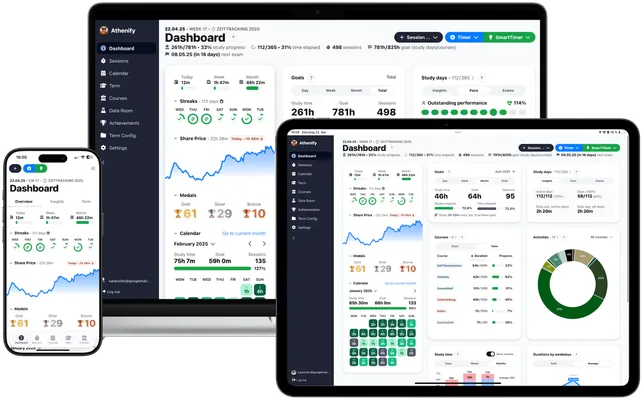
There's a reason Olympic athletes dedicate their entire lives to a piece of metal on a ribbon. Medals carry weight that transcends their material value – they represent hours of discipline, moments of breakthrough, and the satisfying proof that effort leads to achievement. Now imagine bringing that same powerful psychology to your daily study routine.

Alongside the share price, the medals in Athenify represent another powerful motivational tool that keeps you engaged throughout the semester. While the share price tracks your cumulative progress over time, medals celebrate daily achievement – giving you something tangible to work toward every single day.
What are medals in Athenify?
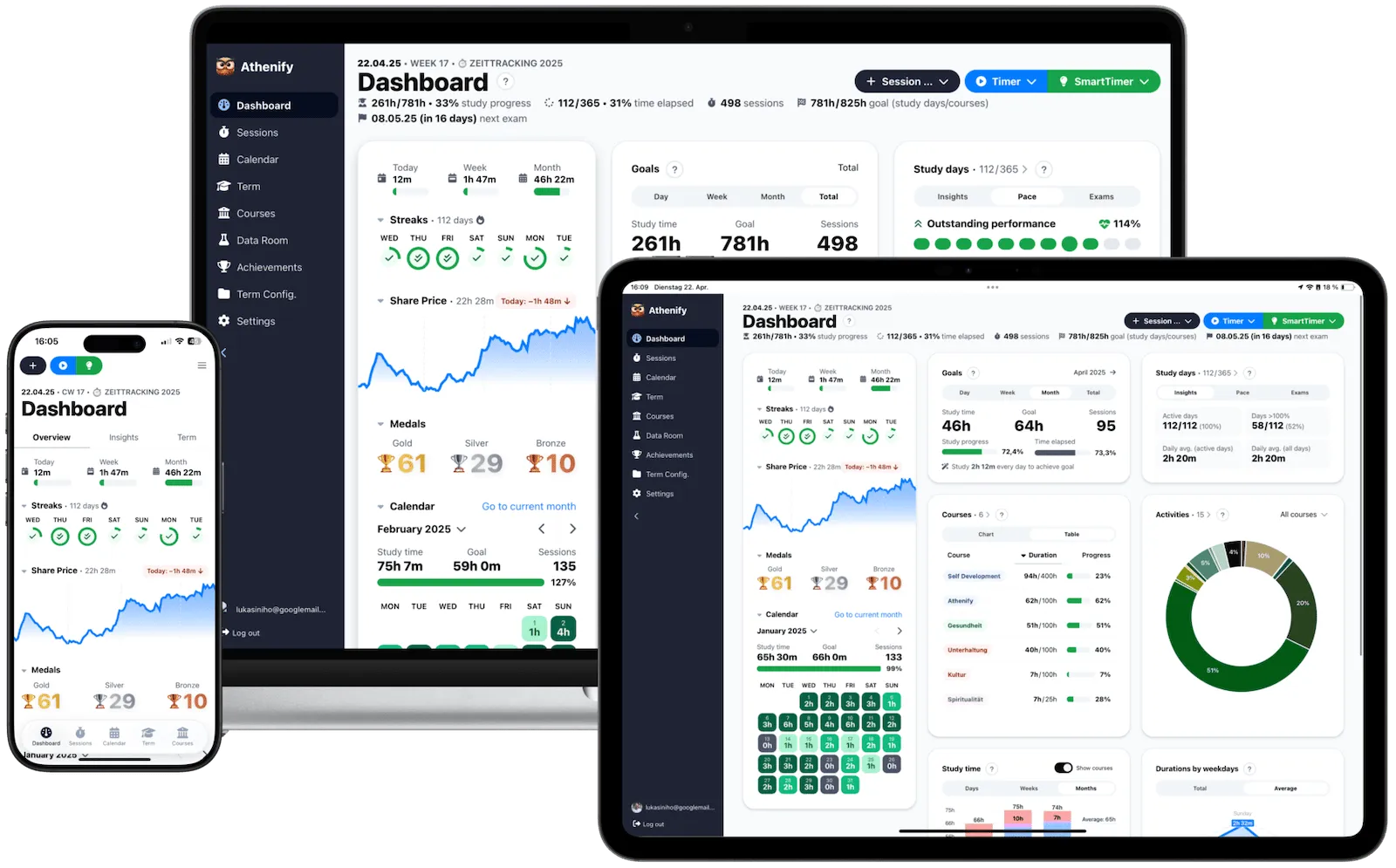
Medals transform ordinary study days into opportunities for recognition. They're awards for particularly productive study sessions, providing immediate feedback that your effort matters. In Athenify, there are three medal tiers – Gold, Silver, and Bronze – each representing a different level of daily accomplishment.
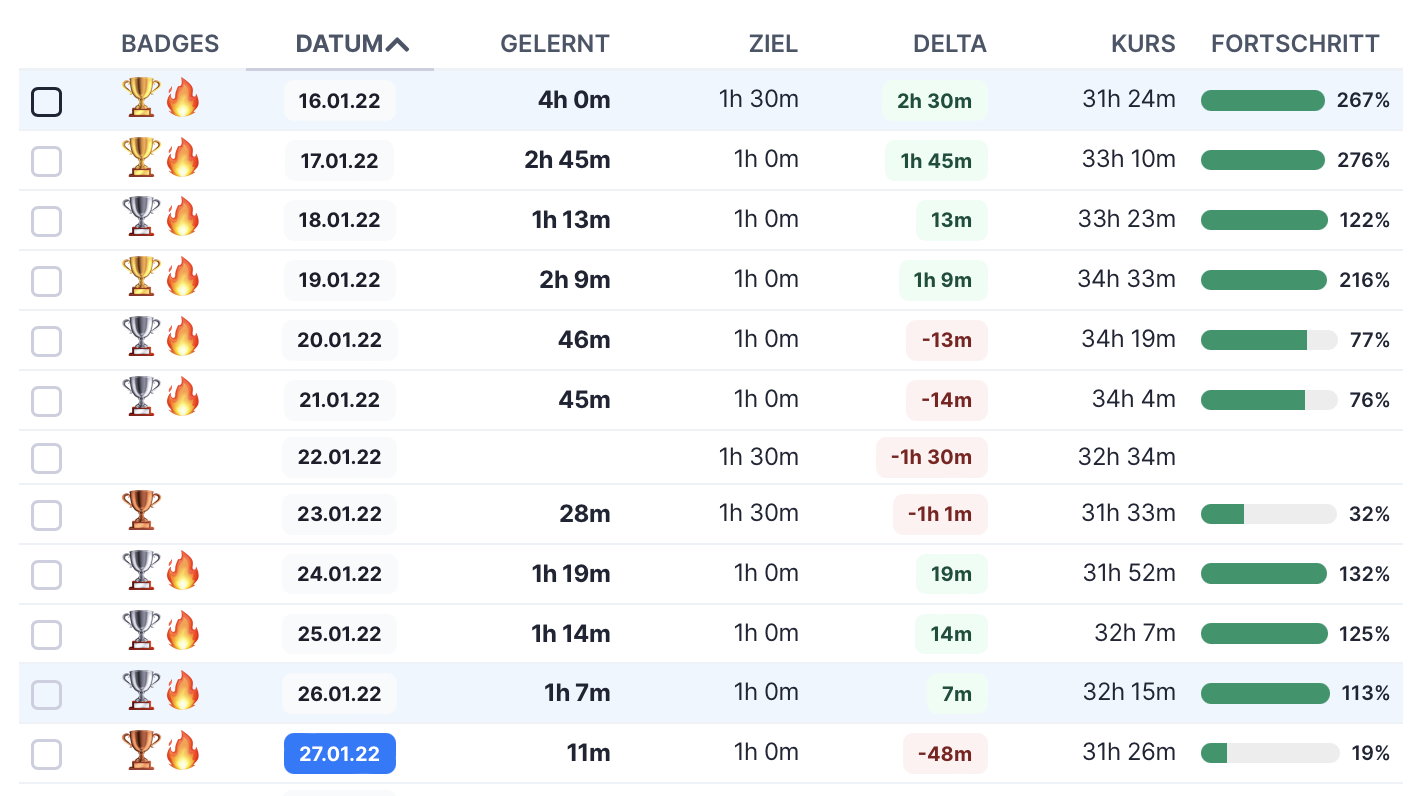
By default, Bronze is awarded for studying more than 3 hours (180 minutes), Silver for more than 4 hours (240 minutes), and Gold for more than 5 hours (300 minutes). These thresholds are designed to be challenging but achievable – Bronze represents a solid study day, Silver shows real dedication, and Gold marks those exceptional sessions where you truly pushed yourself.
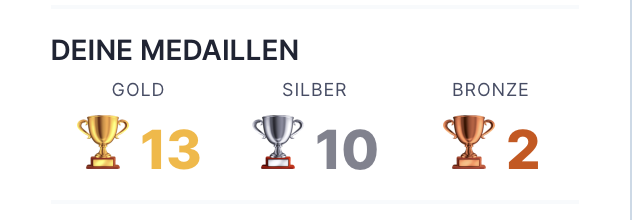
Think of it like the Olympics – except you're competing against yourself, and every medal is a victory. There's no one else on the podium, no pressure to outperform classmates. The only question is: what level of achievement can you reach today?
Why self-competition works better than external competition:
- External competition can discourage when others seem to study effortlessly
- Your gold medal means the same regardless of what others did
- You're measuring progress against your own standards, not someone else's
This self-competition aspect is crucial. Medals eliminate unfair comparisons.
Your gold medal means the same thing whether your roommate studied for 10 hours or didn't open a book.
Why medals work for motivation
Every medal is immediate recognition of your effort – you don't have to wait until the end of the semester to celebrate your wins.
The medal system taps into fundamental principles of gamification in education. But unlike superficial gamification that slaps badges on everything, medals work because they're tied to genuine achievement.
Why medals are so effective:
- Tied to real effort – You earn them through actual study time
- Customizable thresholds – Calibrated to your personal capacity
- Visible collection – Accumulated medals show your consistency
- Self-competition – You're only competing against yourself
Visual progress
Human brains are wired to respond to visual rewards. Medals provide an immediate, tangible recognition of your efforts that abstract numbers simply can't match. When you see a gold medal appear after a long study session, something clicks psychologically – the effort feels validated, real, worth celebrating. A number like "300 minutes" is accurate but sterile; a gold medal carries emotional weight.
Daily targets
One of the biggest challenges students face is knowing when they've done "enough." Without clear targets, it's easy to either stop too early (rationalizing that you've done plenty) or push too hard (never feeling satisfied). Medals solve this by providing concrete thresholds to aim for. When you know that 5 hours earns gold, you have a clear finishing line. This eliminates the exhausting "how much is enough?" uncertainty and replaces it with clarity.
Cumulative satisfaction
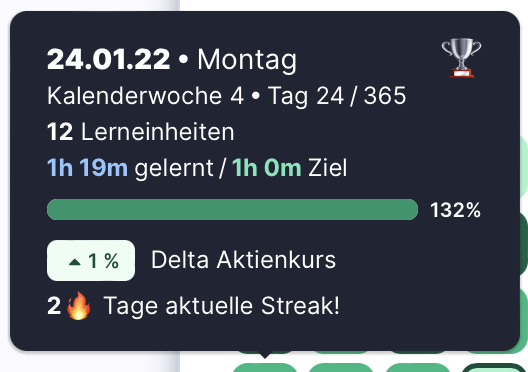
Individual medals are satisfying; a collection of medals is powerful. As the semester progresses and your medal count grows, you build a visible record of your consistency and effort. Looking back at a semester filled with gold medals creates a profound sense of accomplishment – tangible proof that you showed up, day after day, and put in the work. This historical record becomes motivation in itself: you don't want to break the pattern you've worked so hard to build.
Customize your medal thresholds
The default thresholds work for many students, but everyone's capacity and schedule differs. In Athenify, you can freely customize the study time required to earn each medal tier. This flexibility is essential because the "right" threshold depends on your course load, work commitments, personal capacity, and goals.
When you receive which medal (or want to receive) depends on various factors. The key is finding settings that motivate rather than discourage – challenging enough to feel meaningful, achievable enough to maintain hope.
Don't set goals too low
Medals should only be earned when you can truly be satisfied with the study time. If you're earning gold medals every day without breaking a sweat, something is wrong. The medal loses its meaning when it's too easy to obtain – it becomes participation trophy rather than genuine achievement.
The goal is to feel genuine pride when you earn that gold. That pride comes from knowing you pushed yourself, that today's effort was exceptional. If gold happens automatically without any sense of accomplishment, your thresholds are too low. Consider raising them until gold represents a genuinely impressive day.
The goal is to feel genuine pride when you earn that gold – not relief that you met an easy target.
Don't set goals too high
The opposite problem is equally damaging. If you set medal thresholds so high that gold feels impossible, you'll stop trying to reach it. Weeks will pass without a single gold medal, and the feature that was supposed to motivate you becomes a source of discouragement – a constant reminder of standards you can't meet.
If you're consistently missing medals despite working hard and feeling productive, your thresholds are too high. Lower them until medals become achievable on your better days. The system should encourage you to push harder, not make you feel inadequate.
Finding your Goldilocks zone
The art lies in setting the values to a Goldilocks level – not too easy, not too hard, but just right. This calibration isn't something you'll nail on the first try, and that's perfectly fine. Your capacity changes throughout the semester anyway; what feels challenging in week one might feel routine by week eight as you build study stamina.
The good news is that experimentation is easy and low-stakes. You can adjust your thresholds at any time, and the feedback loop is immediate: set new values, study for a few days, and observe how the medals make you feel.
How to calibrate
Follow this calibration process:
- Start with defaults – Use 3 hours for Bronze, 4 hours for Silver, and 5 hours for Gold. These work well for many students and give you a baseline.
- Track for one week – Observe the results. How many medals did you earn? How did earning (or not earning) them make you feel? Were you motivated to push for the next tier?
- Adjust in small increments – If gold comes too easily, raise thresholds by 30 minutes. If you're rarely earning medals despite effort, lower them by 30 minutes.
- Repeat until calibrated – You've found the sweet spot when bronze feels solid, silver feels productive, and gold feels exceptional.
Medals unleash their full power
Once calibrated, medals become an incredibly motivating force in your daily study routine. Like an Olympian training for competition, you'll find yourself actively pursuing medals throughout the semester – not because anyone is forcing you, but because the achievement feels genuinely rewarding.
The medal system transforms the question "Should I study more today?" into "Can I push for gold?" This reframing is subtle but powerful. Instead of debating whether to continue, you're strategizing about how to achieve the next tier. The decision becomes motivating rather than draining.
The medal system transforms "Should I study more?" into "Can I push for gold?"
The psychology behind it
The medal system leverages several psychological principles that researchers have identified as key drivers of sustained motivation:
- Variable reward – Some days you'll earn bronze, some days silver, occasionally gold. This unpredictability is surprisingly engaging. If you earned gold every single day, the reward would lose its punch.
- Loss aversion – After a week of consistent bronze or better, the thought of ending a day with nothing feels uncomfortable. You'll push through that last hour to secure at least a bronze.
- Streak building – When you combine medals with streaks, motivation amplifies. You're not just pursuing today's medal; you're building toward a collection that represents weeks of sustained effort.
Combining medals with other features
Medals are powerful on their own, but they become even more effective when combined with Athenify's other motivation features. Each feature addresses different aspects of motivation, and together they create a comprehensive system that keeps you engaged throughout the entire semester.
Streaks reward consistency – showing up every day, regardless of intensity. Medals reward intensity – pushing hard on days when you have the energy. Used together, you're motivated both to study daily (streaks) and to make each day count (medals). The ideal pattern emerges naturally: consistent daily effort with occasional exceptional days.
Your share price rises fastest on gold medal days, when you're exceeding your goals by the largest margin. Watching the share price climb after a gold medal day provides additional validation – proof that exceptional effort translates into measurable progress.
Analytics help you understand your medal patterns. Which days of the week do you earn the most golds? Which subjects consume the most time? This data reveals insights that help you optimize your schedule and set more realistic expectations.
Start earning your medals
The medal system transforms studying from an obligation into an opportunity for daily achievement. Every study session becomes a chance to earn recognition, to add another medal to your growing collection, to prove to yourself that you can show up and perform.
Try Athenify for free
Set your Bronze, Silver, and Gold thresholds, track your time, and watch the medals accumulate into a semester of consistent progress.
No credit card required.
No credit card required.