You're sitting in the library after an 8-hour shift, trying to understand statistics. Your eyes keep closing. You have another early shift tomorrow.
Welcome to the reality of millions of working students. Studying while holding down a job isn't a luxury choice – it's how many people make education possible. Whether you're working for financial survival, building career experience, or both, you're not alone.

The goal isn't to work more hours – it's to use your limited time optimally.
The reality: your time budget
Before we talk strategies, let's do honest math. A week has 168 hours – and they disappear faster than you think.
Sleep takes 49 hours – that's 7 hours per night, and it's non-negotiable if you want your brain to actually retain what you study. Your job eats 15–20 hours. Classes consume another 15–20 hours. Commuting steals 5–10 hours depending on your setup. Daily life – eating, chores, personal care – claims roughly 15 hours. And if you want any semblance of a social life, exercise, or rest, that's another 10–15 hours.
What's left? Roughly 10–20 hours per week for self-study. That translates to 1.5–3 hours per day – depending on how tightly you organize everything else.
That sounds like less than full-time students get. But the calculation is more nuanced:
| Full-time student | Working student (20 h) | |
|---|---|---|
| Weekly study time | 30–40 h | 10–20 h |
| Flexibility | High | Low |
| Financial stability | Often low | Higher |
| Work experience | Limited | Significant |
| Stress level | Variable | Tends higher |
You have less time, but you gain financial stability and real work experience. A fair trade – if you learn to work with scarce time. For working students, good time management becomes a core skill, not an optional extra.
Strategies that actually work
Study time is non-negotiable
The most important mindset shift: treat your study blocks like work shifts. If you say "I'll study when I have time," you'll never have time. Something always comes up – a coworker asking you to cover a shift, a friend wanting to hang out, the new season of your favorite show.
Block your study times in your calendar as firmly as your work schedule. If you work Monday from 2–6 PM, then 9–11 AM is your study block – untouchable. Your boss wouldn't accept "I didn't feel like coming in today," and neither should you accept that excuse for studying. On days off, schedule two blocks: morning and afternoon. The structure creates momentum.
One non-negotiable boundary: keep at least one day per week – ideally Sunday – completely free. No job, no studying, no obligations. Your brain needs recovery time, and sustainable performance requires rest. Grinding seven days a week works for a few weeks until it doesn't work at all.
Your study blocks are non-negotiable. They're as important as your job.
Use the hidden minutes
When time is scarce, every minute counts. And you have more of them than you think – they're just hiding in plain sight.
Your commute to work or class is prime real estate for flashcards or lecture podcasts. That's 20–40 minutes daily that most students waste scrolling social media. Your lunch break offers another 15 minutes for reading a summary while you eat – not glamorous, but effective. Waiting time accumulates too: at the doctor's office, in line for coffee, between classes. Keep review materials on your phone and these dead zones become productive.
Here's a power move: arrive 30 minutes early to a café near your workplace. That's a focused study block before your shift even begins, when your mind is still fresh and your willpower hasn't been depleted by work.
These mini-sessions feel insignificant in isolation, but they compound relentlessly. Thirty minutes a day becomes 15 hours a month – nearly a full work week you've gained on the margins. The Pomodoro Technique makes these short windows even more effective by creating focused sprints that match your available time.
Manage energy, not just time
Not all hours are equally productive. After an 8-hour shift, you're not as sharp as you were at 9 AM. Ignoring this is one of the biggest mistakes working students make.
One great study hour in the morning beats three tired hours at night.
The implication is clear: schedule demanding tasks for your alert hours. Complex topics and new material belong in the morning or early afternoon, when your prefrontal cortex is firing on all cylinders. Practice problems and review can work even when you're somewhat tired – they require less cognitive horsepower because the neural pathways already exist.
And those evenings after work? Reserve them for flashcard review or light reading. Don't attempt to understand quantum mechanics or constitutional law at 9 PM after an 8-hour retail shift. You'll read the same paragraph four times, retain nothing, and feel like a failure. That's not studying – that's theater.
Not everything is equally important
You can't treat all courses with equal intensity – and you don't have to. Full-time students can afford to chase A's in every class. You can't, and pretending otherwise leads to mediocre results across the board.
Prioritize ruthlessly. Courses with participation grades or oral exams demand consistent preparation – you can't cram the night before. Prerequisites for future courses matter because a weak foundation compounds into bigger problems later. High-credit courses carry more weight in your GPA calculation.
On the flip side, courses with retake options give you a safety net. Electives that don't lead anywhere can receive less attention. Low-credit courses simply matter less mathematically.
This isn't about being lazy – it's about strategic resource allocation. You have finite hours and energy. Spending them where they create the most value isn't cutting corners; it's intelligence.
Talk to your employer
Many working students are afraid to discuss their academic pressures. They worry about seeming unreliable or losing their job. But good employers understand you're a student – that's often why they hired you instead of a full-time employee.
You were hired as a student, not a full-time worker. Your employer knows that.
Communicate proactively. Share exam dates early – not two days before, but six weeks ahead. Request time off during finals when the schedule is still flexible. Set clear boundaries: no overtime during exam weeks, period. A simple message is all it takes:
"I have finals from March 15–28. Would it be possible to reduce my hours to 10 per week during that time, or use some vacation days?"
Most employers respond positively when given advance notice. They'd rather accommodate your schedule than train a replacement because you burned out or quit. And if they react badly to a reasonable, professional request? That tells you something important about whether this job deserves your loyalty.
Finals period: the special case
The normal balance between work and study breaks down during finals. You need a Plan B – and you should prepare it weeks in advance.
The most straightforward option is saving your vacation days specifically for finals. Five days off means five days of full-time studying – a luxury working students rarely experience. Guard those days jealously throughout the semester.
If vacation days aren't available, negotiate a temporary hour reduction. Many employment arrangements allow this flexibility, but you need to ask 4–6 weeks in advance, not the week before exams. If your job offers remote work, grab it during finals – the saved commute time goes directly into studying.
Taking an extra semester isn't failure. It's a strategic decision for sustainable performance.
Sometimes the smartest option isn't working harder but reducing your course load. Passing four courses per semester beats attempting six and failing two. Yes, this extends your graduation timeline. But consider the alternative: retaking failed courses costs more time anyway, plus the GPA damage follows you. One extra semester is a strategic choice for sustainable performance – not a defeat.
Warning signs of overload
Working students are particularly vulnerable to burnout. The double burden of job and school takes its toll – sometimes gradually, sometimes suddenly. The danger is that overload often creeps up invisibly. You adjust to feeling tired. You normalize the headaches. You forget what rested feels like.
Watch your body first. Constant fatigue despite getting sleep is a red flag. Frequent headaches and getting sick often signal that your immune system is struggling under chronic stress. These aren't weaknesses to push through – they're alarms.
Your mind sends signals too. Creeping cynicism ("nothing matters anyway") is a classic early sign. Concentration problems during study sessions that used to feel manageable. Anxiety that spikes not at the difficulty of tasks, but at their mere existence.
Burnout doesn't arrive with a warning label. It creeps in disguised as dedication.
Watch your behavior as well. Social isolation feels easier than explaining why you're exhausted. Hobbies get neglected because "there's no time." Procrastination becomes the default mode – not because you're lazy, but because starting anything feels overwhelming.
How Athenify helps
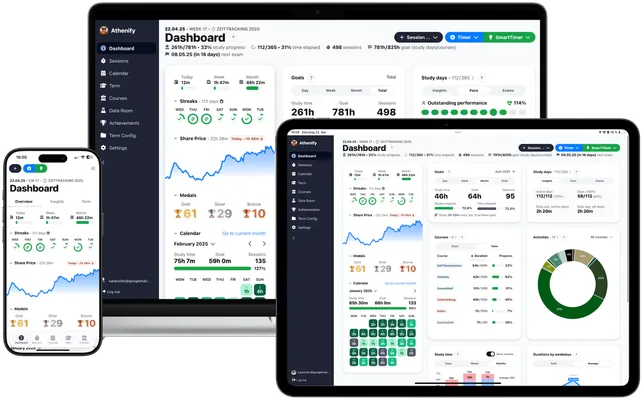
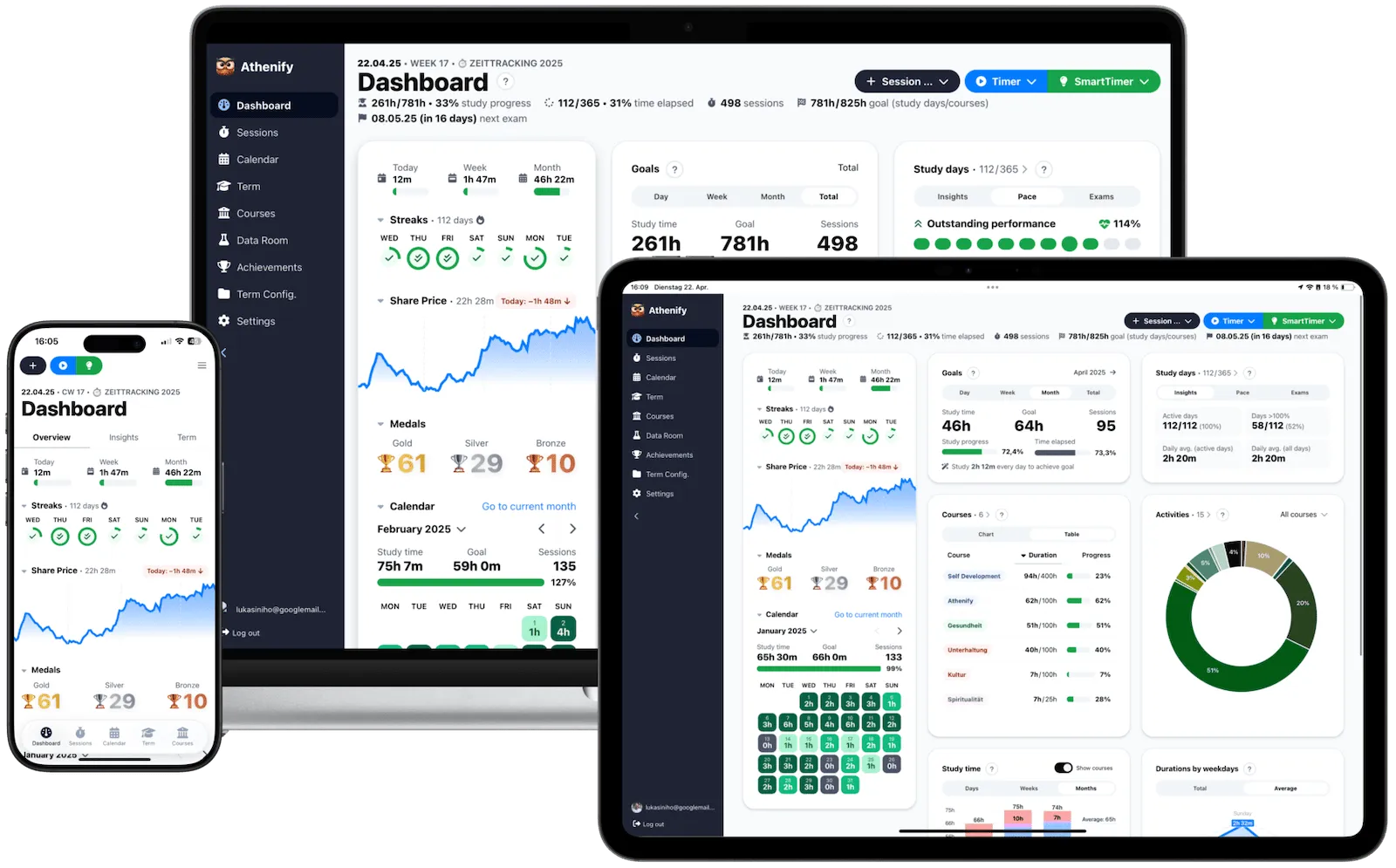
Athenify is especially valuable for working students because every minute matters. You think you're studying 15 hours per week? Through consistent time tracking, you'll see if that's true. The reality is often sobering – but only data enables change. You can't improve what you don't measure.
The SmartTimer makes even mini-sessions effortless: one tap, and the timer starts. Perfect for 15 minutes during lunch or the commute to work. The Dashboard shows how your time distributes across subjects – so you immediately spot if a course is getting neglected.
And the streak feature keeps you in study mode even on exhausting work days. Just 20 minutes daily is enough to maintain your streak. That sounds small, but consistency beats intensity – a little bit every day is better than one weekly marathon session.
Try Athenify for free
Track your study time even in mini-sessions, spot gaps in your weekly schedule, and stay in control – despite the double workload.
No credit card required.
No credit card required.
Conclusion: studying while working is possible
Studying while working part-time is demanding – but absolutely doable. The key isn't working more hours; it's working smarter with the limited time you have.
Start by calculating honestly how much study time you actually have – not how much you wish you had. Block those study times in your calendar as firmly as work shifts, because that's exactly what they are. Capture the hidden minutes that others waste: commuting, breaks, the quiet time before your shift begins.
Match your tasks to your energy. Demanding material goes into your alert hours; review and practice can handle the tired times. Communicate with your employer well before finals hit – surprises help nobody. And know your limits. If the math doesn't work, taking an extra semester isn't defeat. It's wisdom.
You're not studying despite your job – you're developing skills that full-time students never learn: time management, prioritization, resilience.