Your palms are sweating. Your heart is hammering. You flip over the exam paper and the first question looks like it's written in a language you've never seen – even though you spent the last three days studying this exact material. Your mind, which was perfectly functional an hour ago, has gone completely blank.
You know this feeling. Maybe you know it intimately. And the worst part isn't the anxiety itself – it's the knowledge that you know this material but your brain refuses to cooperate when it counts.
Test anxiety is one of the most frustrating experiences in education because it creates a gap between what you know and what you can demonstrate. But here's what decades of research have made clear: test anxiety is not a character flaw, it's not a sign of weakness, and it is absolutely manageable.

Understanding Test Anxiety: What's Actually Happening
Test anxiety isn't just "being nervous." It's a specific psychological and physiological response with well-documented components.
The Two-Component Model
Researchers distinguish between two types of test anxiety:
Cognitive anxiety (worry): The mental component – catastrophic thoughts about failure, self-doubt, comparison to peers, fear of disappointing others. This is the voice in your head that says I'm going to fail or everyone else finds this easy.
Somatic anxiety (emotionality): The physical component – increased heart rate, shallow breathing, muscle tension, nausea, sweating. This is your body's fight-or-flight response activating at exactly the wrong moment.
The Working Memory Bottleneck
Here's the neuroscience behind "going blank." Your working memory – the cognitive system that holds and manipulates information during complex tasks like exams – has limited capacity. When anxiety floods your mind with worry-related thoughts (I'm going to fail, what if I can't answer this, everyone is finishing before me), those thoughts consume working memory resources that should be devoted to recalling information and solving problems.
It's not that the knowledge disappeared. It's that anxiety is hogging the bandwidth your brain needs to access it.
Test anxiety doesn't erase what you know. It blocks the doorway between your knowledge and your ability to express it.
Before the Exam: Building Your Foundation
The most effective test anxiety management starts days or weeks before the exam, not minutes before.
Preparation That Actually Reduces Anxiety
Not all studying is equal when it comes to anxiety reduction. Passive review – rereading notes, highlighting textbooks – creates a dangerous illusion of familiarity without building genuine retrieval strength. When the exam arrives and you can't recall what you "studied," anxiety spikes because your brain correctly senses the gap between recognition and recall.
Practice testing is the single most effective study strategy for reducing test anxiety. When you practice retrieving information under conditions that simulate the exam, you build both knowledge and confidence simultaneously.
This approach directly addresses both components of test anxiety: it improves your actual knowledge (reducing legitimate uncertainty) and builds retrieval confidence (reducing worry about blanking out).
If you struggle with structuring your study sessions, the Pomodoro Technique can help you break preparation into manageable intervals that prevent the overwhelming marathon sessions that fuel anxiety.
Spaced Preparation vs. Cramming
Cramming is anxiety's best friend. When you compress all your studying into the night before, you:
- Sacrifice sleep (which impairs memory consolidation and emotional regulation)
- Create time pressure that elevates baseline stress
- Rely on recognition memory instead of recall memory
- Enter the exam running on adrenaline and caffeine rather than genuine preparedness
Spaced preparation – distributing your study across multiple sessions over days or weeks – produces stronger, more durable memories and dramatically reduces pre-exam anxiety because you've built genuine competence over time.
The Night Before
The night before an exam is not the time for heroic study sessions. By this point, your preparation is essentially complete. What you do in these final hours should serve your mental state, not your knowledge base.
- Review, don't learn. Skim your summary notes or flashcards. Don't try to learn new material – it creates the illusion that you don't know enough.
- Prepare your logistics. Pack your bag, set alarms, plan your route. Reducing morning uncertainty reduces morning anxiety.
- Protect your sleep. Sleep is when memories consolidate. Even two hours of sleep is better than two hours of additional cramming. This isn't motivational advice – it's neuroscience.
During the Exam: Real-Time Strategies
These techniques are designed for the moment of crisis – when you're sitting in front of the exam and anxiety is surging.
1. Cognitive Reappraisal: Reframe Anxiety as Excitement
This is the single most powerful in-the-moment technique, and it sounds almost absurdly simple: when you notice anxiety symptoms, tell yourself I'm excited rather than I'm anxious.
It works because anxiety and excitement share nearly identical physiological signatures – elevated heart rate, heightened arousal, increased alertness. The difference is the cognitive label you attach to those sensations. Research by Alison Wood Brooks at Harvard Business School (2014) found that participants who reappraised anxiety as excitement performed significantly better on math tests, public speaking, and karaoke (yes, karaoke) than those who tried to calm down.
2. Expressive Writing: The 10-Minute Brain Dump
Before the exam begins (or in the first few minutes if allowed), spend 10 minutes writing about your anxious feelings. Write freely about what you're worried about, what you're afraid of, what thoughts are circling in your head.
This technique, studied extensively by Sian Beilock at the University of Chicago, works by offloading worry from working memory onto the page. In her 2011 study, anxious students who wrote about their fears before a high-stakes math exam performed as well as low-anxiety students – effectively eliminating the anxiety-performance gap.
Writing about your anxiety before an exam doesn't feel productive, but research shows it frees up the working memory you need to actually think clearly.
3. Controlled Breathing: The 4-7-8 Technique
When somatic anxiety is overwhelming – shaking hands, racing heart, shortness of breath – breathing techniques directly activate your parasympathetic nervous system, counteracting the fight-or-flight response.
The 4-7-8 technique:
- Breathe in through your nose for 4 seconds
- Hold your breath for 7 seconds
- Exhale slowly through your mouth for 8 seconds
- Repeat 3–4 times
This isn't a placebo. Extended exhalation stimulates the vagus nerve, which directly reduces heart rate and cortisol levels. Two or three cycles can shift your nervous system from panic mode to focus mode in under a minute.
4. Strategic Question Ordering
Don't start with question one and grind through sequentially. Instead:
- Skim the entire exam first – knowing what's coming eliminates the fear of the unknown
- Answer the easiest questions first – this builds momentum and activates relevant neural networks
- Flag difficult questions and return to them – your subconscious will work on them while you answer other questions
- Don't get stuck – if a question triggers a blank, move on immediately and come back later
This approach directly counteracts the anxiety spiral where struggling with an early question convinces you that the whole exam is impossible.
5. Grounding Techniques for Panic Moments
If you experience a true blank-out moment – complete cognitive freeze – use the 5-4-3-2-1 grounding technique:
- 5 things you can see (the desk, the clock, your pencil)
- 4 things you can touch (the chair, the paper, your sleeve)
- 3 things you can hear (the clock ticking, someone writing, the air conditioning)
- 2 things you can smell
- 1 thing you can taste
This technique pulls your attention away from internal catastrophizing and anchors it in present-moment sensory experience, breaking the anxiety loop.
Building Long-Term Resilience
Managing test anxiety isn't just about surviving individual exams. It's about building a different relationship with evaluation over time.
Exposure and Desensitization
Avoidance makes anxiety worse. Every time you skip a study session, dodge a practice test, or drop a course because of exam fear, you reinforce your brain's belief that exams are genuinely dangerous.
The antidote is gradual exposure:
- Start with low-stakes self-quizzing at home
- Progress to practice tests under timed conditions
- Take practice exams in the actual exam environment if possible
- Use the timer for study to simulate timed pressure during study sessions
Each successful exposure teaches your nervous system that exams are challenging but survivable – eroding the catastrophic predictions that fuel anxiety.
Challenge Catastrophic Thinking
Test anxiety thrives on distorted predictions. Common ones include:
| Catastrophic Thought | Reality Check |
|---|---|
| "If I fail this exam, my life is over" | One exam rarely determines your future. Most courses allow recovery. |
| "Everyone else is finding this easy" | You cannot see others' internal experience. Many are struggling too. |
| "I'm going to blank out completely" | You've answered questions before and you will again. Blanking is temporary. |
| "I'm the only one who feels this way" | 25–40% of your classmates share this experience. |
| "If I don't get an A, I'm a failure" | Perfection is not the standard. Understanding the material is the goal. |
If you notice a pattern of perfectionism driving your anxiety, you're not alone – perfectionism and procrastination often form a cycle where the fear of imperfect performance leads to avoidance, which leads to worse performance, which reinforces the fear.
Build a Pre-Exam Routine
Elite athletes don't wing their pre-game routines. You shouldn't wing your pre-exam routine either. Develop a consistent sequence of actions before every exam:
- The morning: Wake up at a set time, eat a real meal, hydrate
- The commute: Listen to a specific playlist or podcast (something calming, not study material)
- Arrival: Get to the exam room 10–15 minutes early – not 45 minutes early (too much time to spiral)
- The wait: Do your expressive writing or breathing exercises
- The start: Skim the exam, begin with easy questions
Routines work because they reduce decision-making and create a sense of control. Anxiety is fundamentally about uncertainty and perceived lack of control – routines directly counter both.
The Connection Between Test Anxiety and Other Challenges
Test anxiety rarely exists in isolation. Understanding how it connects to other challenges helps you address the root causes rather than just the symptoms.
Test anxiety and imposter syndrome frequently co-occur. If you believe you don't really belong in college, every exam becomes an opportunity to be "found out." Read more about imposter syndrome in college and how to challenge those beliefs.
Test anxiety and general study anxiety share common mechanisms. If anxiety affects not just your exams but your daily studying, our guide on managing study anxiety covers strategies for the full spectrum.
Test anxiety and procrastination create a vicious cycle: anxiety makes you avoid studying, poor preparation increases exam anxiety, and the cycle repeats. Breaking the avoidance pattern – even with something as small as the two-minute rule – can interrupt this loop.
Test anxiety and burnout develop when chronic exam stress depletes your emotional reserves over an entire semester. If you're feeling emotionally exhausted by the constant pressure, recognizing burnout signs early can prevent a complete breakdown.
When to Seek Professional Help
Many universities also offer formal accommodations for students with documented anxiety disorders, including extended time, separate testing rooms, and the ability to take breaks during exams. If your test anxiety is severe, speak with your institution's disability services office about what's available.
You Are Not Your Test Scores
Here's something that's easy to say and hard to believe when you're in the grip of test anxiety: an exam is a measurement of performance on one day under specific conditions. It is not a measurement of your intelligence, your worth, or your potential.
Test anxiety makes you feel like every exam is a verdict on who you are. It's not. It's a data point – sometimes a noisy one – about what you could demonstrate in a particular moment.
The strategies in this article work. Not perfectly, not instantly, but consistently and cumulatively. Each exam where you apply them is practice. Each practice builds resilience. And resilience, not the absence of anxiety, is what carries you through.
Courage isn't the absence of fear. It's sitting down for the exam with shaking hands and answering the first question anyway.
Try Athenify for free
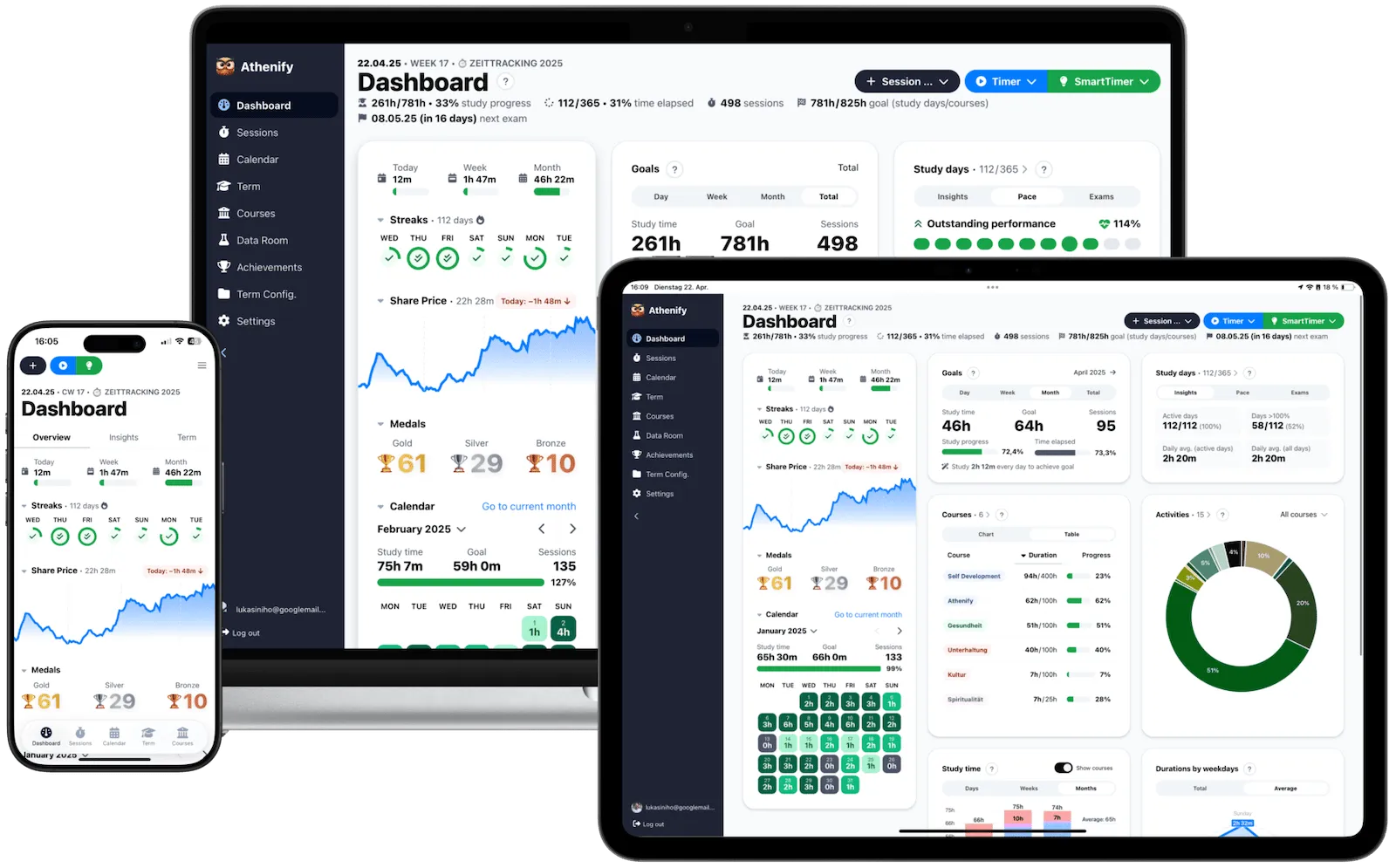
Athenify helps you build structured, spaced study routines that reduce exam anxiety before it starts – by replacing last-minute panic with genuine preparedness.
No credit card required.
No credit card required.
Keep Reading
- Mental Health and Studying: The Complete Guide – the comprehensive hub for all student mental health topics
- Imposter Syndrome in College: You Belong Here – when test anxiety is fueled by the belief that you don't deserve to be here
- Mental Health and Studying – strategies for managing anxiety beyond just exam situations
- How to Stop Procrastinating – break the avoidance cycle that makes test anxiety worse
- The Pomodoro Technique: Complete Guide – structured study sessions that build confidence through consistent preparation