40% of doctoral students drop out. Not because they lack intelligence or expertise – but because they can't manage their time. A dissertation isn't a sprint; it's a 4-year marathon with no visible finish line.

Most dropouts don't fail at research – they fail at time management.
The good news: with the right strategy, you'll be among the 60% who make it. This article shows you how to plan your PhD in phases, set realistic goals, and use tools like Athenify to stay on track – whether you're in sciences, humanities, or law.
How long does a PhD take?
The duration of a PhD varies by field, supervision quality, and personal commitment. In the US, a doctoral degree takes an average of 4 to 6 years. In STEM fields, it's often shorter (around 4–5 years), while humanities dissertations frequently take longer (up to 6 years or more).
What matters is setting realistic goals from the start and managing your time effectively. Good time management helps you not only finish on schedule but also avoid stress and burnout. On our PhD thesis tracker page, you'll find more information on how Athenify can support you during your doctoral journey. General strategies for time management as a student also translate well to the PhD experience.
The 4 phases of a PhD and how to plan them
A dissertation can be divided into four phases, each with distinct time management requirements:
| Phase | Duration | Focus | Biggest Danger |
|---|---|---|---|
| Preparation | 3–6 months | Topic, proposal, methods | Planning forever, never starting |
| Research | 1–3 years | Data, experiments, analysis | Getting lost in reading |
| Writing | 6–12 months | Drafting the dissertation | Perfectionism |
| Finalization | 3–6 months | Revision, defense | Underestimating feedback loops |
1. Preparation phase (approx. 3–6 months)
This phase is about defining your topic, finding an advisor, and planning your research. Use this time for literature reviews, learning methodologies, creating a realistic timeline, and writing your proposal.
An underrated tip: start time tracking immediately – not when you "really" get going. If you track your work hours from the beginning, you'll collect valuable data about how long certain tasks actually take. These insights are gold for planning later phases. On our study time tracking page, you'll learn how to optimize your tracking setup.
2. Research phase (approx. 1–3 years)
This is where you collect data, run experiments, or analyze sources. It's often the most time-intensive phase. Build in ample buffer time to handle unexpected challenges.
Especially during the research phase, keeping an overview is crucial. Many doctoral students underestimate how much time they actually invest in their work – or overestimate themselves. With a study tracking app like Athenify, you can monitor your invested hours accurately.
3. Writing phase (approx. 6–12 months)
Writing your dissertation requires discipline and clear structure. Create a writing schedule that specifies when each chapter should be complete.
The writing phase is particularly demanding because it requires sustained concentration. The Pomodoro Technique can help: work in focused 25-minute blocks with short breaks in between.
The most important advice for the writing phase: write every day – even if it's only 30 minutes. Consistency beats intensity. It's better to write one page daily than to attempt ten pages once a week and give up frustrated after three hours.
Write every day – even if it's only 30 minutes. Consistency beats intensity.
4. Finalization phase (approx. 3–6 months)
This phase involves revising, proofreading, and preparing for your oral defense (dissertation defense or viva voce).
Plan enough time for feedback from advisors and colleagues. Experience shows this phase takes longer than expected because revisions often require multiple rounds.
Tips for effective PhD time management
1. Set clear goals
Define long-term goals (e.g., completing the PhD) and break them into short-term milestones (e.g., finishing a chapter). The SMARTSpecific, Measurable, Achievable, Relevant, Time-bound framework helps:
The SMART framework for your dissertation goals:
- S – Specific – Not "write more," but "finish Chapter 3 by end of March"
- M – Measurable – Success must be objectively verifiable
- A – Achievable – Choose goals that create genuine motivation
- R – Relevant – Check whether the goal is attainable
- T – Time-bound – Without a deadline, there's no urgency
2. Create a realistic schedule
Build in buffer time and stay flexible to handle setbacks. A proven rule of thumb: double your initial time estimate – dissertations almost always take longer than planned.
The Pareto Principle helps with planning: only schedule 80% of your available time firmly. You'll need the remaining 20% for unexpected events – spontaneous meetings with your advisor, technical problems, or simply days when nothing works.
3. Use tools like Athenify
The app helps you organize tasks, track progress, and develop productive habits. With features like the Pomodoro Technique and focus sessions, you can boost your concentration.
How Athenify specifically helps with your dissertation:
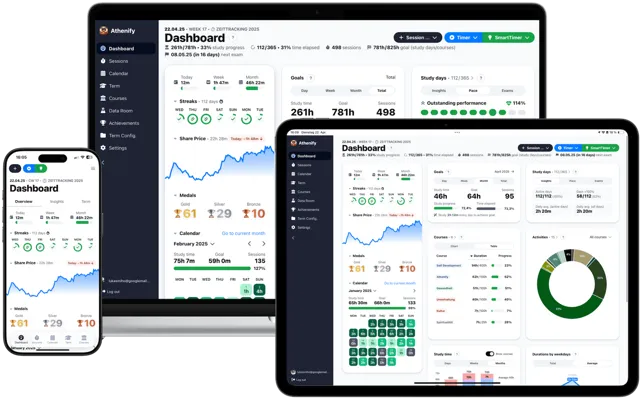
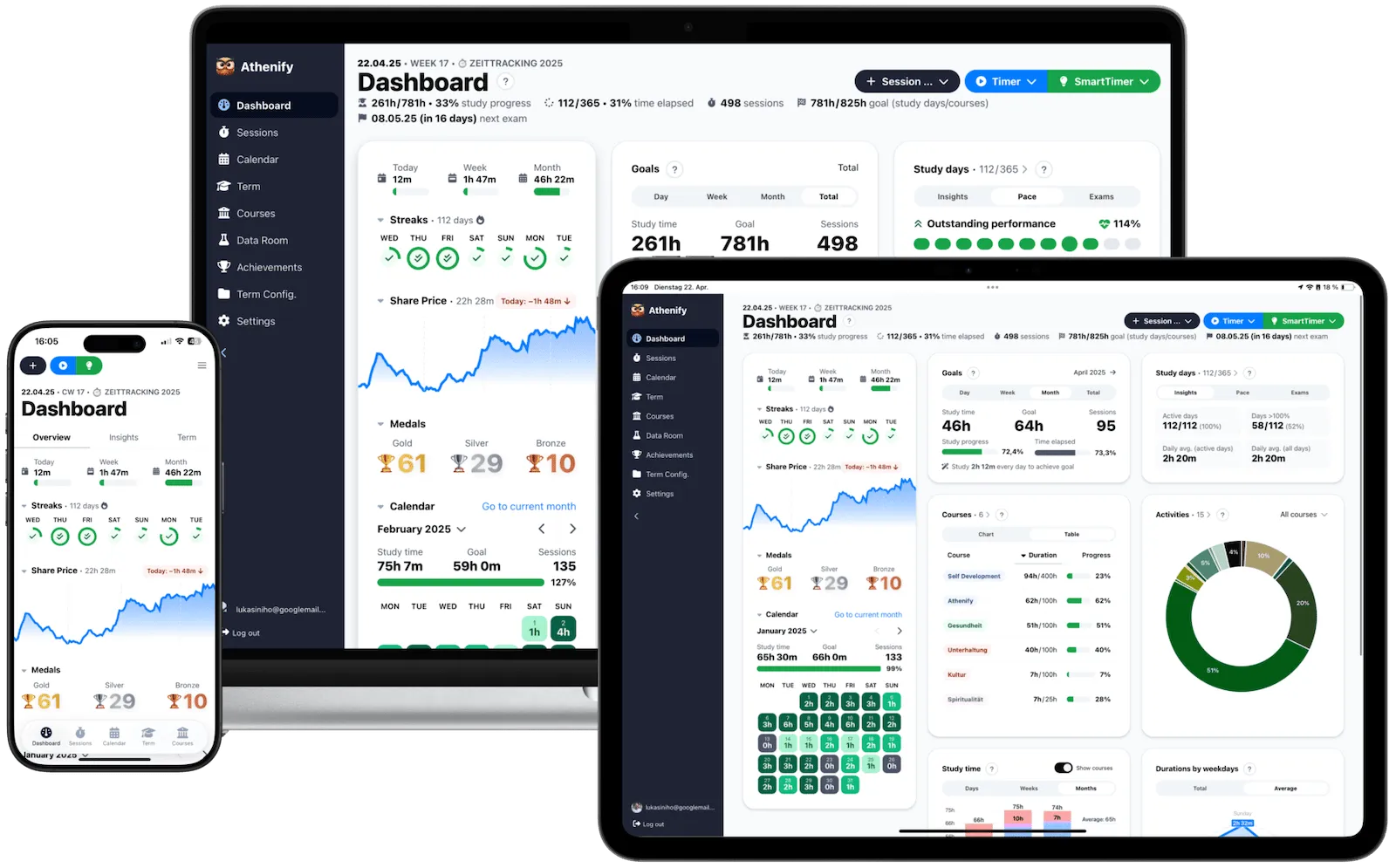
- Time tracking – Shows exactly how many hours per week you invest in your dissertation
- Medal system – Bronze, Silver, and Gold reward productive days
- Share price – Track your long-term progress over months
- Streaks – Build a daily routine – breaking the chain gets harder the longer it grows
4. Avoid procrastination
Procrastination is the biggest enemy of a PhD – and in a project spanning years, it lurks around every corner. The 2-minute rule helps with small tasks: if something takes less than two minutes, do it immediately instead of adding it to a list. For larger tasks, the Eat-the-Frog principle works well: start each day with the most unpleasant task, and everything after feels easier.
One of the most powerful strategies is an accountability partner – someone you regularly report your progress to. This could be a fellow doctoral student, a friend outside academia, or even an online community. Social obligation often works more powerfully than any self-discipline.
The social obligation of an accountability partner often works more powerfully than any self-discipline.
5. Maintain work-life balance
Schedule regular breaks and leisure activities to avoid burnout. A PhD is a marathon, not a sprint – you can't work at full throttle for 5 years. Five hours of focused net work time per day is more realistic than eight hours that are half procrastination.
Plan a recovery week every 4–6 weeks and keep at least one day per week completely free. If you notice you're making little progress despite many hours, that's a warning sign of impending burnout.
How Athenify helps with your dissertation
Athenify is more than just a to-do list – it's a comprehensive tool for effective time management and productivity:
- Time tracking – See exactly how much time you invest per week, month, or year in your dissertation
- Focus sessions – Work in concentrated blocks and avoid distractions
- Progress tracking – Keep an overview of your goals and how close you are to achieving them
- Gamification – Streaks, medals, and the share price make the long journey more motivating
- Analytics – Discover at which times of day you're most productive
Try Athenify for free
Track your dissertation time, analyze your most productive phases, and stay motivated with streaks and medals – perfect for the PhD marathon.
No credit card required.
No credit card required.
Conclusion
A dissertation is a marathon, not a sprint – daily small progress beats sporadic mammoth sessions.
Effective time management is the key to successfully mastering the challenge of a doctoral thesis. By setting realistic goals, dividing your work into phases, and using tools like Athenify, you can complete your PhD efficiently and with less stress.
What to remember:
- Plan realistically – Dissertations almost always take longer than expected
- Track from day one – You can only improve what you measure
- Stay consistent – Daily small progress beats sporadic mammoth sessions
- Use the right tools – Athenify helps you maintain an overview
- Take care of yourself – Work-life balance isn't a luxury; it's a necessity
Whether you're just starting your dissertation or already in the thick of it – with the right planning and the right tools, you can achieve your goals. Best of luck with your PhD!