"I'll start tomorrow." This might be the most frequently spoken sentence among students. And tomorrow? Tomorrow, it gets repeated. You know the feeling: you sit down to study, open your laptop, and somehow two hours later you've reorganized your bookshelf, scrolled through social media, and watched three videos about a topic you'll never think about again. The exam is next week. The guilt is mounting. And still, you can't seem to start.
Here's what most people get wrong: procrastination is not a character flaw. It's not a sign of laziness. And it's definitely not something you can fix with "more discipline." Science shows that procrastination is a complex psychological phenomenon rooted in how our brains regulate emotions—and that's exactly why it can be systematically overcome.

Procrastination isn't a time management problem. It's an emotion management strategy.
In this guide, you'll learn what really drives procrastination, discover which type of procrastinator you are, and master evidence-based strategies that actually work. No motivational fluff—just science-backed techniques that thousands of students have used to break the cycle. For actionable solutions you can implement today, see our comprehensive guide to stop procrastinating and our practical article on how to stop procrastinating.
What is procrastination really?
Procrastination is the voluntary delay of an intended action despite knowing that this delay will have negative consequences.
This distinction matters: It's not about strategic planning or prioritization. If you consciously postpone a task because something more important came up, that's not procrastination. Procrastination occurs when you know you should do something, don't do it anyway—and feel bad about it.
Procrastination: You put off studying even though your exam is in one week, watching Netflix instead. You know it's wrong, but you do it anyway.
Strategic delay: You decide to write the urgent essay today and start exam prep tomorrow because the essay is due first.
The cost of putting things off
Procrastination isn't harmless. The research is sobering: students who procrastinate heavily score 5–10% lower on average than their peers who tackle work promptly. That's the difference between a B and a C, or a pass and a fail on a crucial exam.
But the damage extends far beyond grades. Procrastinators report significantly higher stress levels, especially as deadlines loom—the very stress they were trying to avoid by putting things off. The irony is painful. Chronic procrastination also correlates with poorer physical health: less sleep, worse diet, and reduced exercise. And then there's the psychological toll—the persistent guilt and self-blame that accompanies every cycle of avoidance, eroding confidence and creating a vicious spiral that can seriously affect your mental health as a student.
The science behind procrastination
Temporal Motivation Theory
The most comprehensive theory of procrastination is Temporal Motivation Theory, developed by Piers Steel. It explains why we procrastinate with a formula that captures the four forces at play:
Motivation = (Expectancy × Value) / (Impulsiveness × Delay)
The 4 factors that determine your motivation:
- Expectancy – Do you believe you'll succeed?
- Value – Does the task feel pleasant or important?
- Impulsiveness – How easily are you distracted?
- Delay – How far in the future is the reward?
A boring task with a distant deadline and uncertain payoff? That's a procrastination recipe.
This explains a pattern every student knows: you feel incredibly motivated at the start of the semester ("This time I'll study from day one!"), yet somehow you still haven't started three weeks before the exam. The deadline felt so far away that your brain couldn't generate urgency—until panic mode finally kicks in. For strategies to maintain motivation throughout the semester, see our study motivation guide.
Procrastination as emotion regulation
Recent research has fundamentally changed how psychologists understand procrastination. It's not primarily a time management problem—it's an emotion regulation problem.
When you procrastinate, you're not being lazy or irresponsible. You're trying to escape negative emotions—the anxiety of a difficult task, the boredom of tedious work, the frustration of feeling stuck, the overwhelm of not knowing where to start. When these emotions become chronic, the overlap between procrastination and mental health challenges in students becomes hard to ignore. In that moment, scrolling social media or watching YouTube provides immediate emotional relief. The problem is that this short-term relief comes at a steep cost: long-term stress, mounting guilt, and a vicious cycle that feeds on itself. The more you procrastinate, the worse you feel about the task; the worse you feel, the more you want to avoid it.
Your brain's reward system
Your brain evolved to prefer immediate rewards over delayed ones. This made perfect sense on the savanna—the berry you could eat right now mattered more than the possibly larger berry you might find tomorrow. Survival demanded present-focused thinking.
But in academia, this ancient wiring becomes a liability. Netflix now delivers an immediate dopamine hit; studying now offers only a delayed reward—a good grade in three weeks. Your limbic system (emotional, impulsive, present-focused) battles your prefrontal cortex (rational, planning, future-focused), and without deliberate intervention, the limbic system usually wins. This isn't a character flaw—it's evolutionary neuroscience. The good news? Understanding this gives you a target: the strategies that work are the ones that make the immediate reward of productive action stronger than the immediate reward of avoidance.
The 4 main types of procrastinators
Not all procrastinators are the same. Understanding your type helps you choose the right strategies—because what works for an anxious procrastinator might backfire for a rebel.
Type 1: The anxious procrastinator
The anxious procrastinator is paralyzed by fear of failure. Thoughts like "What if I can't do it?" and "What if my work isn't good enough?" create a wall of dread that makes starting feel impossible. These procrastinators often spend hours preparing, researching, and organizing—anything to delay the moment when they actually have to produce something that might not be perfect.
The solution is counterintuitive: give yourself permission to be bad. Your first draft is allowed to be terrible. The goal isn't perfection—it's starting. Once you've broken through that initial barrier, momentum takes over. (If this sounds familiar, the anxious type often overlaps with perfectionism-driven procrastination.)
Type 2: The perfectionist
Closely related to the anxious type, the perfectionist procrastinator operates under a crushing belief: "If I can't do it perfectly, I'd rather not do it at all." They wait for the "perfect moment" or the "perfect mood" that never arrives. When they do work, they obsess over unimportant details, polishing the first paragraph for hours while the rest of the essay remains unwritten. For a deeper look at this pattern, read our article on how perfectionism fuels procrastination.
Done is better than perfect. A finished B+ beats an imaginary A+.
The antidote is time constraints. Tell yourself: "I will work on this for exactly two hours, and then it's done—whatever state it's in." This shifts focus from impossible perfection to realistic completion.
Type 3: The rebel
Some people procrastinate as an act of resistance. The rebel thinks: "I'll do it when I want to, not when others want me to." Deadlines feel like restrictions on their freedom, and procrastination becomes a way to assert autonomy—even when it's self-sabotaging.
The key for rebels is reframing. Instead of "I have to study," try "I choose to study because I want to pass this exam and move on with my life." When the task becomes a personal choice rather than an external demand, the urge to resist diminishes.
Type 4: The decision-fatigued
The overwhelmed procrastinator doesn't know where to start. Faced with too many options, unclear priorities, and a mountain of tasks, they freeze. Their thoughts spiral: "Where do I even begin? What's most important?" They often procrastinate through "productive" avoidance—cleaning their room, answering emails, reorganizing their notes—anything that feels like progress without tackling the real work.
The solution is ruthless prioritization. Every evening, decide on your single most important task for the next day. Then do that task first, before your decision-making energy depletes.
Quick reference: the 4 procrastinator types
| Type | Core thought | Typical behavior | Best strategy |
|---|---|---|---|
| Anxious | "What if I fail?" | Endless preparation, avoiding the real task | Give yourself permission to be bad |
| Perfectionist | "If it's not perfect, why bother?" | Obsessing over details, waiting for the right moment | Set time limits, not quality standards |
| Rebel | "I'll do it when I want to" | Resisting deadlines, asserting autonomy | Reframe tasks as personal choices |
| Decision-fatigued | "Where do I even start?" | Productive avoidance, cleaning instead of working | Pick one task the night before |
7 evidence-based strategies to beat procrastination
Strategy 1: The 2-minute rule
The principle is deceptively simple: if a task takes less than two minutes, do it immediately. But the real power comes from applying this to larger tasks. Can't face writing your essay? Just open the document. Can't start studying? Just read the first page. The hardest part of any task is starting—and two minutes is short enough that your brain can't muster serious resistance. Our full guide on the two-minute rule for studying explores this technique in depth.
Here's why this works: once you start, the Zeigarnik Effect kicks in. Your brain is wired to feel tension around incomplete tasks—they nag at you, pull you back, demand resolution. After just two minutes of work, you've created an open loop that your mind wants to close. More often than not, you'll find yourself continuing long past those initial two minutes.
Strategy 2: Implementation intentions (if-then plans)
Vague intentions fail. "I'll study tomorrow" is a wish, not a plan. Implementation intentions transform wishes into concrete if-then statements that dramatically increase follow-through.
Instead of "I'll study tomorrow," try: "If I sit down at my desk at 9 AM tomorrow, then I'll open my statistics textbook and work through Chapter 3." The specificity matters—you've defined the trigger (sitting at your desk at 9 AM), the action (opening the textbook), and the scope (Chapter 3).
Why does this work so well? If-then plans shift the decision from the moment of action to the moment of planning. When 9 AM arrives and you're at your desk, you don't have to deliberate or summon willpower—you just execute the plan you already made. The decision is already done.
Strategy 3: Temptation bundling
Temptation bundling is elegant in its simplicity: pair an unpleasant task with a pleasant one, so that you can only enjoy the pleasant thing while doing the unpleasant thing.
The key is finding genuine temptations and linking them exclusively to productive activities. "I only listen to my favorite podcast while reviewing flashcards." "I only go to my favorite café when I'm studying there." "I only watch the new season of that show while writing summaries." Over time, your brain starts associating the dreaded task with the pleasurable reward, making it easier to start.
Strategy 4: The Pomodoro Technique
The Pomodoro Technique structures work into 25-minute focused blocks followed by 5-minute breaks. It's particularly powerful against procrastination for three reasons.
First, it reduces overwhelm. You don't have to face "studying all day"—you just have to focus for 25 minutes. That's manageable. Second, it creates clear boundaries: the timer provides a defined start and end point, which helps your brain transition into work mode—essential for achieving deep work with Athenify. Third, every Pomodoro is a fresh start. Had a distracted session? The next one begins with a clean slate.
For a complete guide to the Pomodoro Technique, including variations and advanced strategies, read our Complete Pomodoro Technique Guide.
Strategy 5: Commitment devices
Commitment devices work by making procrastination harder than working. They're pre-commitments that constrain your future self's options—because your future self, in the moment of temptation, will try to weasel out of your present self's good intentions.
Practical commitment devices:
- Website blockers: Install Cold Turkey or Freedom during study sessions
- Phone exile: Put it in another room—not face-down on the desk, but physically out of reach
- Social commitment: Arrange to meet friends at the library at a specific time
- Financial stakes: Give money to a friend that you only get back if you hit your goal
Willpower is limited. Smart systems are unlimited.
The underlying principle is crucial: instead of relying on willpower—which depletes throughout the day—you design your environment so that productive action becomes the path of least resistance. You're not fighting temptation; you're removing it.
Strategy 6: Environment design
Environment design takes commitment devices further by shaping your entire physical and digital space for productivity. The goal: make focus the default state, not something that requires constant effort.
Physical space design:
- Clear your desk of everything except what you need for the current task
- Study in the library—social pressure plus fewer distractions
- Use noise-cancelling headphones to signal "work mode" to your brain
Digital environment design:
- Put your phone in another room entirely
- During exam periods, delete social media apps (you can reinstall them later)
- Use a separate browser profile for studying—no saved logins, no bookmarks bar
Strategy 7: Time tracking with Athenify
What gets measured gets improved. Athenify makes your procrastination visible—and visibility is the first step to change.
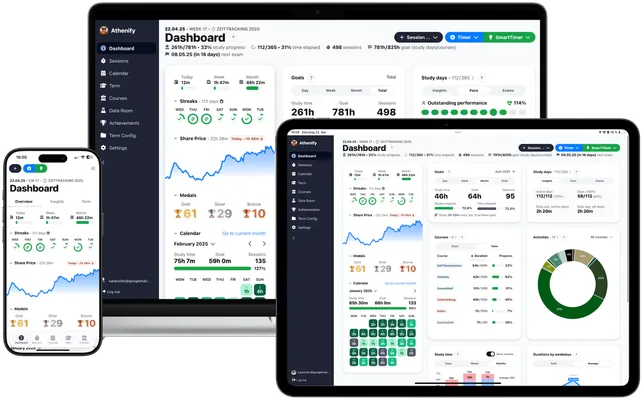
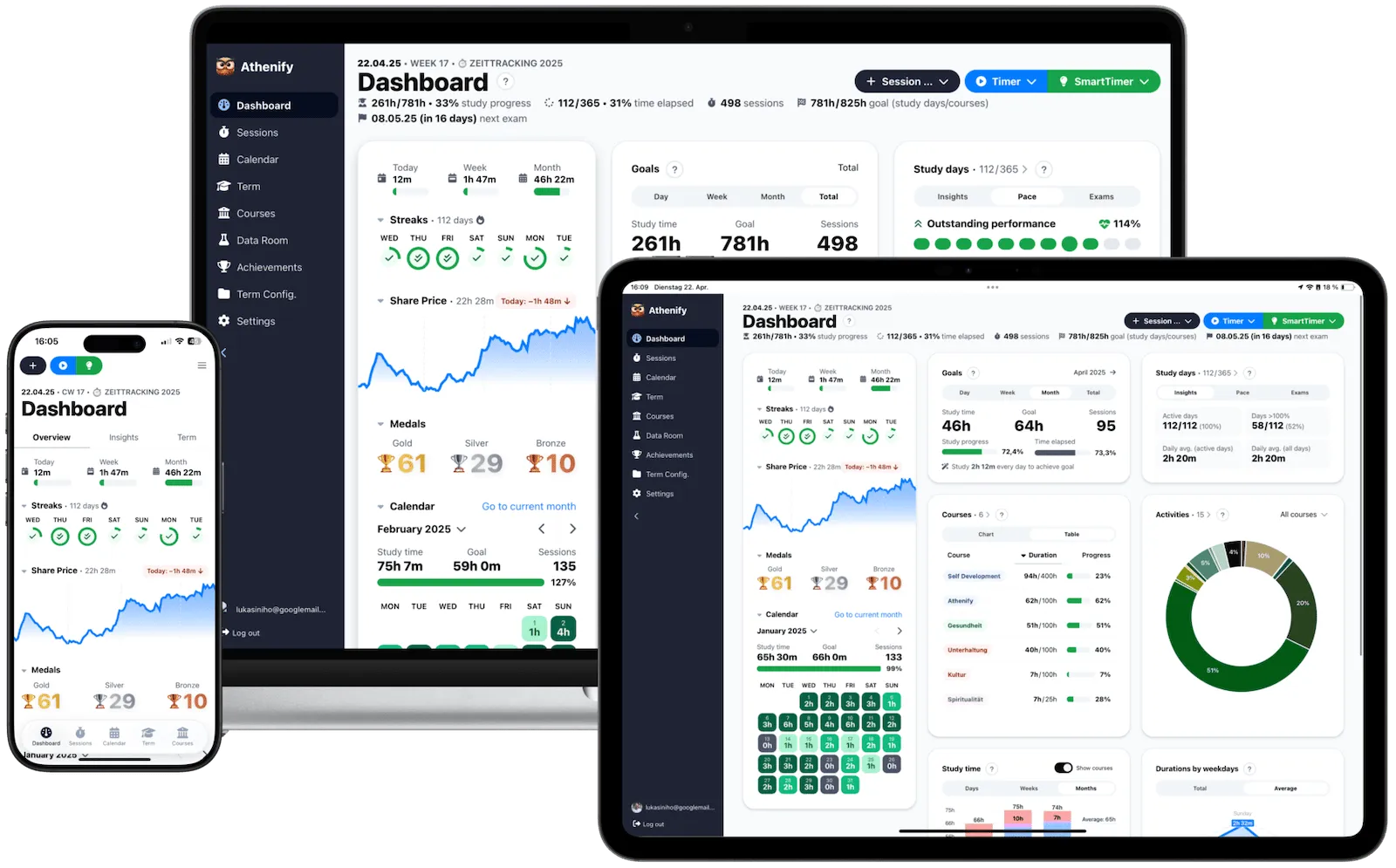
Time tracking works against procrastination on multiple levels. First, it creates an honest inventory. Most students dramatically overestimate how much they actually study. When you track your time, you can't deceive yourself—the data is right there.
Second, the running timer acts as a commitment device. When you start the timer, you've made a decision to work. Getting distracted now means consciously abandoning that decision, which creates just enough friction to keep you focused. It's no longer "I'll just quickly check my phone"—it's "I'm going to stop working to check my phone." That reframing matters.
Third, streaks create powerful motivation. Every day you study builds your streak, and the fear of breaking it often outweighs the temptation to procrastinate. After two weeks of consistent study, the thought of seeing that streak reset to zero becomes genuinely uncomfortable—uncomfortable enough to get you to open your textbook instead of Netflix.
Finally, time tracking enables pattern recognition. After a few weeks of data, you'll see when you procrastinate most. Is it Monday mornings? Friday afternoons? Specific subjects? This insight allows you to deploy targeted countermeasures—schedule easy tasks for your low-motivation slots, or stack commitment devices when you know resistance will be highest.
The action plan: overcome procrastination starting today
Knowledge without action is just entertainment. Here's how to put these strategies into practice, week by week.
Week 1: Awareness
Your first week is about understanding your current patterns—not fixing them yet. Start tracking your time with Athenify, logging every study session and noting every hour you intended to study but didn't. Pay attention to your triggers: When do you procrastinate? On which tasks? At what times of day? By the end of the week, identify your procrastinator type. Are you anxious, perfectionist, rebellious, or decision-fatigued?
Week 2: First interventions
Now you start building defenses. Install a website blocker for your biggest digital distractions. Write out three concrete implementation intentions ("If X, then Y"). And adopt the 2-minute rule as your daily startup ritual—every study session begins with the tiniest possible action, just to get momentum going.
Weeks 3–4: Establish systems
This is where you build the infrastructure for long-term success. Start using the Pomodoro Technique for focused work sessions. Commit to building a streak—at least 30 minutes of studying every day, no exceptions. At the end of each week, analyze your tracking data. What's working? What isn't? Adjust your approach based on evidence, not feelings.
Long-term: Become habit
After 4–6 weeks with these strategies, you'll notice something remarkable: procrastination isn't an insurmountable monster. It's a pattern—and patterns can be changed. The strategies that once required conscious effort will become automatic. The struggle will ease. For more on building lasting routines, explore our study habits guide and our article on the best study habits for 2026.
Try Athenify for free
Start the timer, build a streak, and watch procrastination lose its grip as you build real data on what you accomplish.
No credit card required.
No credit card required.
Conclusion: procrastination is beatable
Procrastination feels like personal failure. But it isn't. It's a human phenomenon with scientifically understood causes—and proven solutions. For immediate, practical techniques you can use right now, read our companion guide: How to Stop Procrastinating: 7 Techniques That Work Right Now.
Here's what to remember: procrastination is emotion regulation, not laziness. You procrastinate to feel better in the short term, and understanding this removes the shame and opens the door to real solutions. Willpower alone will never be enough—you need systems, routines, and an environment designed to make productive action easier than avoidance. And time tracking makes procrastination visible, which is essential because what you can see, you can change.
The best time to stop procrastinating was yesterday. The second best time is now.
You don't need to be perfect. You don't need to eliminate procrastination entirely—that's not realistic, and it's not the goal. The goal is to build systems that make productive action the default, and to gradually shift the balance until good days outnumber bad ones. Every small win compounds. Every day you procrastinate a little less than yesterday is a victory worth celebrating.