You track your steps, your sleep, your calories – but what about your practice time? For musicians serious about improvement, tracking practice is the difference between hoping you're getting better and knowing you are.

What gets measured gets managed. And what gets managed, improves.
Whether you're a piano student preparing for an exam, a guitarist building technique, or a professional maintaining your craft, understanding your actual practice patterns is essential. This guide covers why tracking works, what to track, and how to do it effectively.
Why musicians should track practice time
The science of deliberate practice
In his landmark research, psychologist Anders Ericsson studied what separates elite performers from the rest. The answer wasn't just “more practice” – it was deliberate practice: focused, systematic work on specific skills at the edge of your current ability.
Here's the problem: most musicians don't actually know how much deliberate practice they're doing. They remember the hours they spent at the instrument, not the quality of those hours.
Tracking solves this. When you log your sessions with notes on what you worked on, you start seeing the difference between "I practiced for 2 hours" and "I did 45 minutes of deliberate scale work, 30 minutes of sight-reading, and spent the rest noodling."
The reactivity effect
Psychological research reveals something fascinating: simply observing a behavior changes that behavior. This is called the reactivity effect.
When you know you're tracking, the simple act of measurement changes your behavior:
- You start more sessions because the timer is waiting for you
- You stay focused longer because you see minutes accumulate in real time
- You finish what you planned because you want the data to reflect your intentions
This accountability emerges naturally, even when no one else ever sees the numbers.
Quality vs. quantity: debunking the 10,000-hour myth
You've probably heard that mastery requires 10,000 hours. This oversimplification of Ericsson's research has led many musicians astray.
The truth is more nuanced. Hours alone don't guarantee improvement – you can practice wrong for 10,000 hours and simply ingrain bad habits deeper. What matters most is the quality of those hours: elite violinists in Ericsson's studies practiced deliberately for about 4 hours daily, not 10. And how you distribute those hours matters enormously. One hour daily for a year (365 hours) produces far better results than 365 hours crammed into 3 months, because the brain needs time between sessions to consolidate learning. Tracking helps you focus on this quality and distribution, not just accumulating hours.
Elite musicians don't practice more – they practice smarter. Tracking reveals the difference.
What to track beyond just time
Time is the starting point, but the most useful practice tracking goes deeper.
Categories of practice
Break your practice into meaningful categories:
| Category | Examples | Why Track It |
|---|---|---|
| Warm-up | Scales, arpeggios, stretches | Prevents injury, builds technique |
| Technique | Études, exercises, drills | Targeted skill development |
| Repertoire | Current pieces, new music | Performance preparation |
| Sight-reading | New material at tempo | Builds musicianship |
| Theory/ear training | Intervals, chord recognition | Deepens understanding |
| Review | Previously learned pieces | Maintains repertoire |
When you track by category, patterns emerge. Maybe you're spending 80% on repertoire and 5% on technique – explaining why certain passages never improve.
Instruments and techniques
If you play multiple instruments, track each separately. A guitarist who also plays bass needs to know their time distribution.
Even on a single instrument, granular tracking reveals imbalances you might not notice otherwise:
- Pianists: Track left hand vs. right hand work to develop both equally
- String players: Separate bow technique from left hand fingering
- Wind players: Track tonguing work separately from fingering exercises
- Drummers: Monitor independence drills vs. groove practice
Session quality notes
Numbers tell part of the story. Brief notes complete it:
Struggled with mm. 32–40 at tempo. Slowed to 60 bpm, got clean 3x. Try 70 bpm tomorrow.
These notes turn your practice log into a practice journal – and your future self will thank you.
How to set effective practice goals
Goals give direction to your tracking. Without them, you're just collecting data.
The daily minimum
Set a daily minimum so low it's almost impossible to fail. This isn't your target – it's your floor.
Why small daily sessions work better than marathon weekends:
- Consistency beats intensity – 15 minutes daily for 30 days builds more habit strength than 7.5 hours crammed into one weekend
- Streaks create momentum – After 14 days straight, day 15 feels almost automatic
- Identity reinforcement – Each session reinforces your identity as "someone who practices"
- Compounding wins – Small victories add up to something larger than the sum of their minutes
Weekly and monthly targets
Layer longer-term goals on top of your daily minimum:
- Weekly targets: Total hours plus category distribution (e.g., "at least 3 hours on technique")
- Monthly goals: Repertoire milestones (e.g., "Chopin etude performance-ready by month's end")
- Quarterly objectives: Bigger ambitions (e.g., complete Grade 8 exam prep, master a concerto movement)
Review these targets weekly to catch imbalances before they become ingrained problems.
Goal-setting for specific pieces
For each piece in your repertoire, consider tracking total hours invested, current tempo versus target tempo, sections mastered versus sections in progress, and a performance readiness score (your subjective assessment of how close you are to stage-ready). This data is invaluable for planning. If a piece needs 50 hours and you have 6 weeks, you know you need about 8 hours per week on it – and you can see whether you're on track or falling behind.
Using Athenify for music practice
Athenify was built for students tracking study time, but our Music Practice Tracker App is perfectly suited for musicians. Here's how to use it.
Setting up your subjects
Think of "subjects" as your instruments or practice categories. Your main instrument gets its own subject – Piano, Violin, Guitar, whatever you play most. If you want granular data on technique work, create a separate subject for that. Theory and ear training deserve their own category too, as does ensemble rehearsal time if you play in groups. You can also create subjects for specific pieces if you're preparing for a performance or exam – tracking "Chopin Ballade No. 1" separately from general piano practice reveals exactly how much time you've invested in that particular piece.
Using activities for practice types
Within each subject, use "activities" to categorize your work. Separate warm-up time from scales and arpeggios, études from repertoire, and sight-reading from everything else. This granularity gives you data on how you spend your time within each practice session – revealing whether you're actually working on technique or just running through pieces you already know.
The motivational tools
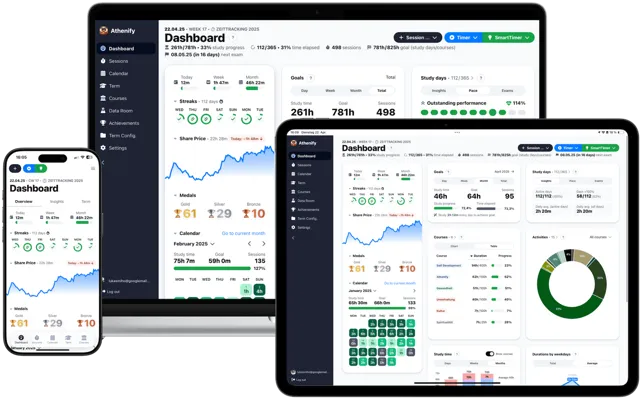
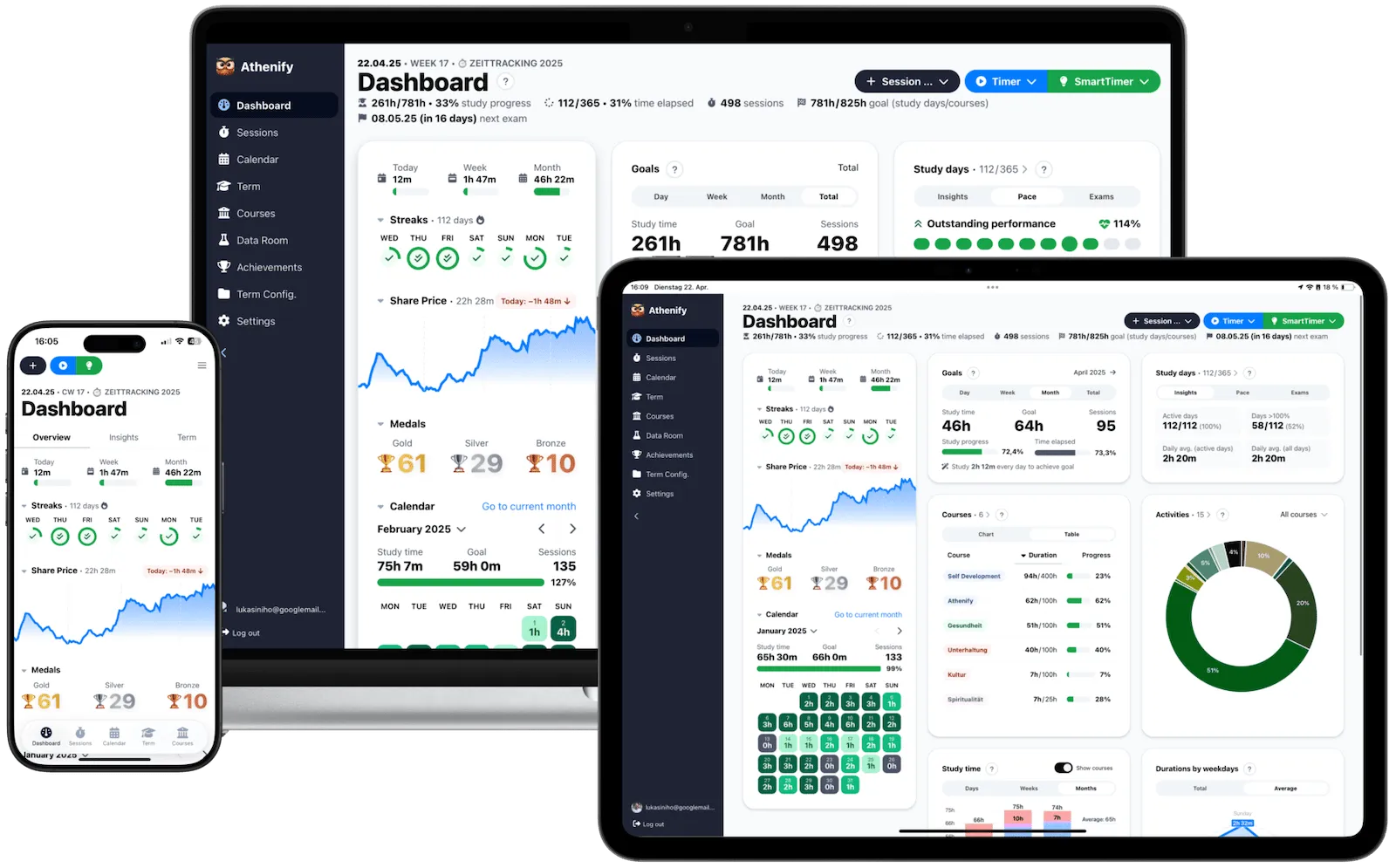
Athenify's gamification features work brilliantly for musicians. The streak system harnesses the "don't break the chain" principle – when you've practiced 30 days straight, you really don't want to miss day 31, and your streak becomes a commitment to your future self. The medal system lets you earn bronze, silver, and gold for hitting practice thresholds: set bronze at your minimum (30 minutes?), silver at your target (1 hour?), and gold at your stretch goal (2 hours?). Watching medals accumulate is surprisingly motivating. And the share price feature rises when you exceed your daily goal and falls when you miss it, showing your cumulative commitment over time. A rising share price means you're consistently showing up.
Analyzing your data
The dashboard reveals patterns you can't see in the moment. Which days are your strongest? Maybe you practice most on weekends – or least. What's your average session length, and is it sustainable? How's your category distribution – all repertoire and no technique? Use weekly reviews to course-correct before imbalances become ingrained habits.
Try Athenify for free
Track practice sessions by instrument, build streaks that make daily practice automatic, and see exactly where your time goes.
No credit card required.
No credit card required.
Common mistakes musicians make
Tracking without reflection
Data without analysis is just numbers. Schedule a weekly 10-minute review where you ask yourself three questions: What went well this week? What got neglected? And what needs to change next week? This simple reflection transforms raw data into actionable insight.
Ignoring rest days
Rest is part of training. Elite athletes don't train 7 days a week, and neither should you. Plan 1–2 rest days weekly and mark them as such in Athenify. Your streak pauses (not breaks) on planned rest days.
Chasing hours instead of outcomes
The goal isn't maximum hours – it's maximum improvement per hour. If you're logging 3 hours daily but not improving, something's wrong with how you're practicing, not how long.
Forgetting the big picture
Daily tracking is tactical. But step back monthly and ask: Am I moving toward my larger musical goals? Is this practice serving my vision, or have I drifted into maintenance mode?
The timer doesn't lie. That's both its challenge and its gift.
Building your practice tracking habit
Start tomorrow
Don't wait for the perfect system. Start with what you have. Create your subjects or instruments in Athenify, set a ridiculously low daily minimum – 10 to 15 minutes is perfect – and start the timer for your first session. You can refine your categories and goals as you learn what matters to you. The perfect system emerges from actually tracking, not from planning to track.
The first 66 days
Research by Phillippa Lally found that habit formation takes an average of 66 days. Commit to tracking for two months before evaluating whether it's "working."
During this time, focus on building the streak without breaking the chain. Don't judge the data – just collect it and let the patterns reveal themselves over time. Do review weekly to notice what's emerging, but resist the urge to overhaul your approach until you have enough data to draw real conclusions.
From tracking to transformation
After a few months of consistent tracking, you'll notice something shift. You'll stop thinking of practice as something you have to do and start seeing it as something you do – as natural as brushing your teeth.
That's when tracking has done its job. The behavior is now automatic. The data confirmed what worked. And your improvement is no longer a mystery – it's a documented journey.
Conclusion
Tracking your music practice time isn't about obsessive data collection. It's about understanding your own patterns, building sustainable habits, and seeing concrete proof of your progress.
The musicians who improve fastest aren't necessarily the most talented – they're the ones who practice with awareness.
Talent helps, of course. But the musicians who improve fastest are the ones who practice deliberately, consistently, and with clear-eyed awareness of what they're actually doing. They know where their time goes because they've measured it. They know what works because they've tracked the results.
Start tracking today. Your future self – the one performing that piece flawlessly – will thank you.